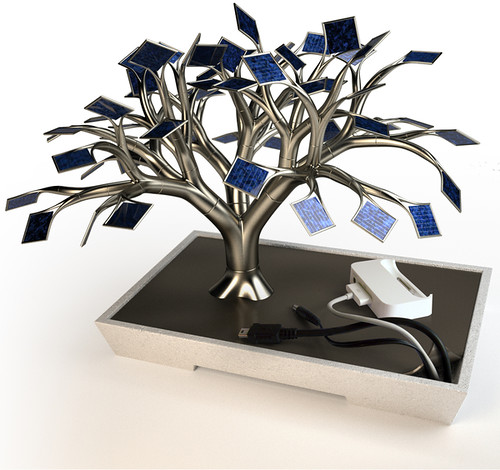
On Aidan's own article[1], you can see that he's referenced work that's guided him in making this breakthrough. Hidden in the bibliography is a Dr Suess children's book!
Geisel, Theodor Seuss (Dr. Seuss). The Lorax. New York: Random House Publishers, 1971.
He "discovered" the Fibonacci sequence in how trees branch? Seriously? Maybe I'm just being a grumpy old guy here, but when I was in school this was in our math textbooks as an example of how the Fibonacci sequence appears in nature.
Depends from the school and the textbook. My math textbooks didn't even mention the Fibonacci sequence and it wasn't until Project Euler that I found out about it.
I learned more about Fibonacci and the golden ratio in nature and art through my high school Art History course than I ever did in a math course. Though I had played with fractals a little bit before that course so the fractal geometry of nature and Fibonacci-fractal relationships weren't a complete mystery to me. http://fractalfoundation.org/OFC/OFC-11-1.html
Everyone always talks about the Fibonacci sequence w/r/t the golden ratio, but in nature it's usually a variant on a Lindenmayer system: http://en.wikipedia.org/wiki/L-system
The description, "The study earned Aidan a provisional U.S patent," is misleading. A provisional patent is merely a completely automated recognition of your claim to an invention. You submit your provisional filing, and then have one year to file an actual patent, which is reviewed by patent examiners. You don't "earn" a provisional patent--you just pay a couple hundred dollars and submit a few forms.
Now I don't disagree that an array of cells that track the sun would produce better results, but it would be fair to assume that this would cost energy. Keeping that in mind, do you think it would still provide better results?
According to Wikipedia ( http://en.wikipedia.org/wiki/Photovoltaic_system#Tracking_th... ): "tracking systems can increase viable output by up to 100%...For large systems, the energy gained by using tracking systems outweighs the added complexity (trackers can increase efficiency by 30% or more)" The new tree design can make 20%-50% more electricity. Wouldn't know till they do some legitimate tests but it seems like…
Why compare the designs, when you can combine them? I'm sure that the tree design can be improved a lot more, by just slightly turning the "leaves" so that they face the sunlight more directly.