Live data from Hacker News

Rendering on the Apple M1 Max Chip

blog.yiningkarlli.com

161–170 of 328 posts

Re: Rendering on the Apple M1 Max Chip

#161

Earlier quoted context omitted.

It has to be 3x faster to match M1's efficiency given the TDP is 30 vs 105.

If you're plugged in all the time, lower TDP is nice but not critical. And if you live in a cold country, you have to heat up the house six months per year, TDP is just heating with a computing side effect.

As someone who lives in south-east Queensland, Australia, lower TDPs and thermal output is always welcome, at least for me. I adore my Ryzen 5600X/3060 Ti mini-ITX desktop, but mining on it makes my room annoyingly warm, and it's not even summer yet.

Was semi-useful in winter though, all 6 weeks of it...

Re: Rendering on the Apple M1 Max Chip

#162
post #92

Earlier quoted context omitted.

This of course has the subtle implication that it’s equally easy for x86 to go as wide as ARM, and it’s not. Yes, it’s true that x86 often relaxes pitch, that doesn’t make up for a factor of 6 perf/watt difference like Anandtech measures. Like I said, I guess we’ll see, Zen4 and A16 will be on the same node next year. By that time the goalpost will move to something else, like this “x86 isn’t designed for power effic…

Why do you think x86 can't go as wide as ARM? (I predict your answer will involve something about decoders and nothing about uop caches.) What goalpost have I moved? I have said one (true) thing: that you should judge by performance rather than by implementation details. You are falling victim to the Megahertz Myth, just the other way 'round.

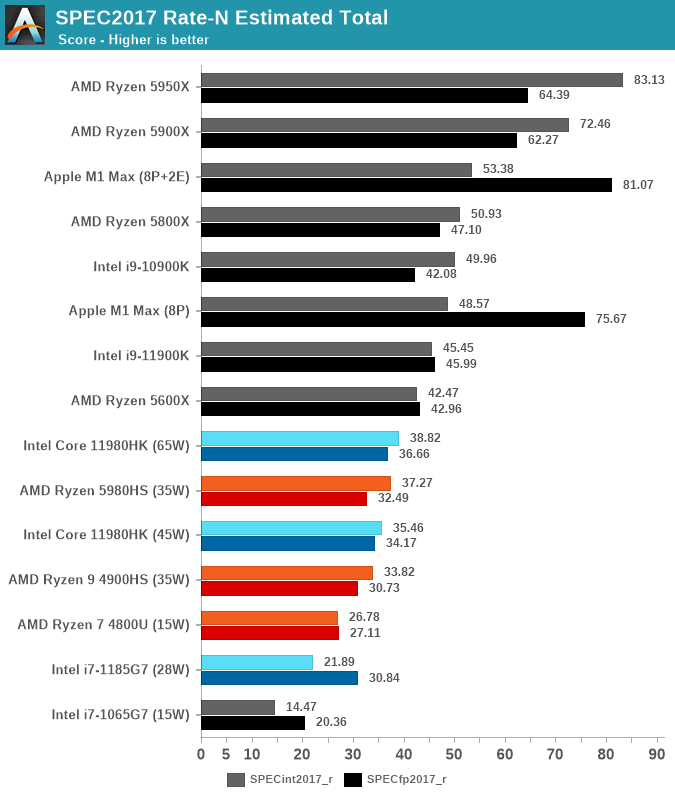
OK, here’s the performance. Factor of 2.2X over its peers (other laptop SKUs) in multithreaded performance, going head to head with 5950X in some (floating-point) scenarios.

https://images.anandtech.com/graphs/graph17024/117496.png

Why do you think megahertz myth is relevant here? Core for core A15/M1 is plainly faster than any of its peers, ignoring clocks, and it is even farther on top when you do look at clocks (i.e. IPC). It doesn’t matter at all which way you look at it, unless you are putting M1 up against HEDT SKUs like 3990WX - there are a few non-peer scenarios like that it only ties x86 in, like OP looking at task energy (3990WX gets to use 280W TDP/375W PPT and race to sleep) but that’s still an incredibly good outcome considering the loaded test, and Mac Pro with its 32+8 configuration will almost certainly be back on top in the “peer” comparison scenario.

It’s amazing how much breath was wasted on “IPC is what really matters” when Ryzen came out and now it’s “the other side of the megahertz myth” when Apple is on top. Ryzen was never even remotely close to being in the lead on IPC compared to where Apple currently is.

Even at iso-power you are looking at a factor-of-3-to-4 difference in performance - I was being generous with the “only 3x IPC” thing. That is what Anandtech measured in their review. And that still means a gap of 4x perf/watt - which is better than 6x for sure, but it doesn’t mean low-clocked x86 magically beats A15.
Re: Rendering on the Apple M1 Max Chip

#163

Earlier quoted context omitted.

This winter I'm going to experiment with having a Raspberry Pi act as a thermostat that starts/stops containers running on a server in our basement. That, combined with the laptop we just got for gaming that has a 3070 in it, should do nicely to supplement our heating system.

Modern heat pumps provide a lot more than 100% efficiency. I'd stick to the heating system unless those containers are doing something profitable (mining?)

Literally nothing provides 100% efficiency. You're conflating coefficient of performance with efficiency. They're not even close to the same thing, modern heat pumps reach their CoP because they don't actually generate heat, they simply move it around, which provides more heat indoors than if you had converted an equivalent amount of electricity directly into 100% heat.

Thermodynamics would not take kindly to you having a >99.999...% efficient anything.

Re: Rendering on the Apple M1 Max Chip

#164
post #67
post #54

Earlier quoted context omitted.

The vast majority of developers will never even see assembly for x86 or ARM. Compiler developers and those need to hand optimize code may care but for everyone else it's a black box.

Sure but I am part of that latter category. The unwashed masses don't have to care and won't actually use the performance, I'm not that bothered whether they care or not, although it's worth saying that X86 is such a mess that hiding instructions at weird alignments is a valid obfuscation technique - i.e. it's not just aesthetics/performance.

I’m not part of the category you’re part of - but after learning 6502, Z80 and 68K, when it came time to look at the 80x86 I gave it a hard pass and learned C instead. I kinda assumed x86 would die a natural death. Wrong!

Sadly I have not programmed in assembly since, and I put it down to how ugly the ISA was.

Pretty stupid perhaps, but ¯\_(ツ)_/¯

Re: Rendering on the Apple M1 Max Chip

#165
post #2

> There’s really no way to understate what a colossal achievement Apple’s M1 processor is; compared with almost every modern x86-64 processor in its class On the other hand I'm sure there's more than a few chipheads out there who are saying "it's about time", there was a longstanding prediction that the arm architecture would overtake x86.

I thought the observation was always that instruction set was not such a big difference in high performance CPUs next to manufacturing technology which was by far the first order effect. It would be expected for a high performance ARM CPU to reach roughly the same performance in that case (AMD is 1 generation behind here, I think Intel is 2). Is there really "chipheads" who are predicting ARM ISA to buck this trend a…

Most of the chip-heads' deep hatred for x86 comes from the number of pain-points for dealing with its ISA.

In terms of actual raw performance the instruction set is extremely secondary to about 10 other architectural choices.

The reason Apple is getting such performance is because it's caught up with all the cutting edge techniques Intel and AMD use, and a few more, and implemented them inside its core architecture.

Re: Rendering on the Apple M1 Max Chip

#166
post #25

Earlier quoted context omitted.

> there was a longstanding prediction that the arm architecture would overtake x86. So now the wheel turns and someone will have to predict how long it takes before RISC-V overtakes ARM.

I'm not totally convinced that'll happen in the desktop space. Embedded, I completely buy it, but I have read fairly convincing arguments that ARM might be a better ISA for really high-performance architectures. RISC-V also seems to value compressed instructions far too much, so we could see a high-performance fork of RISC-V?

Given how much cruft x86 has, there's a comments about world class experts above saying the gap between ARM and x86 is maybe 5%, at best, and probably less.

There's realistically probably no reason RISC-V cannot work, expect that the number of techniques needed to implement a leading edge high performance evaluator is enormous.

Re: Rendering on the Apple M1 Max Chip

#167
post #50
post #35

Earlier quoted context omitted.

> Does anyone expect x86 to close a factor-of-6 perf/watt difference? The one number that surprised me in this review was that the perf/W of Threadripper for the rendering phase: it is very close to the M1 Max. I understand that the numbers are not apples to apples because of the total laptop vs CPU-only comparison, but the power consumption of the Threadripper CPU itself is very high and probably takes the lion's sh…

task energy comparisons are usually won by the processor that gets it done fastest in absolute terms: because of the overhead of the rest of the system, it takes a really big perf/watt win to come out ahead of the system that maybe isn't as efficient in actual watts but gets it done in half the time, because you pay the system overhead for a shorter period of time. it's also a 128-thread processor being put against a…

I have an AMD Ryzen 5900X and it is nearly the same in single core and much faster multi-core (12 core). So I don't think it's accurate to say that x86 needs 4x the silicon just it match the M1.

Re: Rendering on the Apple M1 Max Chip

#168

>in order to give the M1 Max some real competition, one has to skip laptop chips entirely and reach for not just high end desktop chips, but for server-class workstation hardware to really beat the M1 Max this is really interesting

>this is really interesting Sadly this is not really interesting, it's disingenuous. He benchmarked against a ten year old (03/06/2012) server CPU. My two year old intel laptop cpu (i7-9750H) also outperforms the xeon's he's comparing against by almost 40%. The M1 is a great chip, it's sad that this got published with a "server chip" comparison at all. A real server class CPU from the modern era, at a comparable pric…

He also benchmarked it against the Intel Xeon W-3245 which is what that referred to. It's not disingenuous at all: the old Xeon is explicitly called out as old, which is why he compared it to the 2019 Xeon in the Mac Pro as well.

Re: Rendering on the Apple M1 Max Chip

#169

One of several tradeoffs is that M1-based stuff has a RAM ceiling, which until a few days ago was 16GB, now it's 64GB. If you need more than that, then you can't use M1. Does the performance gap close if Intel starts selling similar on-package RAM to consumers? I suspect yes, and rapidly. They have it, they just apparently don't want to sell it outside of specialized high-margin goods like Xeon Phi.

Intel's new Sapphire Rapids is also doing on-package HBM

Re: Rendering on the Apple M1 Max Chip

#170
post #122

The problem with Apple is, and remains, the software, which I find utterly hostile and inflexible for my workflows, and getting worse by the year. Personally, I only consider getting one of these after it is able to a decent Linux distribution well.

Once the Asahi Linux folks get their work into Linux/mesa mainline, you will be able to run any distro on Apple M1. https://asahilinux.org/

How is OpenGL on Metal progressing?
Post reply on HN