Audio tape interface revives microcassettes as storage medium
1–10 of 37 posts
Re: Audio tape interface revives microcassettes as storage medium
#2I wonder what the maximum bitrate of an audio cassette is, using modern encoding techniques like OFDM with error correction? I searched once, and saw estimates in the 25 kbps range, but no usable implementation.
Re: Audio tape interface revives microcassettes as storage medium
#3Those were great little recorders. Pricy, but good. I bought one from a guy at work for $190. He paid $269.00
They are extremely well made. It still works today.
I think he was trying to get our possed boss to say something incriminating.
I didn't have the heart to tell him being a a-hole in America is legal.
Re: Audio tape interface revives microcassettes as storage medium
#4I remember 6/7-year-old me begging my father for a tape deck to use with CoCo3. He refused, saying they were too expensive.
Were they really in the early 90s? I doubt it. I lost interest in writing basic on that thing since I couldn't save programs.
Anyway, I fully intend to try this out if only to close that loop.
Re: Audio tape interface revives microcassettes as storage medium
#5Microcassette, despite being best known for use in answering machines and voice recorders, was briefly a pre-recorded music format. There was even a microcassette deck component you could put in your hifi.
A video about it: https://youtu.be/ZZYpPlpD3ow
Re: Audio tape interface revives microcassettes as storage medium
#6I wonder what the maximum bitrate of an audio cassette is, using modern encoding techniques like OFDM with error correction? I searched once, and saw estimates in the 25 kbps range, but no usable implementation.
The sound quality of an audio cassette is at least as good, and almost certainly better, than the quality of an analogue telephone line. So I bet you could set a lower bound of at least 33.6kbit/s, since that was as fast as telephone modems went.
56k modems relied on your phone line being digital after the switchboard, but I would imagine that 56k should be doable as well.
Re: Audio tape interface revives microcassettes as storage medium
#7I wonder what the maximum bitrate of an audio cassette is, using modern encoding techniques like OFDM with error correction? I searched once, and saw estimates in the 25 kbps range, but no usable implementation.
The sound quality of an audio cassette is at least as good, and almost certainly better, than the quality of an analogue telephone line. So I bet you could set a lower bound of at least 33.6kbit/s, since that was as fast as telephone modems went. 56k modems relied on your phone line being digital after the switchboard, but I would imagine that 56k should be doable as well.
I wouldn't automatically assume that tape is better than a phone line. For instance, a phone line will always clock at 1 second per second, because everything runs in real time with no storage.
Re: Audio tape interface revives microcassettes as storage medium
#8Earlier quoted context omitted.
The sound quality of an audio cassette is at least as good, and almost certainly better, than the quality of an analogue telephone line. So I bet you could set a lower bound of at least 33.6kbit/s, since that was as fast as telephone modems went. 56k modems relied on your phone line being digital after the switchboard, but I would imagine that 56k should be doable as well.
I wouldn't automatically assume that tape is better than a phone line. For instance, a phone line will always clock at 1 second per second, because everything runs in real time with no storage.
I can’t imagine that clock recovery would make a huge amount of difference.
Re: Audio tape interface revives microcassettes as storage medium
#9I remember 6/7-year-old me begging my father for a tape deck to use with CoCo3. He refused, saying they were too expensive. Were they really in the early 90s? I doubt it. I lost interest in writing basic on that thing since I couldn't save programs. Anyway, I fully intend to try this out if only to close that loop.
I had a similar experience with disk drives. They were too expensive, so I had to stick to the built-in tape unit of my Amstrad CPC464. I could save programs, which made a huge difference, but tape was very limited in capability. For example, I couldn't write programs running other arbitrary programs, or programs working on databases. What I wrote was very limited in utility, usually games. Even running an assembler (which I got to hold on very late anyway) was a quite complicated process on tape. Now, after reading your story, I can't imagine being even without a tape. I at least managed to learn BASIC and Z80 Assembly with just a tape.
Re: Audio tape interface revives microcassettes as storage medium
#10I remember 6/7-year-old me begging my father for a tape deck to use with CoCo3. He refused, saying they were too expensive. Were they really in the early 90s? I doubt it. I lost interest in writing basic on that thing since I couldn't save programs. Anyway, I fully intend to try this out if only to close that loop.
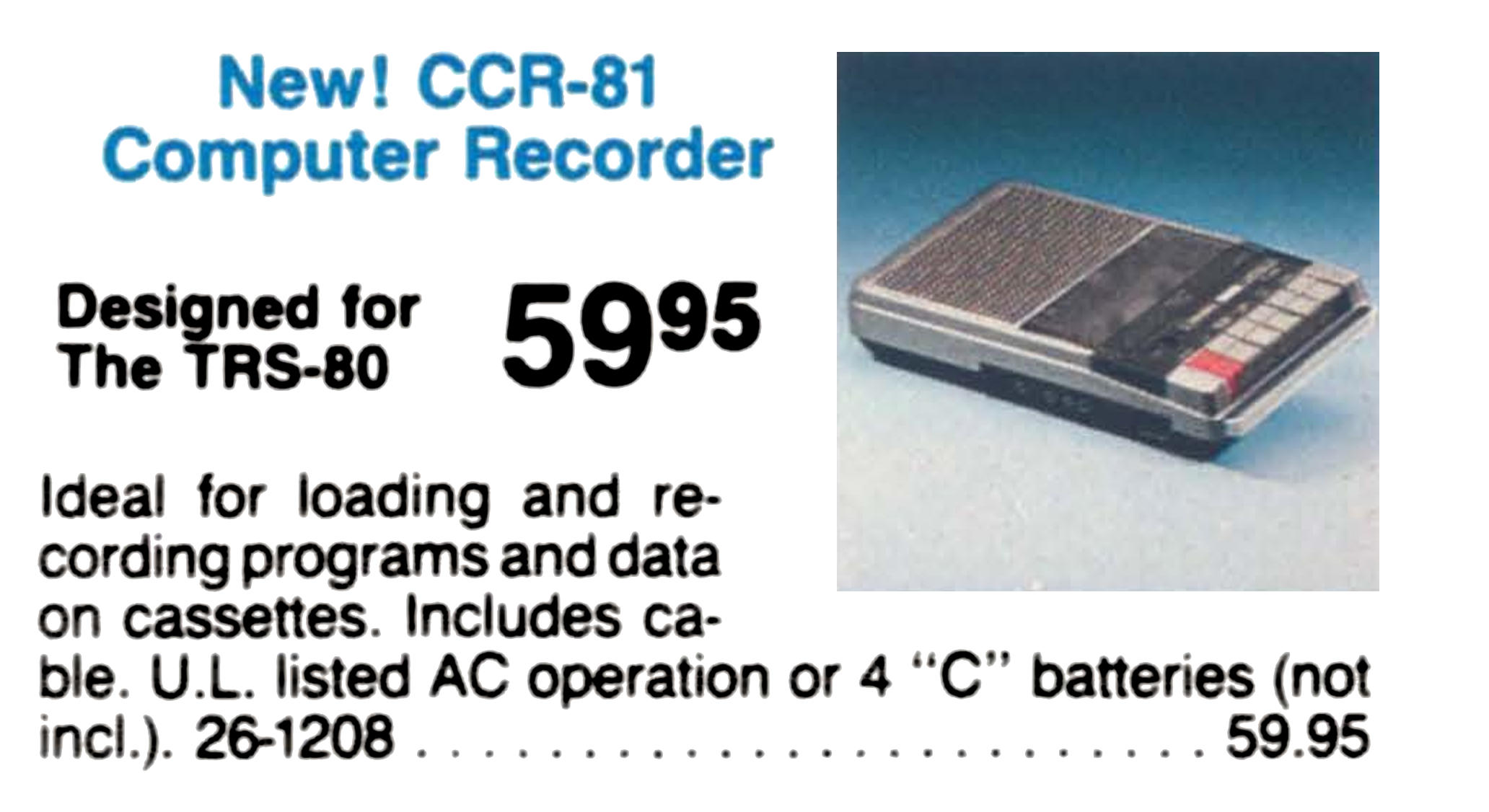
The "ready to use" one with the 5 pin DIN connector/adapter was probably expensive.[1] Otherwise, he would have had to find an adapter or fiddle making one himself. And even that would require a cassette player with all the right jacks (mono in, mono out, remote). They didn't all have those.
[1] This thing: https://colorcomputerarchive.com/repo/Documents/Manuals/Hard...
Edit: An old ad...$59.95 Or $142 if inflation adjusted to 2021 from 1987.