It's about impulse control.
Most criminals do not have it either.
61–70 of 145 posts
Most criminals do not have it either.
Earlier quoted context omitted.
I've always felt like the belief in a large group of "conspiracy theorists" is probably one of the biggest "conspiracy theories". A friend of a relative is an apparent flat earther - my relative is always saying things like "oh you wouldn't believe what this guy thinks, he says the world is actually shaped like a UN map, what a goof". In this situation, which of the two is actually the more gullible? From the situati…
You are being way too charitable. While there certainly are people that fall into the category you claim... there are many who are full blown Jewish space laser, government ice wall, lizard people shadow government, 5g microchip tracker crazies.
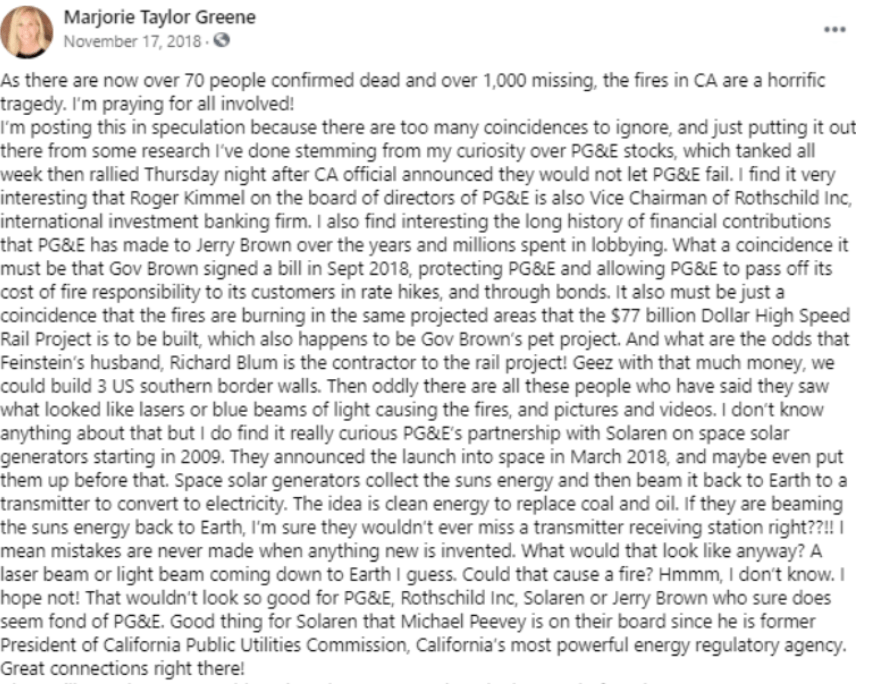
Was her point grounded in reality? Hell no. But the exact point being made above is highlighted by your comment.
Her original post: https://politizoom.com/wp-content/uploads/2021/01/Greene-las....
Earlier quoted context omitted.
> I've seemed to notice a pretty big uptick in 'uncle so and so went off the deep end so we had to cut off communication' type stories. I wonder how long that sort of cutting off has been happening in the past. I know there are members of my extended family I don’t associate with due to their crazy beliefs, but I haven’t talked about it.
My personal opinion is that the pandemic offered a unique opportunity for hidden 'crazy beliefs' to expose themselves. If Uncle Bob in 2017 believed that the federal reserve was run by a cabal hoarding 90% of our tax money to enrich themselves, nobody would really care unless he feels the need to bring it up in every conversation to the detriment of normal human interaction. If Uncle Bob in 2020 believes that, he pro…
The entire problem. You're not speaking to this person to figure out what they actually believe, you're forming a belief based on your own assumption.
Earlier quoted context omitted.
> I've seemed to notice a pretty big uptick in 'uncle so and so went off the deep end so we had to cut off communication' type stories. I wonder how long that sort of cutting off has been happening in the past. I know there are members of my extended family I don’t associate with due to their crazy beliefs, but I haven’t talked about it.
My personal opinion is that the pandemic offered a unique opportunity for hidden 'crazy beliefs' to expose themselves. If Uncle Bob in 2017 believed that the federal reserve was run by a cabal hoarding 90% of our tax money to enrich themselves, nobody would really care unless he feels the need to bring it up in every conversation to the detriment of normal human interaction. If Uncle Bob in 2020 believes that, he pro…
What broke pandemic policy is it was run by people who believe sincerely that they need to deceive people for their own good. It's the maternalism of noble lies. While there is a lot of uncertainty in policy circles about science and truth, there is very little uncertainty about power, and when you have that, truth is what you say it is.
The policy response is absolutely using the crisis as leverage to ensconce measures that would not have been legally or politically possible without it. The only meaningful question (I think) is whether the people behind the policies and supporting them are protagonists or antagonists. Almost nobody is asking, "wait, are we the baddies?" The reason "the banality of evil," is such a controversial idea is it places more intellectual and moral responsibility on each of us than the long tail of people are willing or able to accept, and so it's easier to attack the person with the idea than clear the bar it implies.
That's not conspiratorial, that's critical, and I'm sympathetic to people accused of conspiracy thinking because we've let the culture conflate those - to whose benefit is left as an exercise to the reader. ;)
Conspiracy theories are a manifestation of skepticism. One insight recently in the political theater is to determine what your audience is skeptical of. Everyone is skeptical of something, and these biases, when pinpointed, can be illuminating. On any topic you can split skepticism into groups. Are you more skeptical of government? The pharmaceutical industry? Corporations? Which?
> Conspiracy theories are a manifestation of skepticism. They're a manifestation of biased skepticism. Conspiracy theorists tend to be skeptical of everything except their own favorite conspiracy theories.
Earlier quoted context omitted.
I'm a little spectrumy so I often forget how important emotional support/bedside manner is to many people. I see my doctor as an automaton who I feed problems to and he feeds me solutions. Even something like a broken bone falls under the category of "normal" health issue. It happens all the time. You will be fine with a perfectly mediocre doctor dealing with your broken bone.
My wife broke her hand a few years ago, it required surgery to repair. It was not a "normal" issue. I suppose it could be considered normal for a hand specialist, but when thumb mobility could be permanently compromised, you really don't want to pick the wrong surgeon. As for bedside manner, I'm mostly with you - it's largely irrelevant. For me, it's more of a minimum acceptable level - as long as they're above it, a…
Earlier quoted context omitted.
My personal opinion is that the pandemic offered a unique opportunity for hidden 'crazy beliefs' to expose themselves. If Uncle Bob in 2017 believed that the federal reserve was run by a cabal hoarding 90% of our tax money to enrich themselves, nobody would really care unless he feels the need to bring it up in every conversation to the detriment of normal human interaction. If Uncle Bob in 2020 believes that, he pro…
> he probably also believes The entire problem. You're not speaking to this person to figure out what they actually believe, you're forming a belief based on your own assumption.
My point is that IF uncle bob's belief system segued into beliefs about masks and vax, then it becomes more visible and causes conflict with family members who didn't give a shit about the previous belief system; not that all conspiracies will necessarily turn into beliefs about masks and vax.
Earlier quoted context omitted.
My wife broke her hand a few years ago, it required surgery to repair. It was not a "normal" issue. I suppose it could be considered normal for a hand specialist, but when thumb mobility could be permanently compromised, you really don't want to pick the wrong surgeon. As for bedside manner, I'm mostly with you - it's largely irrelevant. For me, it's more of a minimum acceptable level - as long as they're above it, a…
I don't understand this behavior. Did you think you added something valuable to the conversation by replying with a special case?
Earlier quoted context omitted.
My personal opinion is that the pandemic offered a unique opportunity for hidden 'crazy beliefs' to expose themselves. If Uncle Bob in 2017 believed that the federal reserve was run by a cabal hoarding 90% of our tax money to enrich themselves, nobody would really care unless he feels the need to bring it up in every conversation to the detriment of normal human interaction. If Uncle Bob in 2020 believes that, he pro…
This is an interesting one because the pandemic policy response divide is right on the line where it created an unlikely coaltion of superstitious villagers, with 2+ stddev intelligence people in the habit of checking their priors and rejecting perceived obvious untruths. To extend the metaphor, perhaps it's a coalition of people beyond a stddev in both directions, who together form a huge cohort, if not even potenti…
> This increase in attention feeds news stories about conspiracy adherents (and anybody that can be lumped in with them, even if it's not warranted).
Emphasis on the last bit: whether your contrarian position is "+2 sigma" (as you state) or -2 sigma, you will definitely be lumped in with the other group by some targeted news program.
> to whose benefit is left as an exercise
To everyone's detriment really. Every accuser is also accused. Mainstream news these days is as much a target of conspiracies as they are accusers of conspiracy theorists. So too are leftists, rightists, contrarians, and of course actual conspiracy theorists. Everyone is accusing everyone else of something, to a net negative on society.
Every leftist is accused of marxism, every conservative accused of white supremacy, and so on. It's a miserable state of affairs with no nuance or productive discussion. Even the platforms (Facebook et al) that promulgate the inflammation of public discourse are themselves increasingly under fire by both sides of the aisle for various reasons to the point that both breaking up tech companies or heavily regulating their platforms are regularly discussed and promoted by lawmakers (ie Facebook and family face existential threats because they are so accused of poisoning the well, which well they have done to be fair but that's really just the nature of social media).
Earlier quoted context omitted.
> Conspiracy theories aren't 100% irrational. The term is often used to refer to implausible "theories" that make very strong claims, but have zero supporting evidence and make zero testable predictions. Of course, it's true that people conspire all the time. Implausible "theories" that make strong claims are exciting and entertaining. They're fun to play with. They become a problem when they go viral, among groups o…
> They become a problem when they go viral, among groups of people with limited critical thinking skills. Agreed, and to expand on this: I believe another problem is that these conspiracy theorists also believe that they have secret knowledge that the man doesn’t want you to have. Finally, they are smarter about something than those folks with education and success. This makes them an easy target for real conspiracie…
I'm against GMO. Not because I believe retail GMO food is likely to be harmful; I mean, harmful foods could be made, but we have testing.
I'm against GMO because (a) a lot of GMO plants have been engineered to be grown with heavy use of herbicides and pesticides, (b) GMO crops make a farm non-organic, and I'm in favour of organic farming for environmental reasons; and (c) GMO companies lobby incessantly against food labelling. If a food supplier doesn't want to label my food, then absent any other excuse, I presume there's something they don't want me to know (yes, I read food labels in supermarkets. I carry a credit-card-sized magnifier in my wallet, for that purpose).
What is an "anti-GMO seed pack"? Would that just be a pack containing seeds that are not genetically modified?