Live data from Hacker News

New Optical Switch Up to 1000x Faster Than Transistors

spectrum.ieee.org

71–80 of 94 posts

Re: New Optical Switch Up to 1000x Faster Than Transistors

#71
post #5

In reality, all-optical computing is mostly a terrible idea: fundamentally, it cannot reach the integration density of electronics. It boils down to the elementary differences between Fermions (electrons, neutrons, etc.) and Bosons (photons, etc.). Their intrinsic behavior determines the interaction with matter, i.e. conductive/absorptive properties. As a result, optical wires (waveguides) have to be sized roughly at…

> all-optical computing

The keyword here is ‘all’. There are some things optical computing is bad at. However there are some things it is unparalleled at. For example, light can multiplex. It can have much lower energy losses. It can run at much higher frequencies. It is by far the best way to transmit information at extremely high data rates. Even within a chip, free space optical communication has massive theoretical potential.

Your comment would have been an excellent one without the last sentence.
Re: New Optical Switch Up to 1000x Faster Than Transistors

#72
This is absolutely amazing and is the perfect gift for the research I'm working on: fractal logic and calculating with structures.

The concept is to break down (algebraic) operators into a single fundamental operator and a single reference value (zero/null). And because there is only one operator and one value, they can be removed from the system. What remains is the "essence of information" in the form of connections, opening a new realm of problem solving, especially in the realm of SAT solving. It's not about what the operator does, it's about how they are connected together.

The "fractal operator" is a switch of which one input is inverted. The expressions/structures are stored as vectors and evaluated by activating them sequentially. For some years I visualised it being implemented with photons instead of electrons. And assuming that only a single photon is needed to set the switch state.

This is a wish come true!

  [0] https://github.com/RockingShip/untangle

Re: New Optical Switch Up to 1000x Faster Than Transistors

#73
post #31
post #5

In reality, all-optical computing is mostly a terrible idea: fundamentally, it cannot reach the integration density of electronics. It boils down to the elementary differences between Fermions (electrons, neutrons, etc.) and Bosons (photons, etc.). Their intrinsic behavior determines the interaction with matter, i.e. conductive/absorptive properties. As a result, optical wires (waveguides) have to be sized roughly at…

(I swear I’m not in Fridman’s payroll.) As a layperson I found this episode with Jeffrey Shainline an interesting discussion tangential to the topic of optoelectronic computing. The basic gist was that photons are good for communication, electrons are good for compute. https://youtu.be/EwueqdgIvq4

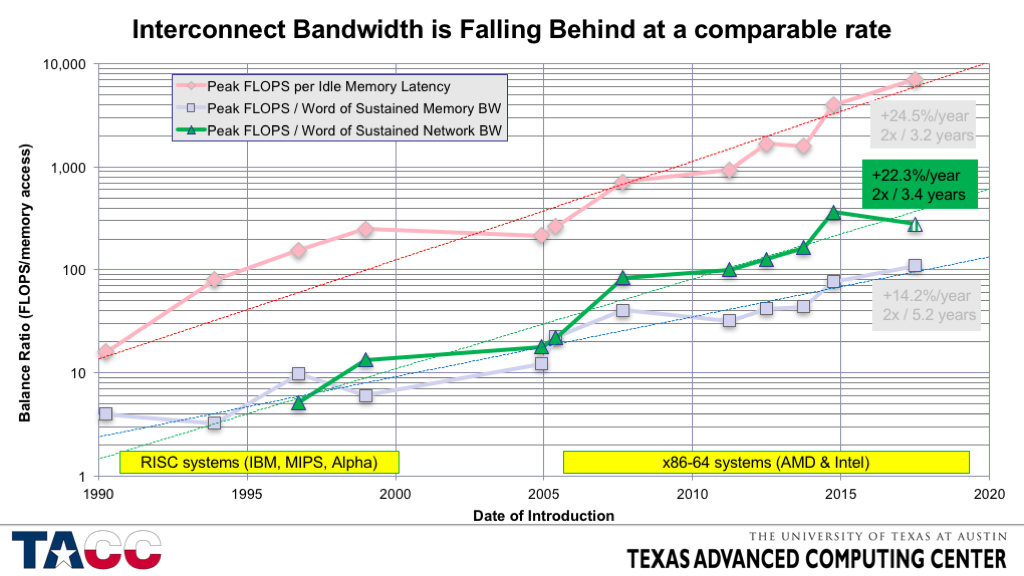
This makes me wonder if transmitting data optically would help with the gradual lowering of the data/compute ratio over time:

https://sites.utexas.edu/jdm4372/files/2016/11/Slide16.png

Re: New Optical Switch Up to 1000x Faster Than Transistors

#74
post #71
post #5

In reality, all-optical computing is mostly a terrible idea: fundamentally, it cannot reach the integration density of electronics. It boils down to the elementary differences between Fermions (electrons, neutrons, etc.) and Bosons (photons, etc.). Their intrinsic behavior determines the interaction with matter, i.e. conductive/absorptive properties. As a result, optical wires (waveguides) have to be sized roughly at…

> all-optical computing The keyword here is ‘all’. There are some things optical computing is bad at. However there are some things it is unparalleled at. For example, light can multiplex. It can have much lower energy losses. It can run at much higher frequencies. It is by far the best way to transmit information at extremely high data rates. Even within a chip, free space optical communication has massive theoretic…

But the whole wisdom of the parent comment is in the last sentence. This is mostly what is happening with such papers.

The keyword here might be "all", and there are some applications where optical computing is unparalled at. But research teams, vendors, and the media spin those things are a recplament for every application, not as some niche thing that's good at some niche applications that most people need not care about...

Re: New Optical Switch Up to 1000x Faster Than Transistors

#75
post #50

Earlier quoted context omitted.

Being able to do any kind of computation in the optical domain would benefit telecommunications immensely. Basic things like optical muxing/demuxing and serialization/deserialization would be fantastic.

I was going to say "But wavelength/polarization multiplexing is the norm", but you have "fiber network design" in your about so I'm wondering what I'm missing - I guess you mean dynamic muxing, essentially routing? SerDes is of course annoying.

Yes, being able to do anything dynamically in the optical domain would improve things.

My main point is that to be able to do even the small stuff in the optical domain would be a big win. You don’t need to be able to achieve L2/L3 switching/routing to move the needle.

Re: New Optical Switch Up to 1000x Faster Than Transistors

#76
post #5

In reality, all-optical computing is mostly a terrible idea: fundamentally, it cannot reach the integration density of electronics. It boils down to the elementary differences between Fermions (electrons, neutrons, etc.) and Bosons (photons, etc.). Their intrinsic behavior determines the interaction with matter, i.e. conductive/absorptive properties. As a result, optical wires (waveguides) have to be sized roughly at…

This sounds to me like doctors claiming they know so much about the human body when in reality we are at the infancy of our understanding

Are you familiar with physics?

What engineers work with is, maybe, 1/1000 of our physics knowledge (maybe 2/1000 for electronical engineers who need a solid basis of quantum mechanics).

Our physics knowledge is maybe 1/1000 of what we roughly know should be there but cannot be probed (quantum gravity, nonlinear field theories, dark stuff...).

The Universe is so huge that it is pretty impossible to descrive how much bigger than us it is - probably infinitely.

The point is, between the stuff that we know and the stuff that we roughly know but don't really know - we know a lot more than what we can use.

Saying that something is not so useful technologically, as OP stated, is rather a safe statement. We know a lot about fermions and bosons, light and electrons - and we know sufficient information to be able to state when something is overhyped and not really useful as it seems

Re: New Optical Switch Up to 1000x Faster Than Transistors

#77
post #71
post #5

In reality, all-optical computing is mostly a terrible idea: fundamentally, it cannot reach the integration density of electronics. It boils down to the elementary differences between Fermions (electrons, neutrons, etc.) and Bosons (photons, etc.). Their intrinsic behavior determines the interaction with matter, i.e. conductive/absorptive properties. As a result, optical wires (waveguides) have to be sized roughly at…

> all-optical computing The keyword here is ‘all’. There are some things optical computing is bad at. However there are some things it is unparalleled at. For example, light can multiplex. It can have much lower energy losses. It can run at much higher frequencies. It is by far the best way to transmit information at extremely high data rates. Even within a chip, free space optical communication has massive theoretic…

You are right about transmission of data. But the article is about transistors, i.e. processing of data.

Re: New Optical Switch Up to 1000x Faster Than Transistors

#78
post #31

Earlier quoted context omitted.

(I swear I’m not in Fridman’s payroll.) As a layperson I found this episode with Jeffrey Shainline an interesting discussion tangential to the topic of optoelectronic computing. The basic gist was that photons are good for communication, electrons are good for compute. https://youtu.be/EwueqdgIvq4

This makes me wonder if transmitting data optically would help with the gradual lowering of the data/compute ratio over time: https://sites.utexas.edu/jdm4372/files/2016/11/Slide16.png

We already transmit data optically, that's what fiber optics is.

Re: New Optical Switch Up to 1000x Faster Than Transistors

#79
post #5

In reality, all-optical computing is mostly a terrible idea: fundamentally, it cannot reach the integration density of electronics. It boils down to the elementary differences between Fermions (electrons, neutrons, etc.) and Bosons (photons, etc.). Their intrinsic behavior determines the interaction with matter, i.e. conductive/absorptive properties. As a result, optical wires (waveguides) have to be sized roughly at…

> In reality, all-optical computing is mostly a terrible idea: fundamentally, it cannot reach the integration density of electronics.

It doesn't need this density to be useful or better than electronics in many cases. For instance, photonic quantum computation happens at room temperature, but this doesn't seem like it will be feasible with any other method for long time, if ever.

Re: New Optical Switch Up to 1000x Faster Than Transistors

#80
post #74
post #71

Earlier quoted context omitted.

> all-optical computing The keyword here is ‘all’. There are some things optical computing is bad at. However there are some things it is unparalleled at. For example, light can multiplex. It can have much lower energy losses. It can run at much higher frequencies. It is by far the best way to transmit information at extremely high data rates. Even within a chip, free space optical communication has massive theoretic…

But the whole wisdom of the parent comment is in the last sentence. This is mostly what is happening with such papers. The keyword here might be "all", and there are some applications where optical computing is unparalled at. But research teams, vendors, and the media spin those things are a recplament for every application, not as some niche thing that's good at some niche applications that most people need not care…

There seems to be an awfully large amount of projection here from people seemingly just reading the headline and not the article (much less the paper).

Even just the article's sub-title has tempered predictions: "“Optical accelerator” devices could one day soon turbocharge tailored applications"

And the research has immediate practical applications, again per the article:

> "The most surprising finding was that we could trigger the optical switch with the smallest amount of light, a single photon," says study senior author Pavlos Lagoudakis, [..] Lagoudakis says the super-sensitivity of the new optical switch to light suggests it could serve as a light detector that could find use in lidar scanners, such as those finding use in drones and autonomous vehicles.

Post reply on HN