Live data from Hacker News

Canadian military saw pandemic as opportunity to test propaganda techniques

ottawacitizen.com

101–110 of 145 posts

Re: Canadian military saw pandemic as opportunity to test propaganda techniques

#101
post #97

Earlier quoted context omitted.

Ah yes, the asymptomatic aspect of Covid, a disease so deadly most people need to be tested to know they came near it. How did the "connected" nature of our existence make it necessary to shut down entire countries, as well as the air travel links? My local playgrounds were officially closed until late into 2020 (obviously, I ignored that), as well as all sorts of other places that were obviously harmless. In fact, t…

> Ah yes, the asymptomatic aspect of Covid, a disease so deadly most people need to be tested to know they came near it. Wow. Yes, because while you might have zero symptoms, you still spread it, and will probably infect multiple other people ( the so called R), especially without masks and other such precautions. Those people will infect many more in their turn. Among those, some will develop symptoms, sometimes hea…

If you're at risk of Covid, stay at home (which is behaviour very common in old folks anyway, during flu season). Frankly, even then your risk is very low. I know several people in their 90's who tested positive for Covid and survived just fine.

>The point of those restrictions was to stop people from meeting, at all.

Yes, the insidious and damaging idea that meeting people at all is dangerous, as we are all disease-ridden carriers of death. When I made a complaint at work that the Covid policies were making the workplace demoralising and miserable, the head of the Health and Safety committe specifically told me that government guidance was to "eliminate conversations". How is this at all healthy for us as a society?

You're also still taking about planes and trains, when I was asking how does that justify being literally shut in my house. Saying that, I understand your point of view. Covid is so bad, that absolutely no risk of passing it must be tolerated, and policy should be set accordingly.

Re: Canadian military saw pandemic as opportunity to test propaganda techniques

#102
post #85
post #83

Earlier quoted context omitted.

You've got that backwards. Brexit is the prime example of the British public rejecting a campaign that was being pushed on them.

Both sides did heavy pushing, albeit one included much more lies (where are the 350 million per week for the NHS, Boris?)

Weren't there a lot of fearmongering whoppers of budget black holes, economic collapse, shortages and famine, increased risk of war, etc., coming out of remain? How do you judge which side lied more?

Re: Canadian military saw pandemic as opportunity to test propaganda techniques

#103
post #4

> A military investigation determined what the Canadian Forces public affairs leadership was doing was “incompatible with Government of Canada Communications Policy (and the) mission and principles of Public Affairs.” I would hope that deploying the military against your own citizens is against more than just an executive branch policy that can be changed at any moment.

It's worse than that. Of course the government can call the army against its own population, that's what armies were for before modern "crowd control". Counter-insurrection doctrines were specifically developed to reduce the bloodshed from military interventions so that social control and political repression would be more socially acceptable.

Without even talking of the most famous colonial wars during which these techniques were developed (Indochine, Algeria), the French army has repeatedly massacred its citizens during the Paris commune in 1871 (10-50k dead) [0] or during the may first demonstration in Fourmies in 1891 (9 dead) [1].

Nowadays the army is still used against the population but rarely with actual bullets. The police has a much bigger killing record (including during demonstrations), but at least two anarchists i know of were killed by explosive grenades thrown by the military police (gendarmerie) during ecological protests: Vital Michalon in 1977 (physics teacher) [2] and Rémi Fraisse in 2014 (botanist) [3].

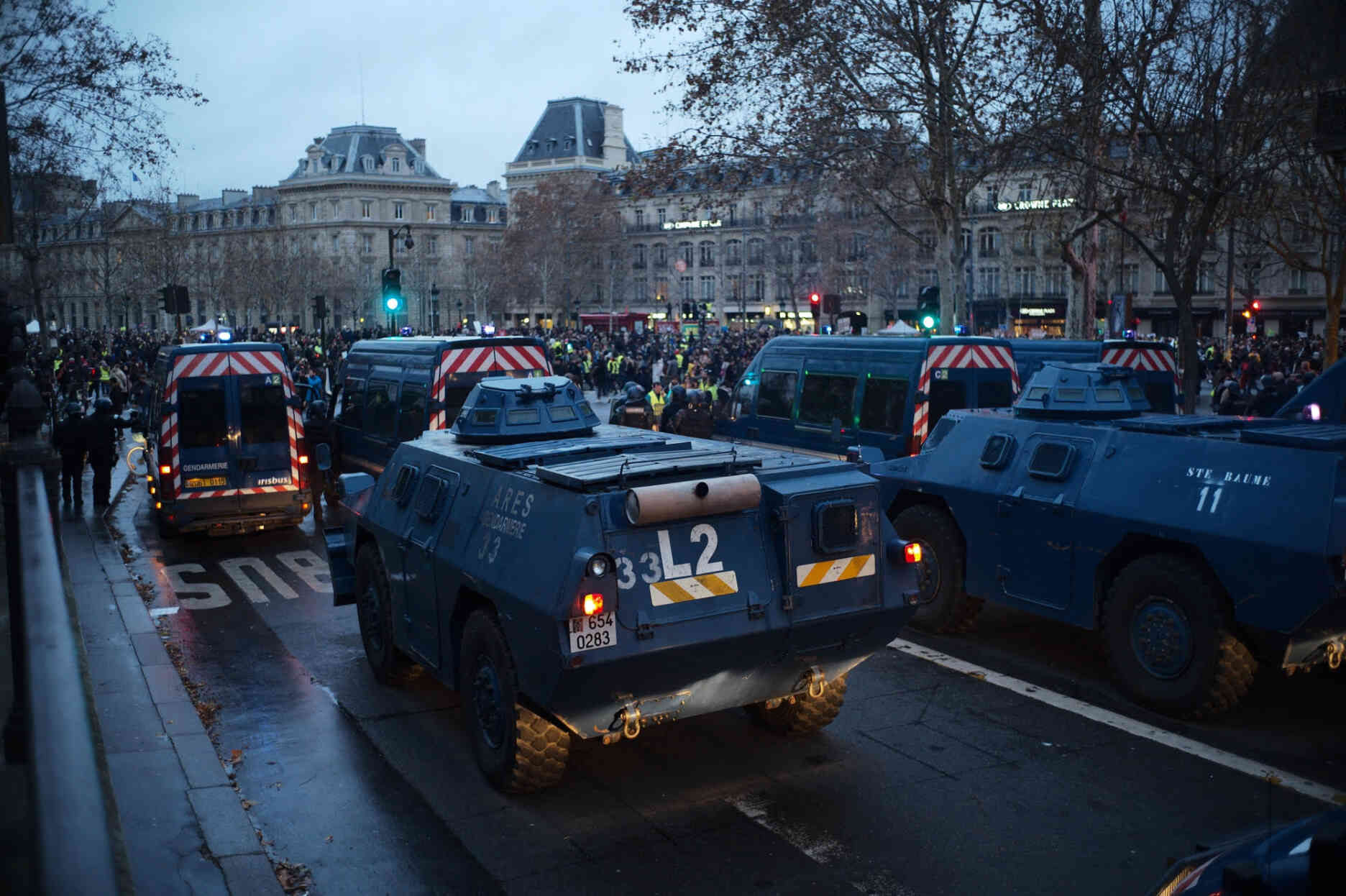
Even more recently, during the Gilets Jaunes protests, the army's anti-terrorist patrols (Sentinelle) were redeployed by the government to defend key buildings/institutions from a potential revolution. That move was criticized both by soldiers who said it was not their role, and by opposition parties. They even deployed the Gendarmerie's armored tanks in Paris, which was a first. [5] Despite teargas being banned by the Geneva convention against chemical weapons, these tanks were equipped with stronger chemicals, which the government denied, before acknowledging its existence (they did not use this "powder" during the protests). [6]

On the countryside, especially in rural land occupations against GPII (Grands Projets Industriels et Imposées, or Grand and Imposed Industrial Projects), also known as ZADs [7], the Gendarmerie (military police) is heavily deployed, both regular "Gendarmerie Mobile" units as well as "PSIG". These units PSIG units, involved in fast deployment for crushing popular dissent on the countryside, were 37 in 1978, 138 in 1988, 310 in 2000 and 370 in 2015 [8], so we can say that aspect of counter-insurrection apparatus is growing. In Bure, where the local population is opposing the construction of an underground nuclear storage facility [9], there are more stationed gendarmes (both GM and PSIG) than there are inhabitants, and the operation has often been described as a military occupation [10] unseen since WWII. You have road blocks and mobile patrols doing ID checks on everyone, and the local forest has been privatized and is heavily guarded, and local residents have been regularly fined for just taking a walk in the forest. It is not uncommon for the local population to be ID-checked 3 times going to the supermarket and back. More information about this struggle against industrial capitalism can be found here [11].

This is just for France. In more democratic countries, the situation may be different. But i know in America (north and south) the situation is very similar with the national guard (or equivalent) called to crush popular insurrections against injustice, corruption police brutality, and privatization of public/indigenous land.

[0] https://en.wikipedia.org/wiki/Paris_Commune [1] https://en.wikipedia.org/wiki/Fusillade_de_Fourmies [2] https://fr.wikipedia.org/wiki/Vital_Michalon [3] https://en.wikipedia.org/wiki/R%C3%A9mi_Fraisse [4] https://www.francetvinfo.fr/economie/emploi/metiers/armee-et... [5] https://img.lemde.fr/2018/12/08/0/0/2000/1333/1872/1246/30/0... [6] https://paris-luttes.info/macron-pret-a-utiliser-des-armes-1... [7] https://en.wikipedia.org/wiki/Zone_to_Defend [8] https://fr.wikipedia.org/wiki/Peloton_de_surveillance_et_d%2...

[9] The storage is not operational yet, and there has already been serious injuries and collapses, so the inhabitants are concerned that the engineers promising the facility will store nuclear content safely for >10K years have no clue what they're talking about.

[10] https://reporterre.net/Bure-En-Meuse-nous-vivons-sous-occupa...

[11] https://bureburebure.info/category/english/

Re: Canadian military saw pandemic as opportunity to test propaganda techniques

#104
post #84

Earlier quoted context omitted.

It absolutely has. I maintain that without social media, which simultaneously provided a way into everyone's thoughts, and also contented people with a feeling of connectedness while living under house arrest conditions of historic proportions, people would have simply rejected the whole campaign of Covid restrictions.

Quarantines and lockdowns have been used throughout history to combat epidemics, with great success. Why do you think that the only thing that made people accept the latest ones is social media?

They were more local, more flexible, and were used to combat highly-deadly epidemics such as the plague or spanish flu. Such previous epidemics were more deadly, and were perceived as such by the local population, who therefore probably found the measures more justified.

Also, the 2020 quarantines arrived at a time where global resource inequalities were at unprecedented levels in human history, and when popular insurrections were growing across the planet (Liban, France, Soudan, etc), so they were interpreted (in my opinion, rightly so) as a political repression measure more than a sanitary measure... which was confirmed by the lack of sanitary measures from most governments, including the French government who during the pandemic cut public hospitals budgets by 800M€, continued to shut down hospital beds while the bodies were piling up, and covered up their failures (such as destroying the national mask stocks before the pandemic) via heavy propaganda campaigns.

Finally, opposition to the quarantines was fueled by how unevenly the measures were applied. Government officials and rich people have been publicly documented eating in restaurants and throwing parties, while common people like you and me were routinely beaten up by the police, fined or detained, for daring to go out and breathe fresh air (which here in France was illegal by decree for most of the 1st quarantine, before that was relaxed).

I don't think social media is entirely responsible for the growing conspiracy theories (Qanon) and other forms of popular opposition to quarantines, but they sure played a role in giving more facts to the population to know for sure the government can't be trusted to protect the local population (at least here in France).

PS: For historical context on a previous epidemics, you may be interested to take a read at this article, which offers an anarchist perspective about the 1884 cholera epidemic: https://crimethinc.com/2020/05/26/the-anarchists-versus-the-...

Re: Canadian military saw pandemic as opportunity to test propaganda techniques

#105

Earlier quoted context omitted.

The war measures act was repealed in 1988

Indeed, it was replaced with the Emergenices Act as I mentioned. In fact Justin Trudeau considered invoking it for the first time since the replacement in the COVID situation. [edit] Between that and the Notwithstanding Clause [1] there's a lot of latitude here. [1] https://en.wikipedia.org/wiki/Section_33_of_the_Canadian_Cha...

Wait, are those two Treudeaus relatives?

Re: Canadian military saw pandemic as opportunity to test propaganda techniques

#106
Happen to have just finished a biography of John Buchan (author of "The Thirty-nine Steps" among many others, as well as being Governor General of Canada 1935-40). In the first world war he was high up in the Propaganda Bureau - which was considered quite successful, including by the Germans. He also wrote some of his fiction with a view to influencing public opinion.

Re: Canadian military saw pandemic as opportunity to test propaganda techniques

#107
post #84

Earlier quoted context omitted.

Quarantines and lockdowns have been used throughout history to combat epidemics, with great success. Why do you think that the only thing that made people accept the latest ones is social media?

They were more local, more flexible, and were used to combat highly-deadly epidemics such as the plague or spanish flu. Such previous epidemics were more deadly, and were perceived as such by the local population, who therefore probably found the measures more justified. Also, the 2020 quarantines arrived at a time where global resource inequalities were at unprecedented levels in human history, and when popular insu…

> They were more local, more flexible, and were used to combat highly-deadly epidemics such as the plague or spanish flu. Such previous epidemics were more deadly, and were perceived as such by the local population, who therefore probably found the measures more justified.

Yes, previous epidemics were more deadly, but also easier to contain because:

1) cases were symptomatic

2) incubation period was lower

So the effectiveness of quarantines and lockdowns was much higher and easier to measure ( we have no more visibly sick people, and it's been like this for a week, everything is OK).

> Also, the 2020 quarantines arrived at a time where global resource inequalities were at unprecedented levels in human history, and when popular insurrections were growing across the planet (Liban, France, Soudan, etc),

I can't comment on Lebanon and Sudan, but in France you're flat out wrong.

There were the Gilets Jeunes, whose numbers were falling all through 2019 and were at less than 100k before the protests against the retirement reform, which were sometimes done in coordination [0]. In any case, the numbers for february are at 10-30k protestors, which is nothing for a country of 67 million inhabitants.

> which was confirmed by the lack of sanitary measures from most governments, including the French government who during the pandemic cut public hospitals budgets by 800M€, continued to shut down hospital beds while the bodies were piling up, and covered up their failures (such as destroying the national mask stocks before the pandemic) via heavy propaganda campaigns.

Again, you're flat out wrong. Hospital beds were reorganised and more emergency ones were added - this is why during the third wave hospitals in many regions were over "original capacity"; in Ile de France we got to ~140% if memory serves me right[1]. Mask stocks have been falling since 2009, so you can't pin that on the current government[2].

> Finally, opposition to the quarantines was fueled by how unevenly the measures were applied. Government officials and rich people have been publicly documented eating in restaurants and throwing parties, while common people like you and me were routinely beaten up by the police, fined or detained, for daring to go out and breathe fresh air (which here in France was illegal by decree for most of the 1st quarantine, before that was relaxed).

It wasn't illegal to go and breathe fresh air, there was just a distance limit from your home.

> but they sure played a role in giving more facts to the population to know for sure the government can't be trusted to protect the local population (at least here in France).

That's funny, because the government's approval was very high during the initial waves, and Macron's is still higher than before the pandemic[3]. Not only that, but he's the first one since Chirac to have such a high approval this late into his term.

Honestly i think the French government's action was among the best possible ( and obviously i'm not the only one if Macron's ratings are any indication); at any case, they were really trying to strike a fine balance. No lockdowns on the third wave, keeping schools open, financial help, etc.

0 - https://fr.wikipedia.org/wiki/D%C3%A9roulement_du_mouvement_...

1 - https://www.data.gouv.fr/fr/datasets/synthese-des-indicateur...

2 - https://www.lemonde.fr/sante/article/2020/05/07/la-france-et...

3 - https://en.wikipedia.org/wiki/Opinion_polling_on_the_Emmanue...
Re: Canadian military saw pandemic as opportunity to test propaganda techniques

#108
Probably useful to workshop messaging in event Quarantine Act was ever triggered.

>The federal government never asked for the so-called information operations campaign, nor did cabinet authorize the initiative

Does this insinuate teh gov was informed and explicitly did not authorize or military acted independantly?

Re: Canadian military saw pandemic as opportunity to test propaganda techniques

#109

Earlier quoted context omitted.

Indeed, it was replaced with the Emergenices Act as I mentioned. In fact Justin Trudeau considered invoking it for the first time since the replacement in the COVID situation. [edit] Between that and the Notwithstanding Clause [1] there's a lot of latitude here. [1] https://en.wikipedia.org/wiki/Section_33_of_the_Canadian_Cha...

Wait, are those two Treudeaus relatives?

Yes.
Post reply on HN