Live data from Hacker News

Home Price to Income Ratio

longtermtrends.net

621–630 of 704 posts

Re: Home Price to Income Ratio

#621
post #260

Earlier quoted context omitted.

I've thought about this a lot, though if you google around you'll find people who dispute this claim. Still, it makes sense to me. If you have single income households, and all of a sudden everyone's a double income households, you're not any better off. You'll get inflation, especially in housing. People will point out that stay at home moms weren't THAT pervasive, even decades ago (not as pervasive as us younglins…

> If you have single income households, and all of a sudden everyone's a double income households, you're not any better off. You'll get inflation, especially in housing. ?? The growth in output would offset the increase in dollars bidding for the same goods - ie. more people working would mean more supply and also more $$ bidding for goods. Seems absurd to say "you're not any better off."

It makes constructing high quality housing more affordable but it also makes land more expensive.

Re: Home Price to Income Ratio

#622
post #146

Why do they use "average" home price (without specifying whether it's mean, median, or modal), with "median" income? It makes these graphs very difficult to interpret.

Also, I would be willing to wager that the spread of housing prices has increased over time. That prices in the cities have grown much much faster.

So nowadays there are many people who want to live in a city but can't afford to, and there are many homeowners in the towns who haven't seen much appreciation of their largest asset.

Meanwhile back in the 50's someone could afford a house in the suburbs on a single income (a laughable concept today) because it wasn't many times more expensive than a house in a small town.

Re: Home Price to Income Ratio

#623

Earlier quoted context omitted.

The birth rate is already dropping in the US....

And yet the population is not. Ergo, you're competing not just with your fellow citizens, but the whole planet.

The OP suggested vasectomies to bring down population, the result is the same.

Are you suggesting we kill off part of the current population? What's your point with this comment?

Re: Home Price to Income Ratio

#624
post #141

Earlier quoted context omitted.

A ban on marketing prescription-only drugs directly to the public existed in the US until recent decades. The amount spent on marketing skyrocketed when that ban was removed.

Since there's no way to reinstate the marketing ban short of a Constitutional amendment (basically impossible) that point is moot.

An outright ban would be very difficult now that the genie is out of the bottle. The FDA can regulate what goes in the ads, like requiring disclosure of the expected benefit, how prevalent some of those side effect them mention are, how common the condition it's meant for actually is, and of the list price of the medication. Many of these drugs are for rare conditions and the drugs, though approved, help a smaller percentage of patients than the ads portray and to a lesser extent.

Re: Home Price to Income Ratio

#625
post #287

Earlier quoted context omitted.

It depends where, as cities have some level of freedom in the shenanigan they implement in their tax structure. Normally though, taxation is just a matter of the property value. Often, cities with lower housing cost have higher tax rates (because the people working the sewers aren't any cheaper and they need to get paid). Many cities also have owner occupant or primary residence abatements, so the landlords pay more…

> Normally though, taxation is just a matter of the property value. Total tax burdens are a function of government expenditures. Property tax is a rough attempt at scaling the tax burden to a person’s wealth, but it has many caveats varying in many jurisdictions. However, government debt is a big part of expenses, and each city and state’s debt can vary greatly than from another. Here is a good website ranking the bi…

yes, though I'm not sure what it has to do with the original question. Someone is comparing 2 types of property in a given area. The city's tax burden is a constant between the two in that scenario, so the only variable will be how the tax burden is implemented by that city, which is usually property value with some abatements based on residency status and type of properties.

Re: Home Price to Income Ratio

#626
post #480

Earlier quoted context omitted.

Kinda. If I buy a 1M home at 2.5% interest, I have a $4,000 monthly payment. If rates go to 6%: - Housing prices plummet to $600,000, assuming people are willing to spend the same per month. - My monthly payments are identical to had I bought at $600k at 6%. If I stay there, I'm not much worse off. It's harder to pay off the home quickly. - If I move out, and I rent out my home, it covers monthly payments approximate…

"If I move out, and I rent out my home, it covers monthly payments approximately exactly." You cannot borrow for rent, so rents follow income growth more closely. So in some expensive real estate markets, if no income growth, rent might not cover your mortgage repayments.

This is very true. I have pretty expensive home that I rent out which is in a pretty affluent area. The rent is insanely low relative to the supposed value of the house (3% cap rate).

You make s great point as to the reason for this. Rental rates are completely detached from current interest rates.

Re: Home Price to Income Ratio

#627
post #448
post #252

Earlier quoted context omitted.

Yup. Don't forget the whole "frequently choose not to have a kid" part, and it becomes extremely one sided. Dual income families aren't new, but 2 high earners professionals with no kids aren't just the occasional doctor/dentist/lawyer couples anymore. I'm a software engineer myself in one of the high paying tech hubs, and married the same. When we went to look for a home and toured open houses, all you saw were pair…

What do you think are the best books to recommend to people who don't have enough financial literacy? This is a common theme in this kind of HN thread but I haven't seen many recommendations or lists of books that can help people level up in their financial wisdom. The bigger problem is that everyone wants to live in the same place (usually in urban centers, where the jobs are, and where you don't have to drive an ho…

WFH only changes things in a small number of professions (hard to wait tables remotely, and sometimes doctors need to see patients in person). A large amount of people in those professions don't want to WFH (thus why a lot of big tech companies are INCREASING their real estate footprint rather than reducing it right now. Google, HubSpot, Spotify. Some of these are very open to WFH, but a lot of folks don't want to).

It will make a difference, but it will be small. During that time, the rest of folks will still flok to cities.

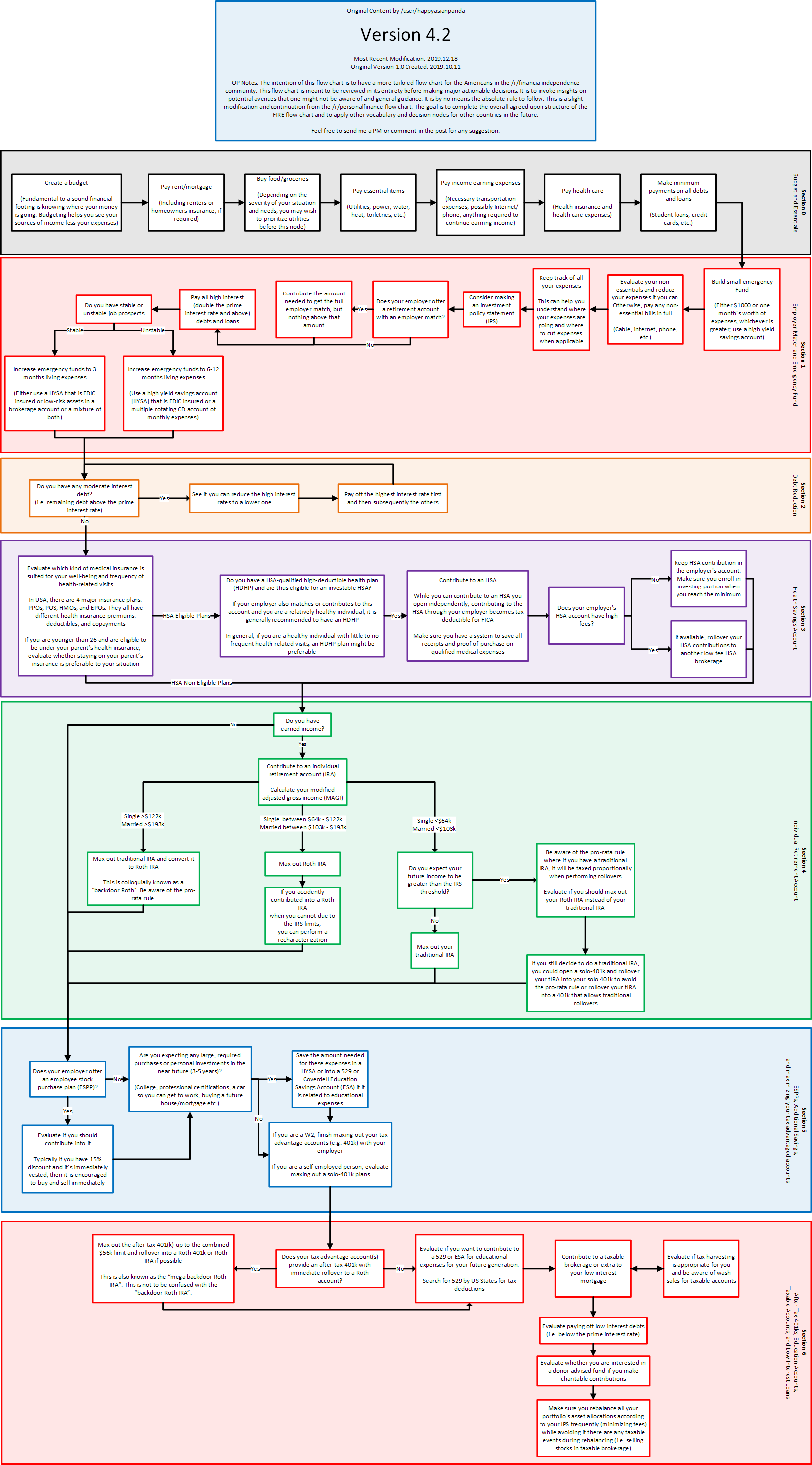
As to financial literacy, books tend to make things much more complicated than they are, and will be too focused. For a beginner, there's a few things that matter.

First, the "flowchart". You can find a bunch of these online, but I like this one:

https://u.cubeupload.com/demonlesondledon/FIREFlowChart.png

This is so you don't fall in the trap of, let say, having a 5% investment while sitting on a 15% debt, or not use your employer 401k matching and invest the money somewhere worse.

Then there's basic investment strategies to get started. Bogglehead gets you pretty far there: https://www.bogleheads.org/wiki/Three-fund_portfolio

The next is understanding how the US market works. It averages 10% a year even if you include the great depression/recession and every other downturn. One day it could do like Japan and never recover/stay flat, but it has never happened in the US so far:

https://advisor.visualcapitalist.com/historical-stock-market...

Even for the great depression, while you'll hear that it took 25 years to recover, but that's based on the Nasdaq, which is a very small sample of stocks. The market in aggregate recovered much faster.

Finally, you want to understand all the variables when comparing cost/return of home ownership vs renting. It's a LOT more complex than people make it sound. The NYT has a calculator that shows it, alongside a paywalled article: https://www.nytimes.com/interactive/2014/upshot/buy-rent-cal...

Bonus: a lot of it just comes down to internalizing the average market return and its risk, and comparing it against all the gains and leverage you can make in other ways. For example, with current interest rates, you probably want to pay your mortgage -as slowly as possible-, which is counterintuitive to most people.
Re: Home Price to Income Ratio

#628
post #616

Earlier quoted context omitted.

The weird thing is that 5 year adjustable rates are higher then 30yr. fixed. That only makes sense if interest rates will go down over the next 5 years, which seems unlikely to me.

If you look at it from the bank's perspective it makes more sense. I got a 5 year and paid it off early. The bank got about 8% of my home value. My friend has a 30 year and the bank will get ~110% of his home value.

This is for 30 year 5/1 ARMs the term is the same, but the rate is not locked

Re: Home Price to Income Ratio

#629
post #365

Earlier quoted context omitted.

Interest rates are irrelevant when you can only borrow 4.5x income but home prices are at 8-9x Interest rates are irrelevant when you need 20% down and it will take you a decade to save that up while renting, because of said multiple.

Why do people think you need 20% down? You don't need 20% down on a mortgage. There are first-time home buyer loans where you can put down as little as 0% and for conventional loans you just have to buy personal mortgage insurance if you're below 20% down. This is such a weird home buying myth and I don't understand how it sticks around.

I agree. However, not putting 20% does typically result in less-than-the-best interest rate as well as PMI, thus adding more to your monthly costs. Also, less than 20% also results in a larger mortgage payment regardless than compared to putting more down.

Re: Home Price to Income Ratio

#630

Earlier quoted context omitted.

> Ask a minority what it’s like going on a road trip sometime - I guarantee there’s many places where they won’t want to stop. Certified brown person here. The only thing I think about in terms of deciding where to stop is how far I can get before needing gas, and what the odds of finding decent food are. I've travelled in rural areas all over the country: midwest (my wife grew up in rural iowa), west coast (wife's f…

This is immaterial. People can be very welcoming to tourists and hostile to the very same people as immigrants. As a brown person who drove extensively through the US both North and South you would mostly see very welcoming people, the same places you would hear horror stories from people like me who actually lived there.

The above comment was in reference to a road trip.
Post reply on HN