Earlier quoted context omitted.
Treasuries act as a money store for large institutions that I think would be hard for them to replace in practice. They use T-bills in particular as more or less a jumbo-sized version of an FDIC-insured bank account. Where would they move that money to? I.e., who else provides a similarly safe account where you can deposit $50 billion? Can't be to a bank account, because all the major banks have even lower ratings. T…
You could, for example, move your money to Canadian treasuries, which are AAA rated, couldn't you? I am admittedly learning much of this as I read, but it seems to me that a large concern would be the amount of money that might simply shift out of our economy to economies with better (safer) credit ratings.
United States loses AAA credit rating from S&P
91–100 of 518 posts
Re: United States loses AAA credit rating from S&P
#92Earlier quoted context omitted.
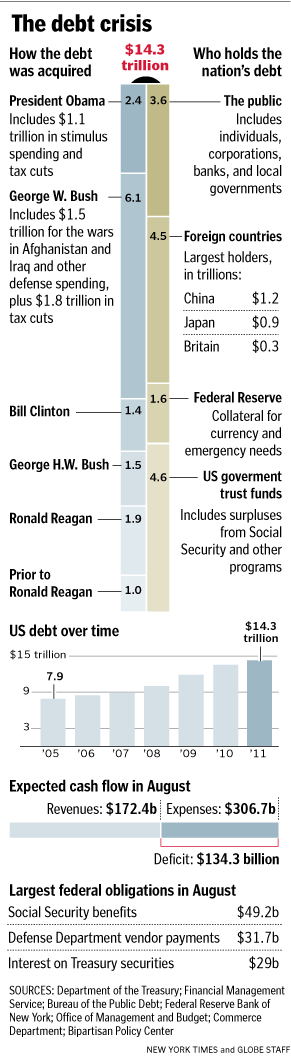
Isn't most of the US debt also financed by its own citizens?
Yes, about 70% of it.
http://cache.boston.com/bonzai-fba/Globe_Graphic/2011/07/31/...
[EDIT] Sorry, read the original statement wrong. I was thinking the parent said 70% was held foreign, not vice-versa.
Re: United States loses AAA credit rating from S&P
#93Earlier quoted context omitted.
> Again this is based on the same logic that people will treat the U.S. Government the same way they'd treat any other person and that's just not going to happen. It's not a matter of how "people" treat it. Many funds are prohibited from holding anything other than AAA. Those folks will now be selling bonds. For those that haven't looked at the math of bonds: When the price of a bond goes down (as it does when there…
I was under the impression that there were funds that were legally required to not anything lower than a certain value, but those values were much lower than AAA (AA or AA-). Which funds cannot hold anything lower than AAA, and are they really big enough to dump enough US bonds to make a difference?
That type of downgrade is very unlikely
Re: United States loses AAA credit rating from S&P
#94Earlier quoted context omitted.
Treasuries act as a money store for large institutions that I think would be hard for them to replace in practice. They use T-bills in particular as more or less a jumbo-sized version of an FDIC-insured bank account. Where would they move that money to? I.e., who else provides a similarly safe account where you can deposit $50 billion? Can't be to a bank account, because all the major banks have even lower ratings. T…
You could, for example, move your money to Canadian treasuries, which are AAA rated, couldn't you? I am admittedly learning much of this as I read, but it seems to me that a large concern would be the amount of money that might simply shift out of our economy to economies with better (safer) credit ratings.
I think that is largely why this won't have that much of an effect, there isn't a replacement for that much money that is AAA. The "cure" (crowding into what is left) would be more painful to the bond market than the "disease" (us).
Re: United States loses AAA credit rating from S&P
#95Earlier quoted context omitted.
Some institutions are obligated (by charter or contract) to only buy AAA rated bonds. That's why it's a big deal... Now that being said, I have no idea how this would work in practice.
I'm sorry but that's bull. Anything can be changed. Contracts can be revised and even charters can be updated by a Board of Directors. If you hold a significant amount of U.S. Bonds you aren't going to ditch them on S&P's say so. You're going to call a meeting of the Board of Directors or Trustees or whoever and decide based on your own judgement. The whole point of a rating agency is to provide you with research tha…
Re: United States loses AAA credit rating from S&P
#96One thing to keep in mind is that many institutional investors, including those in Europe, are required to invest exclusively into triple-A instruments. This downgrade means a major sell-off of US bonds and whatnots currently held by such investors, and that could have an interesting avalanche effect.
Naive question: the money that gets de-invested will be reinvested where? France? UK?
Re: United States loses AAA credit rating from S&P
#97I am not American, and here's what I don't get: America can borrow money right now at 1.5% for five years. Why is there such a clamour to stop? I would hope that the government would be able to get better than 1.5% return with the money - if the CEO of any company chose not to take on debt at this rate they'd get fired. It seems like all of the media coverage is glossing over this.
There's a lot that doesn't make any sense. As you say, interest rates are low. Plenty of people are out of work. To me, that says, "perfect time to build and repair infrastructure!" Whether you believe FDR's New Deal helped or hindered recovery from the Great Depression, the simple, business-oriented financials of it would seem to indicate that right now is the time to be building roads, trains, dams, nuclear plants,…
Re: United States loses AAA credit rating from S&P
#98(Reference: http://www.federalbudget.com/ ) Steps to recovery: 1) End all offensive military actions overseas. Finish winding down Iraq and abandon Afghanistan wholesale. These actions have cost several trillion dollars over the last 10 years. We can't get that money back, but we can stop spending more. 2) Defense spending is in the top 3 highest budget expenditures. Cut it by 1 third across the board. Maintain impor…
Is it largely salary payments to current troops? Wouldn't we have to deal with a large unemployment problem in case we laid off a bunch of military employees and told them to go find a job somewhere else?
Or is it payment to defense contractors, such as Valley's own Lockheed Martin? Wouldn't this cause a large number of people to be unemployed, contributing to recession?
Re: United States loses AAA credit rating from S&P
#99Re: United States loses AAA credit rating from S&P
#100Earlier quoted context omitted.
Treasuries act as a money store for large institutions that I think would be hard for them to replace in practice. They use T-bills in particular as more or less a jumbo-sized version of an FDIC-insured bank account. Where would they move that money to? I.e., who else provides a similarly safe account where you can deposit $50 billion? Can't be to a bank account, because all the major banks have even lower ratings. T…
You could, for example, move your money to Canadian treasuries, which are AAA rated, couldn't you? I am admittedly learning much of this as I read, but it seems to me that a large concern would be the amount of money that might simply shift out of our economy to economies with better (safer) credit ratings.