Great conference talk with a brief recap of color perception https://www.youtube.com/watch?v=xAoljeRJ3lU
New alternatives to HSL and HSV that better match color perception
51–60 of 80 posts
Re: New alternatives to HSL and HSV that better match color perception
#52Earlier quoted context omitted.
Brown is weird [1]. It's basically dark orange. Flesh tones fall into that same category - people are orange-hued [2]. Oranges/reds are mostly produced by various unsaturated molecules, such as carotenes, lignins, phenols, and tars, and browns are just dark collections of many kinds red-orange pigments. It does not map well to any of the common color spaces because its inherently heterogeneous. The solution would pro…
I don’t understand that video. Can’t all colours be described differentially to another colour? And don’t we have lots of names for different shades? Why does this make brown unusual?
In English, pink and brown are very specific colors which the brains of native speakers might not associate with their true hue values.
That's why the original commenter was having difficulty finding brown, because we do not necessarily associate it with a dark orange or flesh color with de-saturated red or orange.
But if we were trying to paint something like dark teal water. The brain would immediately go straight to blues/greens.
These "color categories" that we form in our brains can be different in every culture or language. That is issue with what was suggested.
Re: New alternatives to HSL and HSV that better match color perception
#53Any good explanation why HSV has the color distortion problem mentioned in the article? I thought hue was the main thing it got right. Is it due to a problem with sRGB itself?
Re: New alternatives to HSL and HSV that better match color perception
#54Earlier quoted context omitted.
I don’t understand that video. Can’t all colours be described differentially to another colour? And don’t we have lots of names for different shades? Why does this make brown unusual?
In English, pink and brown are very specific colors which the brains of native speakers might not associate with their true hue values. That's why the original commenter was having difficulty finding brown, because we do not necessarily associate it with a dark orange or flesh color with de-saturated red or orange. But if we were trying to paint something like dark teal water. The brain would immediately go straight…
> That's why you were having difficulty finding brown
Not sure if you’re replying to the right person? I didn’t say anything about finding brown being difficult.
I don't even know what that would mean for it to be difficult to find a colour?
> because you do not necessarily associate it with a dark orange
That’s what brown is - a dark orange. The same way navy is a dark blue. But nobody makes videos claiming that navy is a weird colour because it’s actually dark blue.
Re: New alternatives to HSL and HSV that better match color perception
#55I really like the de-saturated color wheel / hue slider in this. It makes it very noticeably easier to pick good de-saturated colors.
Re: New alternatives to HSL and HSV that better match color perception
#56What I don't like in standard HSV color picker [1] is that the colors are distributed non-uniformly. For example, there is a wide area of same looking green color, but just a thin line of yellow and orange. I didn't understand if new models solve this issue. [1] https://bottosson.github.io/img/colorpicker/hsv-picker.png
You can try it out in the interactive color picker comparison page linked from the article.
Re: New alternatives to HSL and HSV that better match color perception
#57Good related reading: https://raphlinus.github.io/color/2021/01/18/oklab-critique.... , with some analysis of various colour spaces of different types, focusing especially on their behaviour in gradients, to do with interpolation. My biggest complaint about perceptual colour spaces has been that they make working with colours near gamut boundaries really hard. For example, with #ff0 (yellow) in LCH, you can’t tweak a…
Perceptual colour spaces are basically great if you want to pick an exact colour for the mud you are drawing.
They really, really aren't good for picking useful colours. People don't keep using HSV because they are idiots, and have remained idiots for the last thirty years, they are using HSV because it lets you pick usable colours.
The article goes through a lot of deep, thoughtful work only to arrive at an end result of this: https://bottosson.github.io/img/colorpicker/okhsl_circle.png
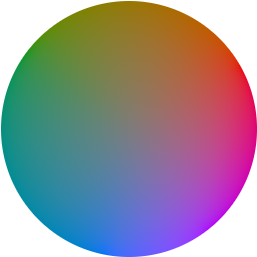
A circle of different muds and a little bit of hot pink.
Re: New alternatives to HSL and HSV that better match color perception
#58Earlier quoted context omitted.
Brown is weird [1]. It's basically dark orange. Flesh tones fall into that same category - people are orange-hued [2]. Oranges/reds are mostly produced by various unsaturated molecules, such as carotenes, lignins, phenols, and tars, and browns are just dark collections of many kinds red-orange pigments. It does not map well to any of the common color spaces because its inherently heterogeneous. The solution would pro…
I don’t understand that video. Can’t all colours be described differentially to another colour? And don’t we have lots of names for different shades? Why does this make brown unusual?
I think what makes brown unique in this regard is its ubiquity in nature, partial desaturation, and lack of obvious mapping to a saturated color.
Emergence of names of colors in languages usually goes black, white, red, yellow, grue, then blue forks from blue, brown, orange, then "specialty" colors like pink, purple, indigo, teal. It's the only partially saturated shade that gets a name before its saturated variant (orange). Being able to name things brown is more important than orange, so that mental link is weaker. Hence why we have "dark blue" but brown is not "dark orange." (though I think some languages call it "dark red"? I'm a bit hazy on that detail)
Re: New alternatives to HSL and HSV that better match color perception
#59Earlier quoted context omitted.
I don’t understand that video. Can’t all colours be described differentially to another colour? And don’t we have lots of names for different shades? Why does this make brown unusual?
I think what makes brown unique in this regard is its ubiquity in nature, partial desaturation, and lack of obvious mapping to a saturated color. Emergence of names of colors in languages usually goes black, white, red, yellow, grue, then blue forks from blue, brown, orange, then "specialty" colors like pink, purple, indigo, teal. It's the only partially saturated shade that gets a name before its saturated variant (…
> lack of obvious mapping to a saturated color
30 degrees hue, 50% value, 100% saturated, looks exactly brown to me?
> brown is not "dark orange."
I think it is. In fact, take my 30 degrees hue, 50% value, 100% saturated, then gradually increase the value and see where you get to!
Re: New alternatives to HSL and HSV that better match color perception
#60What I don't like in standard HSV color picker [1] is that the colors are distributed non-uniformly. For example, there is a wide area of same looking green color, but just a thin line of yellow and orange. I didn't understand if new models solve this issue. [1] https://bottosson.github.io/img/colorpicker/hsv-picker.png
You can try it out in the interactive color picker comparison page linked from the article. https://bottosson.github.io/misc/colorpicker/
Thank you for the link, very interesting. Now I see there's another problem: the colors on the hue bar (especially with OKLrCH model) look too blurred and mixed with each other. And there's almost no green, but mostly reddish and blueish tones.