Live data from Hacker News

The effects of remote work on collaboration among information workers

nature.com

91–100 of 216 posts

Re: The effects of remote work on collaboration among information workers

#91
post #68

Earlier quoted context omitted.

"We used to pay for entire buildings to house our employees, but covid made us realize we can pass that cost on to them!"

It kind of depends on the details. My company has offices that you can go to, but if you want to work remotely then it’s up to you to manage your environment. The company already has offices. Why would they pay for more just because you don’t want to go to the offices. There is a one time budget for hardware, such as a second monitor at home, we’ll have to see how that plays out with upgrades in a few years.

The cost of outfitting an employee with state-of-the-art equipment for their home office is at most a few months of commuter benefits. It's a comically small price to pay for employee happiness and productivity.

Employers that don't or aren't willing to pony up are going to be losers in the long run. Cheap is cheap.
Re: The effects of remote work on collaboration among information workers

#92

The key thing is here: > over the first six months of 2020 Those first six months were pretty rough. The large majority of people had little to no experience working remotely, so many folks didn't have a good home office environment, and there was a general sense of being unsure if this would just be temporary or if employees should settle in for the long haul. Many orgs didn't have good practices set up for remote w…

> The key thing is here: > > over the first six months of 2020 This also implies that most of the employees already knew each other and worked together before being forced into remote work. One of the biggest problems with switching to remote work is that people carry over the in-person relationships they were already comfortable with. It's the new hires who suffer most, in my experience. When everyone else has month…

So true. I’ve personally experienced this with starting a new job in January 2020 and subsequently working on 3 teams.

Team 1: 3 engineers of various tenure already on the team. Built good relationship with 2 before pandemic put us in WFH about 6 weeks in. I still talk to both of these engineers on a regular basis, even though we no longer work together.

Team 2: Changed about 8 months in due to a reorg. Working with a different set of people who had all worked in this area together pre-reorg. Very hard to “break in” and ramp up. Things were not going well. Manager, another engineer, and my manager all moved teams.

Team 3: 6 months later. Brand new team with engineers all coming from different parts of the company plus an external new hire. Working well together but we’ve all been remote working together the entire time.

Team 2 was _rough_, and its situation is what most new joiners will face.

Re: The effects of remote work on collaboration among information workers

#93

Earlier quoted context omitted.

I think the hardest thing remote work has to replicate is just random small talk between smart people that can lead to great ideas. This speech from Richard Hamming about Bell Labs sticks in my mind, especially the segment about open vs closed office doors. I'd say remote work is objectively better for pure productivity in terms of getting things done, but you run the risk of limiting innovation I think https://www.c…

> But 10 years later somehow you don't know quite know what problems are worth working on It seems normal mow to move job every 3 years so that’s not a concern

That’s a very Silicon Valley tech influenced meme.

Re: The effects of remote work on collaboration among information workers

#94

The key thing is here: > over the first six months of 2020 Those first six months were pretty rough. The large majority of people had little to no experience working remotely, so many folks didn't have a good home office environment, and there was a general sense of being unsure if this would just be temporary or if employees should settle in for the long haul. Many orgs didn't have good practices set up for remote w…

I think the hardest thing remote work has to replicate is just random small talk between smart people that can lead to great ideas. This speech from Richard Hamming about Bell Labs sticks in my mind, especially the segment about open vs closed office doors. I'd say remote work is objectively better for pure productivity in terms of getting things done, but you run the risk of limiting innovation I think https://www.c…

>random small talk between smart people that can lead to great ideas.

Outside of maybe a very innovative R&D department I don't really see these "brilliant ideas that only smalltalk could achieve" in your typical run of the mill company.

Re: The effects of remote work on collaboration among information workers

#95
post #93

Earlier quoted context omitted.

> But 10 years later somehow you don't know quite know what problems are worth working on It seems normal mow to move job every 3 years so that’s not a concern

That’s a very Silicon Valley tech influenced meme.

Not really. I see that pattern across the entire software landscape, from big companies down to startups. It's true that there are occasionally people who stay put for 17 years at Microsoft, but those seem to be the exception rather than the norm.

Re: The effects of remote work on collaboration among information workers

#96
post #94

Earlier quoted context omitted.

I think the hardest thing remote work has to replicate is just random small talk between smart people that can lead to great ideas. This speech from Richard Hamming about Bell Labs sticks in my mind, especially the segment about open vs closed office doors. I'd say remote work is objectively better for pure productivity in terms of getting things done, but you run the risk of limiting innovation I think https://www.c…

>random small talk between smart people that can lead to great ideas. Outside of maybe a very innovative R&D department I don't really see these "brilliant ideas that only smalltalk could achieve" in your typical run of the mill company.

doesn't have to be ground breaking research, could just be ideas for product iteration or for an employees own side project. Benefits individuals more than the company really

Re: The effects of remote work on collaboration among information workers

#97

The key thing is here: > over the first six months of 2020 Those first six months were pretty rough. The large majority of people had little to no experience working remotely, so many folks didn't have a good home office environment, and there was a general sense of being unsure if this would just be temporary or if employees should settle in for the long haul. Many orgs didn't have good practices set up for remote w…

> The key thing is here: > > over the first six months of 2020 This also implies that most of the employees already knew each other and worked together before being forced into remote work. One of the biggest problems with switching to remote work is that people carry over the in-person relationships they were already comfortable with. It's the new hires who suffer most, in my experience. When everyone else has month…

What I’ve found is that I will work with people I didn’t previously know if there’s some forcing function but the people I randomly reach out to for working on things re mostly people I knew previously. Reaching g out to strangers for help/collaboration with something mostly isn’t very effective in my experience.

Re: The effects of remote work on collaboration among information workers

#98
Two issues jump out at me:

1 ) It’s unclear to me why Microsoft, a leading software firm with distributed offices, should be considered representative of “information workers”.

Contrary to this study of a digitally inter-connected firm, finding their preferred connection patterns and rhythms took a hit before adapting (see #2 below), most enterprises had no established digital connection patterns or rhythms and despite the challenges of going online, had been so bad before they saw a boost.

Many “big enterprise” firms’ collaboration and productivity shot way up from April through September, as necessity drove adoption of any collab at all.

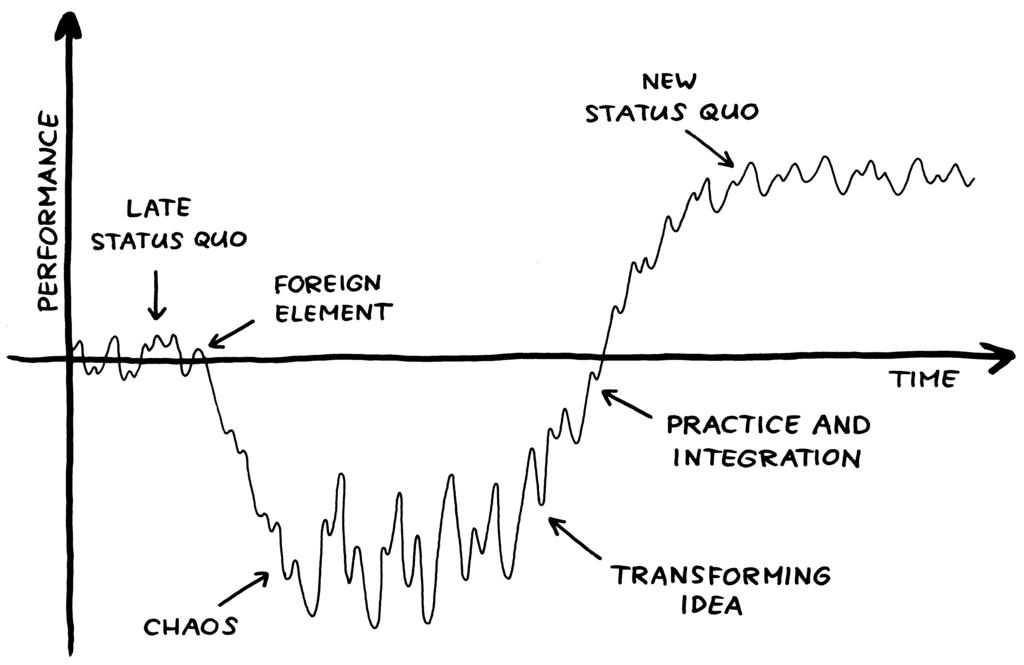
2 ) Aside from this, “the first six months” is not how adapting to change works. MBA types like it call it “Storming, Norming, Performing”, but I prefer this:

- Virginia Satir Change Curve image: https://www.plays-in-business.com/wp-content/uploads/2018/11...

- Virginia Satir Change Curve discussion: https://dhemery.com/articles/managing_yourself_through_chang...

Bottom line: I’d argue they studied a top decile performing firm far ahead of typical US enterprises, and found that Satir was right, a foreign element can induce a performance hit.

Re: The effects of remote work on collaboration among information workers

#99
One thing about slack- and zoom-based remote working I've noticed is that there's less room to be your "informal self".

Meetings require more coordination since only one person can speak at a time and there are fewer non-verbal cues to communicate which topics are resonating with you. You also can't continue smaller conversations with people after a meeting. Everything is more formalized.

Likewise, conversations outside of meetings go on in Slack, generally. You could set up a zoom meeting with someone informally, but it feels too "heavy" an operation compared to a in-person hallway chat.

In person, I feel like people are more likely to be critical of their work, workplace, bosses, and coworkers. Now I don't think people should go overboard and whine all the time, but I think it's valuable to get stuff off your chest once in a while, and doing that in person, to me, feels natural, and it's not "recorded" anywhere (Slack messages aren't deleted and a lot of our meetings are recorded for others to view later).

Anyway, what I'm getting at is the channels for communication are more "formalized" and it has a sort of chilling effect on our expressiveness in conversations about our work's office culture.

Post reply on HN