Live data from Hacker News

The operating system: should there be one? (2013) [pdf]

citeseerx.ist.psu.edu

111–120 of 208 posts

Re: The operating system: should there be one? (2013) [pdf]

#111
post #67

Related question: do we need device drivers?

In the (post)modern world, every device should have its driver built-in (along with a CPU to run it on). The communication protocol (the command language) should be standardized for each given class of devices. The protocol should support the ability to upload custom “shaders,” whenever this makes sense, to tweak or extend the default behavior.

Re: The operating system: should there be one? (2013) [pdf]

#112
post #12

(Only read the abstract). I’m learning Emacs and it’s making me think that we missed on the correct abstraction level of the operating system. There are programs that are OS-like (Emacs, browsers, Electron, anything that takes plug-ins). Maybe operating systems could have been lower level, and we could have developed more/better options on the pseudoOS level on top. This seems somewhat inline with the Smalltalk visio…

Well, have a look at http://www.softwarepreservation.org/projects/LISP/interlisp_... Then follow up with "The Interlisp Programming Environment" https://www.computer.org/csdl/magazine/co/1981/04/01667317/1... "Graphical Programming in Interlisp-D" https://www.youtube.com/watch?v=wlN0hHLZL8c "Eric Bier Demonstrates Cedar" https://www.youtube.com/watch?v=z_dt7NG38V4 Cedar was the very first graphical workstation for so…

While that seems to be like almost lost history, and a forgotten art, it is not!

Because

[1] https://interlisp.org/

&

[2] https://github.com/interlisp

Re: The operating system: should there be one? (2013) [pdf]

#113

If you have one job to do, and it doesn't involve other computers, you don't need an OS. MS-DOS or equivalent program loader/file system API will work just fine. Windows, MacOS, and Linux work fine in a stand alone environment (unless an APT {advanced persistent threat, like the NSA} is after you) On the other hand, if you're even thinking about touching the internet, or any other computer, you need to have every sin…

Isn't what you just described Fuschia?

>Isn't what you just described Fuschia?

It would be, if I could get it to run my PC. Same with Genode. Of course at this point nobody expects HURD to come back to life.

Re: The operating system: should there be one? (2013) [pdf]

#114
post #88
post #79

Earlier quoted context omitted.

But humans generally like to organise things hierarchically and I would think database are not well suited for this purpose. That is, unless there exists some kind of tree structured database that I don't know about ... Many years ago Microsoft tried to implement some kind of database oriented file system (it was a big dream of Bill Gates IIRC and probably meant for Longhorn), but this project never became part of an…

> It'd be interesting to know why Microsoft abandoned this initiative. There were technical issues. They simply never managed to get the system performant enough to be use as a FS replacement. There also were tons of issues with the concept itself, like proper tooling for visualising the stored objects to the user and a compatibility layer for legacy software. It seems as if parts of it was merged into MS SQL server…

Yeah, it was based on Jet, so if I had to guess they're probably just talking about including some perf improvements in the core database engine that they made profiling the WinFS use case.

Re: The operating system: should there be one? (2013) [pdf]

#115
post #9

I can't help but think about what happened with graphics APIs - the older ones (DX9, OpenGL) held your hand more, and the new ones are super bare metal and not written for the faint of heart. I think most would agree this is better though; for an application developer you can simply use a much higher level library built on top, and for the library/engine developer you have a lot more power and control. The old APIs w…

You might find the Exokernel approach interesting.

https://en.wikipedia.org/wiki/Exokernel

Re: The operating system: should there be one? (2013) [pdf]

#116
I've been playing with Unikernels for Go server deployment - so far so good. I'm not sure if this counts as "no OS" - as I understand it (and I'm not sure I do) the Unikernel core provides the calls that the Go runtime is expecting.

But the central idea that the server system can only run one program makes a lot of sense to me. Obviously it won't work for a desktop, but then the whole idea that desktops and servers run the same OS doesn't make much sense to me.

Re: The operating system: should there be one? (2013) [pdf]

#117

Earlier quoted context omitted.

This affects all GUIs, if you have a lot of elements then you have to be careful not to propagate complex updates through the whole tree because it kills your performance. There are various tools to deal with this, one of them is making it retained mode, but I would say basically all of those tools come with more footguns in that the GUI can easily end up in an inconsistent state. That's what you trade for performanc…

I've heard that argument before, yet for almost all apps I've used in real life the opposite is true. Game UIs are (from what I understand) written almost exclusively ImGui-style, with every single widget being fed updated state data every single frame as part of the game loop. Yet, for whatever reason, even crazy-complex UIs like SupCom's seem to have no issue rendering in realtime with an entire 3D game running in…

I play games very infrequently, but my anecdata is the opposite: games usually have laggy UI with an inconsistent reaction to input events, noticeable latency, frequent breakage and generally worse user experience (and of course mostly without the ability to resize anything, to compare with browser), even when compared to browsers and Electron apps.

Re: The operating system: should there be one? (2013) [pdf]

#118
post #9

I can't help but think about what happened with graphics APIs - the older ones (DX9, OpenGL) held your hand more, and the new ones are super bare metal and not written for the faint of heart. I think most would agree this is better though; for an application developer you can simply use a much higher level library built on top, and for the library/engine developer you have a lot more power and control. The old APIs w…

>I think modern OS stacks are in a similar boat, at least Windows and macOS. I come from a background as a EEE mainly writing embedded code before somehow stumbling into frontend code (in win32, Cocoa and Qt) at my old job. From my experience, OS-Level APIs definitely have more in common with Electron or Qt than they do "bare metal". To make the top left pixel red on a bare metal system or RTOS, you simply write `fra…

> To make the top left pixel red on a bare metal system or RTOS, you simply write `framebuffer[0] = 0x00ff0000`.

Really? In my brief experience it was more like sending a bunch of commands over SPI/I2C/UART to some LCD module. Which isn't thaaaat different from how an OS driver communicates with a GPU, only the commands are far, far more complex, so using an OS-level API avoids having to do it by hand.

Re: The operating system: should there be one? (2013) [pdf]

#119

I've been playing with Unikernels for Go server deployment - so far so good. I'm not sure if this counts as "no OS" - as I understand it (and I'm not sure I do) the Unikernel core provides the calls that the Go runtime is expecting. But the central idea that the server system can only run one program makes a lot of sense to me. Obviously it won't work for a desktop, but then the whole idea that desktops and servers r…

I've been expecting the unikernel approach to catch on more too - although not the "no OS" it can be pretty stripped down compared to a regular OS. Now that unikernels are starting to gain more traction in the DOD I expect this will continue.

Re: The operating system: should there be one? (2013) [pdf]

#120
post #91
post #67

Related question: do we need device drivers?

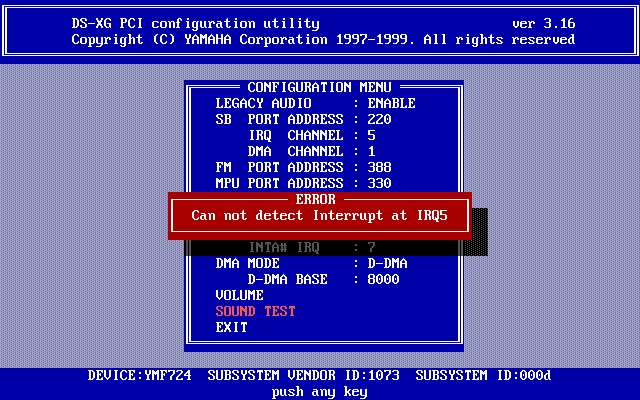
That's a definite yes. I do NOT want to go back to the times when we had to write and ship individual drivers for each graphics card, sound card and peripheral we wanted to support in our software. Could you imagine having to select the physical port, IRQ and DMA channel of your sound device for each app that wants to output sound? Because that's what had to be done in DOS and screens like this https://flaterco.com/k…

> I do NOT want to go back to the times when we had to write and ship individual drivers for each graphics card, sound card and peripheral we wanted to support in our software.

This 1000x - I remember this time and it was quite painful

>Could you imagine having to select the physical port, IRQ and DMA channel of your sound device for each app that wants to output sound? Because that's what had to be done in DOS and screens like this https://flaterco.com/kb/audio/PCI/DS-XG_IRQ_error.png were commonplace. Good enough if you had well-defined devices like SoundBlaster(Pro) or GUS that you could auto-detect without crashing the PC, but a living nightmare with clones that didn't quite behave the same way.

I also remember the application working one second, unrelated hardware change (1), and back to the drawing board all over again
Post reply on HN