Live data from Hacker News

Life Improvements Since the 1990s

gwern.net

11–20 of 480 posts

Re: Life Improvements Since the 1990s

#11
post #5

With the exception of a few (very important) services (e.g. college tuition, healthcare, childcare), increases in income have actually outpaced inflation for most other goods and services over the last 20 years [0]. This is something I almost never see discussed; almost everyone seems to believe that real incomes have totally stagnated. That said, given current inflationary trends, it will be interesting to see if th…

Average hourly wages have, but what about the median?

Average vs. median have grown fairly proportionally since 2000 [0]. Note, this chart is adjusted for inflation.

[0] https://s3-us-west-2.amazonaws.com/gs-live/uploads%2F1527022...

Re: Life Improvements Since the 1990s

#13

With the exception of a few (very important) services (e.g. college tuition, healthcare, childcare), increases in income have actually outpaced inflation for most other goods and services over the last 20 years [0]. This is something I almost never see discussed; almost everyone seems to believe that real incomes have totally stagnated. That said, given current inflationary trends, it will be interesting to see if th…

Well you can’t remove things and then say “See, inflation is fine!” If you want uneducated children with no healthcare and no affordable place to live I guess things are fine, and that’s pretty much what we see now.

The point of Gwern’s article is to highlight specific things that have improved since the 90s. I’m pointing out that this is supported by looking at inflation stratified by various goods and services. Nowhere in my post did I say that “inflation is fine”; I’m just saying many goods and services have gotten dramatically cheaper since the 90s, which is still counter to the prevailing narrative.

Re: Life Improvements Since the 1990s

#14
I often ask people: “if you could be 20-years old in 1991 or 2021, which would you pick?”

An incredible number of people pick ‘91. Some people even ask to go back to the seventies.

This article explains why I would much rather be young now rather than before.

Re: Life Improvements Since the 1990s

#15

This note at the bottom, about high mortality rates in the past, is always striking to remember: "My grandmother casually horrified us a few years ago by going through the list of her dead siblings: 2 died on the farm of ‘summer diarrhea’ (bovine tuberculosis from unpasteurized milk) as infants, an unremarkable fate in the area, and then 3 died in their teens–20s after moving to the city to work in textile factories.…

Indeed. What I found interesting is that when I looked up the stats, the death rates for under 1 year olds has continued to decline even in recent decades. I had previously thought it would have stalled after the things you mentioned had been solved. My guess is premature births have much higher survival now than 20 or 40 years ago.

Re: Life Improvements Since the 1990s

#17
>Imagine dealing with the 2019–20 coronavirus pandemic in 1989 instead.

I've wondered about this. No vaccines presumably. But, also, the sort of work from home, online shopping, remote school, etc. that many people/companies were able to more or less adapt to basically wouldn't have been possible in 1990--and, arguably, much before 2000 if that.

It's true that there was less air travel, including international travel, in 1990 than in 2019 but I'd need to be convinced this would be an important factor.

Comparisons to 1918 are hard, if only because of WWI and associated secrecy, but from what I can tell having read a bit, it doesn't appear as if there were widespread or long-lived closures of schools and other places. I assume, we would have acted likewise in 1990; i.e. we wouldn't have done a lot because there wasn't a lot we could do.

ADDED: This was not intended as a political comment. Merely speculation about how the world may have reacted differently in a world effectively without internet or (likely) a rapidly-developed vaccine.

Re: Life Improvements Since the 1990s

#18
post #5

Earlier quoted context omitted.

Average hourly wages have, but what about the median?

Average vs. median have grown fairly proportionally since 2000 [0]. Note, this chart is adjusted for inflation. [0] https://s3-us-west-2.amazonaws.com/gs-live/uploads%2F1527022...
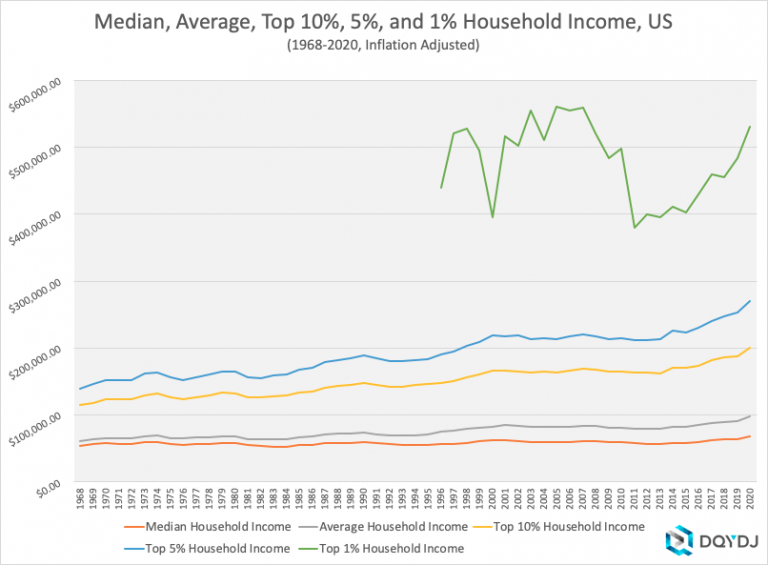
This is a better graph including the past 5 years:

https://cdn.dqydj.com/wp-content/uploads/2020/09/inflation-m...

Source:

https://dqydj.com/individual-income-by-year/

Re: Life Improvements Since the 1990s

#19
Time between 1990 to now is not linear.

The web kicked off in the late 90's, picked up the 2000's but not real fast, and now is really flying and one assumes it will continue to accelerate.

Power tools are amazing. And that's the internet pushing them. I can see reviews with each new advancement anywhere in the world. They can see R&D around the world. Each company has to keep up and so do the counterfeiters. I'll order from overseas if they are not available local. Power tools augment humans, you can see people's home improvements getting more complex which is also pushed by the internet. Everything is in hyper mode.

Re: Life Improvements Since the 1990s

#20
I think he kind of missed the elephant that is modern communication technology has reduced the marginal cost of skilled services enabling pretty much every object designed in an office and manufactured in a factory to benefit from a broader array of engineering and design professionals and methodologies. The average product and service that the average actor in the economy interacts with is designed and optimized to a far greater degree today than they were historically.

Look at the bottle of Elmers glue on the table. Today the glue probably works better (barring regulation that forces compromises to product efficacy) and comes in a bottle that uses half as much plastic. Something like a bottle revision that would have formerly required expensive salaried employees to come up with multiple options, send them to the supplier, supplier has to respond to each with details and quotes, etc, can now be accomplished in a fraction of the man hours thanks to email and CAD being ubiquitous in the entire supply chain from marketing, to engineering, to the vendor's contractor who will actually design the tooling. Sign off might take days instead of weeks. This sort of efficiency improvement allows more engineering, design work, or other optimization to be done to every good and service in our economy allowing it to penetrate into even the most thin margin use cases. From farming to high finance products and services are substantially more influenced and optimized by specialist professionals than they were in 1990. Increase efficiency like this throughout the national and global economy is how lawnmowers and A/C units can be sold on sale for $100 and still make a profit. (yes I know that example isn't perfect but you get the point).

Post reply on HN