Live data from Hacker News

The emergence of heat and humidity too severe for human tolerance (2020)

advances.sciencemag.org

301–310 of 414 posts

Re: The emergence of heat and humidity too severe for human tolerance (2020)

#301

Kim Stanley Robinson's recent book The Ministry For the Future starts with a very disturbing scenario: A heatwave with a "web bulb" temperature of 35 Celsius. It turns out, in those temperatures, even young and healthy people can't survive. Combined with power outages, as happens in the book, everyone living under such a heat wave will likely die. It's looking increasingly likely that such heatwaves are possible in t…

> Combined with power outages, as happens in the book, everyone living under such a heat wave will likely die. That's an exaggeration. Extreme heat (including heat waves that exceed this threshold) happen semi-regularly, and the death rate when they occur is nowhere near 100%. More like 0.1% or less. Electrically-powered air conditioning is not the only way to cool a human body. Simply escaping to an underground or s…

The smart thing to do now would be for everyone around to world to start digging underground relief shelters.

Re: The emergence of heat and humidity too severe for human tolerance (2020)

#302

Can we start considering high tech solutions to actively cool the planet? We're going to slowly work on carbon, but it won't be fast enough. In the meantime, We need to prevent heat getting to Earth, either via more cloud cover or space mirrors in the LaGrange point. I'm not a fan of either, but what's the alternative? Bake to death while the powerful decision makers delay changing anything?

Unfortunately most solutions are in the realm of science fiction, solar shades and the like.

Re: The emergence of heat and humidity too severe for human tolerance (2020)

#303

Earlier quoted context omitted.

> Combined with power outages, as happens in the book, everyone living under such a heat wave will likely die. That's an exaggeration. Extreme heat (including heat waves that exceed this threshold) happen semi-regularly, and the death rate when they occur is nowhere near 100%. More like 0.1% or less. Electrically-powered air conditioning is not the only way to cool a human body. Simply escaping to an underground or s…

> Extreme heat (including heat waves that exceed this threshold) happen semi-regularly The threshold is wet bulb 35 for 7 hours. That is when fit young humans can't survive. Older people die well before that of course. And no, it doesn't happen regularly. I wasn't aware it had happened at all, although others here say it has. But it has come close. From https://www.telegraph.co.uk/global-health/climate-and-people...…

> Jacobabad crossed the 35C wet bulb threshold in July 1987, then again in June 2005, June 2010 and July 2012. Each time the boundary may have been breached for only a few hours, but a three-day average maximum temperature has been recorded hovering around 34C in June 2010, June 2001 and July 2012.

Jeez what a hot place... Any idea what geographic features make it so dang hot? It's not too far from water (just looking at a map).

Re: The emergence of heat and humidity too severe for human tolerance (2020)

#304
This post appears to be fully within the Hacker News "approach to comments" and "site guidelines".

The atmospheric temperature discussed as dangerous has been common in many parts of the earth for many years and is not nearly new. The real threat discussed is from heavy consideration of

"business-as-usual RCP8.5 emissions scenario"

and that is based on climate models evaluating the future, 2050+, effects of human sources of CO2 on temperature and climate.

We have a long history of such models. Apparently they are usually based on the fact that CO2 is a greenhouse gas.

The main question about CO2 is how much warming will be caused by a given quantity of CO2 from human activities.

Yes, CO2 is a greenhouse gas, but maybe surprisingly so far from either observations or models, we have no credible evidence that human sources of CO2 have caused, are causing, or will cause significant warming.

Okay, let's look at the observational data:

There was a movie, An Inconvenient Truth. With data from Antarctic ice cores, the movie showed, for the atmosphere, a graph of temperature and CO2 concentrations going back about 800,000 years.

As I watched the movie, it appeared that the claim was that the graph showed temperature and CO2 concentrations going up and down together. Then the movie concluded that the higher concentrations of CO2 caused the higher temperatures. Then there was a claim that currently more CO2 from human activities would rapidly cause significantly higher temperatures.

But, we could look at that graph more closely, and doing that we will see three situations:

(1) When temperature started to increase, CO2 (concentration, here and below) was low, not high. So, something caused the warming, but it was not high CO2.

(2) About 800 years later, CO2 had increased. Presumably the cause was more biological activity from the higher temperatures.

(3) Some thousands of years later, while CO2 was high, the temperatures fell again. There was a cause, but it was not low CO2. Indeed, the high CO2 did not keep temperatures from falling.

Net, from that 800,000 years of data, there is no evidence that high CO2 caused high temperatures. It would be more accurate (though of course still wrong) to say that the data supported that CO2 caused LOWER temperatures.

For some more recent data, there was some significant warming during the time of the Roman Empire and during the Medieval Warm Period, and there is no evidence that the cause was high CO2. There was some significant cooling during the Little Ice Age from roughly 1300 to 1900, but there is no evidence that the cause was low CO2. There was some cooling from 1940 to 1970 and concerns in the media about another ice age, and those years were when there was more CO2 from human activity from WWII and the post-war economic boom. So, in those years, with more CO2, we got some cooling instead of warming.

Again it would be more accurate (though of course still wrong) to say that the data supported that CO2 caused COOLING.

For some details, can start with "Global Cooling" at

https://en.wikipedia.org/wiki/Global_cooling#1974_Time_magaz...

which discusses the two famous magazine stories, the 1974 Time story and the 1975 Newsweek story, worrying about "global cooling" and asking if we were entering a new ice age. For more on these magazine stories, at

https://longreads.com/2017/04/13/in-1975-newsweek-predicted-...

can see the April 28, 1975, Newsweek article “The Cooling World”.

So, net, there is no data on temperature and CO2 from the past that says that CO2 will cause warming.

Yes, CO2 is a greenhouse gas. This means that it absorbs some light in the infrared but not the visible. In the case of CO2, it absorbs light out in the infrared in three narrow bands. The absorption spectrum is given at

https://webbook.nist.gov/cgi/cbook.cgi?Spec=C124389&Index=0&...

Part of the mechanism is Planck black body radiation.

We have had some warming since the Little Ice Age. It may be that we are still pulling out of the Little Ice Age, e.g., it can take a long time for the oceans to warm up. But even with this warming, it's cooler than in the Medieval Warm period and the Roman times when the polar bears didn't go extinct, the ice in Greenland and the Antarctic didn't melt, the oceans didn't rise and flood the coasts, and apparently humans didn't suffer. Apparently the main effects were greater agricultural productivity, e.g., in England, grapes were grown for wine.

Could the warming since the Little Ice Age be due to CO2? No: The warming is at the surface, and CO2 absorbs high in the troposphere with definition at Google:

the lowest region of the atmosphere, extending from the earth's surface to a height of about 3.7–6.2 miles (6–10 km), which is the lower boundary of the stratosphere.

which, from MIT climate scientist Richard Lindzen, Alfred P Sloan Professor of Atmospheric Sciences, Emeritus, at Massachusetts Institute of Technology, has gotten cooler, not warmer.

Several attempts were made to model the atmosphere and calculate and predict the effects of human sources of CO2 on temperature. Nearly all the efforts predicted temperature increases that were rapid and significant.

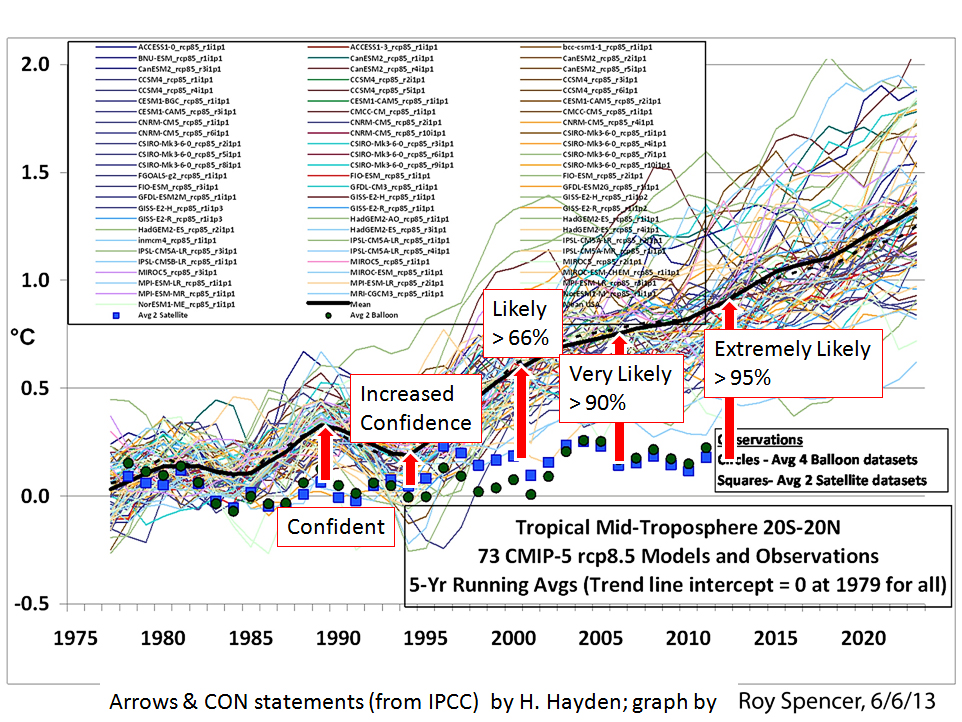
It has now been some years since the times of the predictions, and the predictions and reality are compared in the graph at

http://www.energyadvocate.com/gc1.jpg

Summary: Nearly all the predictions were way too high.

Science: So, so far climate modeling has no predictive value and, thus, is not good science.

Result: The predictions have no meaningful credibility.

Current Summary: There is no credible evidence from either the 800,000 years of the earth or the climate models that human sources of CO2 have had, are having, or will have significant effects on temperature or climate.

As a result of this lack of evidence, there is no scientific reason to attempt to lower human sources of CO2.
Re: The emergence of heat and humidity too severe for human tolerance (2020)

#305

Earlier quoted context omitted.

> Combined with power outages, as happens in the book, everyone living under such a heat wave will likely die. That's an exaggeration. Extreme heat (including heat waves that exceed this threshold) happen semi-regularly, and the death rate when they occur is nowhere near 100%. More like 0.1% or less. Electrically-powered air conditioning is not the only way to cool a human body. Simply escaping to an underground or s…

> Extreme heat (including heat waves that exceed this threshold) happen semi-regularly The threshold is wet bulb 35 for 7 hours. That is when fit young humans can't survive. Older people die well before that of course. And no, it doesn't happen regularly. I wasn't aware it had happened at all, although others here say it has. But it has come close. From https://www.telegraph.co.uk/global-health/climate-and-people...…

What city doesn't have running water?

Re: The emergence of heat and humidity too severe for human tolerance (2020)

#306

Can we start considering high tech solutions to actively cool the planet? We're going to slowly work on carbon, but it won't be fast enough. In the meantime, We need to prevent heat getting to Earth, either via more cloud cover or space mirrors in the LaGrange point. I'm not a fan of either, but what's the alternative? Bake to death while the powerful decision makers delay changing anything?

We can’t. Let’s say that you find a magic box that can offset 20% of the carbon emissions globally. Yay you just reduced carbon emissions. But there is no budget for carbon emissions. So those who produce it (agriculture, heavy industry) can now feel free to just produce more CO2 and toss it into the air. Besides, not every place is as industrialized as the US or China but they want to be. So the emissions will soon…

If (some) people already emit however much CO2 they want, why would offsetting emissions cause them to emit even more?

Re: The emergence of heat and humidity too severe for human tolerance (2020)

#307

Earlier quoted context omitted.

What about just nationalizing the entire energy industry and everything related, instead of trying to work within the parameters of a free market for something with so many externalities?

Interesting. It’s possible the government could run it well but I would worry without a profit motive they might not adjust to supply and demand quickly and might not pursue new technologies like fusion.

fission and fusion did not begin with private interest at heart. Not everything should be profit motivated, especially with public goods.[0]

[0] https://en.wikipedia.org/wiki/Public_good_(economics)

Re: The emergence of heat and humidity too severe for human tolerance (2020)

#308

The gloom and doom posts on HN seem to be increasing lately. I can go to CNN if I want this kind of content. That being said I would be ok with posts talking about fixing climate change especially if it preserves human rights and dignity.

How is that "gloom and doom"?

He doesn't want to sacrifice anything or changes that will affect him personally.

Re: The emergence of heat and humidity too severe for human tolerance (2020)

#309

Earlier quoted context omitted.

> Combined with power outages, as happens in the book, everyone living under such a heat wave will likely die. That's an exaggeration. Extreme heat (including heat waves that exceed this threshold) happen semi-regularly, and the death rate when they occur is nowhere near 100%. More like 0.1% or less. Electrically-powered air conditioning is not the only way to cool a human body. Simply escaping to an underground or s…

Wet bulb of 37C does not happen semi-regularly. Table S2 of the article shows a TW of 35+ has only happened 14 times in their ~30 year dataset so I would even hazard a guess that TW of 37 has not yet happened. These events are usually short (for TW >35, majority only last an hour, see Sup fig 2), which is perhaps why we are not seeing many deaths associated with them. With regards to immersing oneself in water, a bat…

Air is an insulator, 35 degree weather will cause extreme internal temparatures but 35 degree water allows you to transport all your excess energy to the water. 38 or 40 degree water would be deadly, but I wonder what the air temparature is when it gets that far.

Re: The emergence of heat and humidity too severe for human tolerance (2020)

#310

Earlier quoted context omitted.

I'm not sure you understand wet bulb and heat index. Heat index is largely irrelevant when talking about the precautions mentioned. The actual temperature is no where near 70C, and actual temperatures matter when talking about cooling that does not use ambient air (and evaporative cooling assuming 100% humidity in this case). A wet bulb of 35C means that there is a thermometer covered with a wet cloth reading that te…

Re-read the comment you're responding to.

I did... and?
Post reply on HN