Regulators should treat stablecoins like banks
economist.com
Regulators should treat stablecoins like banks
1–10 of 224 posts
Re: Regulators should treat stablecoins like banks
#2> With estimated leverage of 383-to-1, Tether would be unable to honour all its tokens after losses of just 0.26%—a safety cushion that regulators would never allow at a bank.
So even if they are telling the truth, it is still on the edge.
Re: Regulators should treat stablecoins like banks
#3Intellectuals should stop advocating that people be treated like children. PayPal and other e-wallets are not required to have bank charters to issue dollar-backed digital currency, and neither should stablecoins.
In the wake of the 2008 financial crisis, a well-capitalized player, Walmart, which was expanding its banking activity via its Sam's Club lending, was well positioned to replace the incumbent Wall Street firms as a major lender, but that was forestalled by Congress withholding a bank charter for political reasons:
https://www.nytimes.com/2007/03/17/business/17bank.html
Gatekeeping a market activity is extremely dangerous because it allows for massive rent seeking through corruption of the gatekeeper. It's inherently concentrates power in the hands of an elite.
e.g. this is a bit dated, but gets the point across about the revolving door between regulatory agencies and major market players:
https://philebersole.files.wordpress.com/2013/10/venn-diagra...
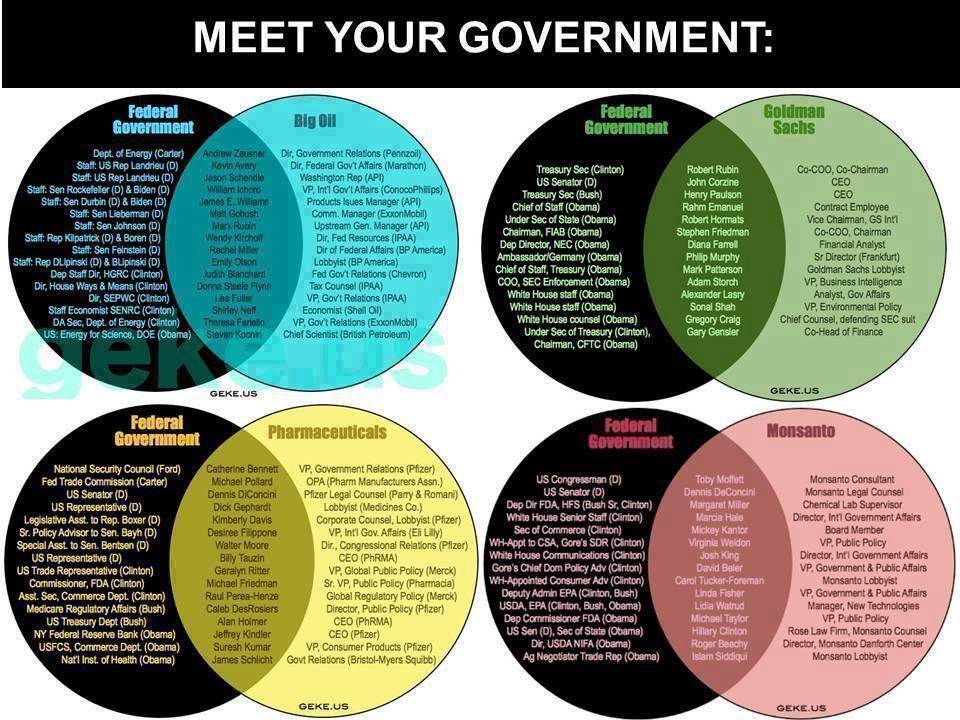
Even a non-corrupt gatekeeper can do enormous damage by poorly regimenting the industry. Something that has a systemic impact on a market is a systemic risk to the market. And government intervention is the only phenomena that no market player can opt out of, so it is the only one with a truly systemic impact on the market. Reducing government intervention reduces systemic risk.
Right now there is a free market in stablecoins. If you trust the attestations of USDT [1], you can use USDT. If you trust those of USDC [2] more, you can use that instead.
People should decide for themselves. And the systemic risk argument for limiting people's choices is absurd. The risk posed by any financial asset is not distributed uniformly across the economy. Its impact on any party is proportional to their direct and indirect exposure to that asset, which is something that they control and have to take responsibility for. In the absence of the government bodies that socialize the losses of irresponsible actors, those actors who take on imprudent risks would see the share of the financial market that they control steadily shrink at the expense of those who do not.
The suspension of this market feedback mechanism is what increases the risk of financial crisis.
[1] https://tether.to/wp-content/uploads/2021/08/tether_assuranc...
Re: Regulators should treat stablecoins like banks
#4> With estimated leverage of 383-to-1, Tether would be unable to honour all its tokens after losses of just 0.26%—a safety cushion that regulators would never allow at a bank. So even if they are telling the truth, it is still on the edge.
So if 0.26% of tether is withdrawn into currency the coin would collapse? Am I reading that right?
Re: Regulators should treat stablecoins like banks
#5Intellectuals should stop advocating that people be treated like children. PayPal and other e-wallets are not required to have bank charters to issue dollar-backed digital currency, and neither should stablecoins. In the wake of the 2008 financial crisis, a well-capitalized player, Walmart, which was expanding its banking activity via its Sam's Club lending, was well positioned to replace the incumbent Wall Street fi…
> stop advocating that people be treated like children
Stablecoins are money market funds. Those initially came about due to regulatory limits on deposit-account interest rates and risk thresholds. They nearly took out the real economy in 2008. Stablecoins are recreating that structure, guaranteeing a peg against a portfolio of risky assets inextricably tied to the mainline financial system. (This is a summary of the article.)
Re: Regulators should treat stablecoins like banks
#6Intellectuals should stop advocating that people be treated like children. PayPal and other e-wallets are not required to have bank charters to issue dollar-backed digital currency, and neither should stablecoins. In the wake of the 2008 financial crisis, a well-capitalized player, Walmart, which was expanding its banking activity via its Sam's Club lending, was well positioned to replace the incumbent Wall Street fi…
Not sure if they require one, but Paypal has an EU banking license since 2007: https://www.faz.net/aktuell/wirtschaft/netzwirtschaft/intern...
Re: Regulators should treat stablecoins like banks
#7> With estimated leverage of 383-to-1, Tether would be unable to honour all its tokens after losses of just 0.26%—a safety cushion that regulators would never allow at a bank. So even if they are telling the truth, it is still on the edge.
So if 0.26% of tether is withdrawn into currency the coin would collapse? Am I reading that right?
> if 0.26% of tether is withdrawn into currency the coin would collapse
If 0.26% of Tether is withdrawn, it would need to start liquidating assets. That will, most of the time, be fine. Commercial paper is exceedingly liquid.
But sometimes, the liquidation will prompt a price fall. This is a fire sale. That, in turn, prompts more redemption, as holders of Tether grow concerned about its stability. This is a bank run. If Tether has a safety buffer between the value of its assets (U.S. dollar money market securities) and its liabilities (Tethers), this will--most of the time--be fine. If the situation spirals, however, a bank run can lead to collapse.
Re: Regulators should treat stablecoins like banks
#8> With estimated leverage of 383-to-1, Tether would be unable to honour all its tokens after losses of just 0.26%—a safety cushion that regulators would never allow at a bank. So even if they are telling the truth, it is still on the edge.
So if 0.26% of tether is withdrawn into currency the coin would collapse? Am I reading that right?
Prob not but itd shake everything up. They'd have to get a lot of loans, and maybe sell out the company. For comparison, banks allowed to go as high as 10:1 so 383:1 is insane.
Re: Regulators should treat stablecoins like banks
#9Intellectuals should stop advocating that people be treated like children. PayPal and other e-wallets are not required to have bank charters to issue dollar-backed digital currency, and neither should stablecoins. In the wake of the 2008 financial crisis, a well-capitalized player, Walmart, which was expanding its banking activity via its Sam's Club lending, was well positioned to replace the incumbent Wall Street fi…
> stop advocating that people be treated like children Stablecoins are money market funds. Those initially came about due to regulatory limits on deposit-account interest rates and risk thresholds. They nearly took out the real economy in 2008. Stablecoins are recreating that structure, guaranteeing a peg against a portfolio of risky assets inextricably tied to the mainline financial system. (This is a summary of the…
The interest bearing accounts on the stablecoins are the (edit: things analogous to) MMFs, not the stablecoins themselves — at least for backed ones like GUSD and USDC.
Edit: not sure why a basic point is downvoted, I updated to clarify.
Re: Regulators should treat stablecoins like banks
#10Hm wasn't regulation the problem that cryptocurrency was originally intended to solve? How does this regulation work for p2p transactions. The economist got one thing right, they are indeed a threat to existing systems of money, manipulation, and control.