The artist probably wanted to highlight the fact that there are an even number of them, in contrast to Adam's odd number, since the story is that one of his was taken (to make Eve).
Does this medieval fresco show a hallucinogenic mushroom in the Garden of Eden?
11–20 of 110 posts
Re: Does this medieval fresco show a hallucinogenic mushroom in the Garden of Eden?
#12I guess I've never given much credence to this theory. Why would they beat around the bush and use symbols and other words for it. Why wouldn't they just say "eat this mushroom"? Was there even a stigma against it back then?
Re: Does this medieval fresco show a hallucinogenic mushroom in the Garden of Eden?
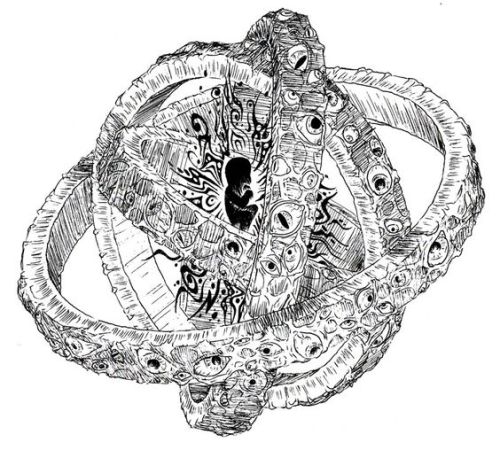
#13I’ve long been thinking about how things like this are in the Bible: > They sparkled like topaz, and all four looked alike. Each appeared to be made like a wheel intersecting a wheel ... Their rims were high and awesome, and all four rims were full of eyes all around. — Ezekiel 1:15 And I’ve been thinking, that these kinds of things could have their explanation in people having ingested plants or been stung by insect…
Re: Does this medieval fresco show a hallucinogenic mushroom in the Garden of Eden?
#14[1] - Starting at around 9'50" in "Psychedelics - In Spirituality and Religion (by Aware Project)" https://www.youtube.com/watch?v=WEkF2ER0Zwc
Re: Does this medieval fresco show a hallucinogenic mushroom in the Garden of Eden?
#15The serpent wrapped around the tree indicates that this is to represent the Tree of Knowledge of Good and Evil , not the Tree of Life . So, even if this were depicting hallucinogenic mushrooms, if anything it would mean that Christians viewed them as forbidden.
Re: Does this medieval fresco show a hallucinogenic mushroom in the Garden of Eden?
#16The premise doesn’t even make sense, the tree of knowledge is a Bad Thing in the Genesis story. Even if it was a magic mushroom, how could you possibly come to the conclusion that it’s being depicted in a positive light?
Re: Does this medieval fresco show a hallucinogenic mushroom in the Garden of Eden?
#17There are several problems with this article. To start with, it mixes up the Tree of Life[1] and the Tree of Knowledge of Good and Evil[2]. Second, the Genesis story is Jewish, and predates Christianity by at least five if not ten centuries. And most importantly, early Christians were Jews first. Post-Pauline times, pagan or Gentiles in the Roman empire did join the growing movement that was soon to be called Christi…
There is no evidence of roman paganism being the origin of either holiday. Easter and Christmas were celebrated before the romanization of Christianity. The only thing that was added were pagan symbology to the existing feast days, which is typical, as the church is happy to incorporate pagan traditions. The issue here is that in America we see a myopic view of Christianity from Europe. We note that during Easter, many European pagan symbols are incorporated, and mistakenly apply that to all Easter celebrations.
In reality, Christianity is not a european religion. In other centers of christianity, like Ethiopia, the Middle East, and India, European pagan symbology for easter was not adopted until recently. For most of history, there would either have been local rituals incorporated, or none at all.
This does not contradict the fundamental idea of Easter or Christmas though, because the Church explicitly desires that local rituals be incorporated. Catholic missionaries are happy to include anything non-contradictory with the Christian religion into Catholic practice. For example, it is the official policy of the church, after much deliberation, and much back and forth, that Chinese Catholics who desire to do their ancestor veneration rites are allowed to do so, with certain changes made to ensure that the rites fit the Catholic understanding of prayers to ancestors. But for the most part, Catholic Chinese are allowed to partake in these confucian rituals, and can even do so in the context of Catholicism. There is no contradiction.
To support my claims, here is an article on a traditional Syro-Malabar (Indian) Catholic celebration of easter. The Syro-Malabar Church has existed for 2000 years since the times of Thomas. If easter was a European pagan incorporation, we'd expect to see lots of European pagan symbology, like Easter bunnies, eggs, etc. Except we don't. The traditional syro-malabarese feast is a celebration of passover, but with Indian food instead of the middle eastern stuff.
https://homegrown.co.in/article/802431/a-traditional-easter-...
That is not to say that European traditions haven't been incorporated (american cultural hegemony is an unstoppable force), but the rituals that are traditional are nothing close to them.
I can speak to this myself, as an Indian Catholic. I didn't know what the Easter bunny did (apparently he brings candy to little American boys and girls? -- I was clearly short-changed and am still somewhat bitter haha) until middle school. Although my family mentioned the Easter bunny in passing, it was not part of our celebrations at all. Although we dyed eggs with other people in our church because that's what they did, we didn't really do it at home. It was just a social thing.
Re: Does this medieval fresco show a hallucinogenic mushroom in the Garden of Eden?
#18There are several problems with this article. To start with, it mixes up the Tree of Life[1] and the Tree of Knowledge of Good and Evil[2]. Second, the Genesis story is Jewish, and predates Christianity by at least five if not ten centuries. And most importantly, early Christians were Jews first. Post-Pauline times, pagan or Gentiles in the Roman empire did join the growing movement that was soon to be called Christi…
But this whole thing is a pretty big stretch, you can’t tell if it’s a tree or a mushroom then maybe it’s just the artist wasn’t the greatest and trying to shoehorn psychedelics into it isn’t at all a worthwhile way to spend your time.
Re: Does this medieval fresco show a hallucinogenic mushroom in the Garden of Eden?
#19Traditional Catholic and Christian iconography was not meant to be accurate, but rather to symbolize meaning.
For example, in my church, the priest recently pointed out there is a dog in every single stained glass window depicting scenes of Jesus's life. In particular, the dog is a dalmation.
If we were to apply this same line of reasoning in the article to these windows, we'd be forced to make ridiculous conclusions that Catholics of 20th century Portland believed Dalmations were holy holy dogs alive at the time of Christ.
In reality, the dalmation is a symbol of St Dominic (it's a dominican church), whose mother had a dream she gave birth to a dalmation (St Dominic) with a torch in his mouth who lit the world on fire. The symbology is obvious, since Dominic, founder of the Order of Preachers, did indeed spread the gospel message throughout large portions of the world at the time. The dalmation symbolizes St Dominic's following of Jesus's example. At no point is any of the art intended to be realistic.
So if that's true of 20th century Catholic art, made by people alive at a time when art is expected to portray reality, then even more so should we not interpret this fresco as realistic, since it was made at a time when people couldn't even paint realistically (perspective was an enlightenment / renaissance invention IIRC).
Re: Does this medieval fresco show a hallucinogenic mushroom in the Garden of Eden?
#20There are several problems with this article. To start with, it mixes up the Tree of Life[1] and the Tree of Knowledge of Good and Evil[2]. Second, the Genesis story is Jewish, and predates Christianity by at least five if not ten centuries. And most importantly, early Christians were Jews first. Post-Pauline times, pagan or Gentiles in the Roman empire did join the growing movement that was soon to be called Christi…
But the fresco the article is about is from the 13th Century. Christians at that time or even earlier might have re-interpreted the Genesis story in light of psychedelic experiences.
However, on the subject of psychedelic use in early Judaism, there is an interesting article titled "Strange Fires Weird Smokes and Psychoactive Combustibles Entheogens and Incense in Ancient Traditions"[1]:
"The incense cults of Israel have been the subject of a wide variety of theological and academic treatments. Researchers have speculated on the use of entheogens of a variety of species in the Bible (Shanon 2008; Merkur 2000; Allegro 1 970) as well as linking a shared entheogenic heritage with Persia in such crucial texts as the Book of Ezra, which sheds much light on foreign influences on Jewish cultic practices (Dobroruka 2006). A number of scholars have discussed the psychoactive incense used in the temple with various theories as to ingredients (Ruck, Staples & Heinrich 200 I ) and cannabis has been suggested as the kaneh bosom (appearing throughout the Old Testament with the first mention in Exodus) that eludes -- along with the other ingredients of the holy incense -- positive or at least complete identification (Benet 1976). ...
...
The exact recipe of the Old Testament incenses (Levitical and foreign), if there ever was an official recipe that persisted with exact continuity, will likely never be known. Some of the ingredients may be deduced from other examples in the ancient world of incense cults and their psychoactive aromatics. A starting point would logically be Egypt, from which the Israelites made their Exodus, and their various temple incenses and magico-medical fumigants, which included benzoin, cannabis, Hyoscyamus, bitumen and arsenic sulphide (Shehata 2006). Psychopharmacologists link Egyptian plants found in the various Greek writings and Egyptian medical papyri with the soma/haoma of the ancient world and Peganum harmala, which is still used as a magical incense to this day. Linked with the nybt of the Papyrus Ebers (Flattery & Schwartz 1 989) Peg anum is also mentioned by Dioscorides as being used by ancient Syrians as besasa, or "Plant of Bes" and that it was burned in Egypt before the statue of Bes. The ancient kyphi has been speculated by some scholars to have contained cannabis as well as other psychoactive plants such as Acarus calamus and from sixteen to fifty other ingredients, many of which are unidentified."
[1] - https://sci-hub.tw/https://www.researchgate.net/publication/...