Live data from Hacker News

Observation-based early-warning signals for a collapse of the Gulf Stream

theguardian.com

201–210 of 441 posts

Re: Observation-based early-warning signals for a collapse of the Gulf Stream

#201
post #175

After seeing the global chaotic response to COVID I'm convinced that climate change will not receive a meaningful response until it is way too late. It apparently needs to hit the majority of the planet right in the gut (and then preferably the wealthy part) for people to get off their collective asses and do something about it. I'm just about ready to pack it in and hope the next generation is smarter than this one…

I love the optimism here, everyone always states this like the tipping point is sure to be in the future. TBH, it seems equally likely to me that the last year we could seriously avoid major climate change was in the early 1990s.

That's very well possible.

Re: Observation-based early-warning signals for a collapse of the Gulf Stream

#202
There is a lot of hand wringing, worrying, blaming about evil, short sighted, negligent, irresponsible humans doing serious damage to the environment and the planet and causing disastrous, dangerous, destructive world wide climate change, global warming, rising sea levels, etc.

There is no end of what we can worry about, e.g., Yellowstone erupting, another Krakatoa, having the atmosphere of the earth blown off by the blast from a supernova, etc.

But just now the claim that human sources of CO2 are having significant effects on the climate, temperature, sea level, etc. are the source of a lot of angst and anxiety.

So, we need to filter, separate possible disasters for which we have good evidence and can do something about from the endless number of disasters for which we have no credible evidence.

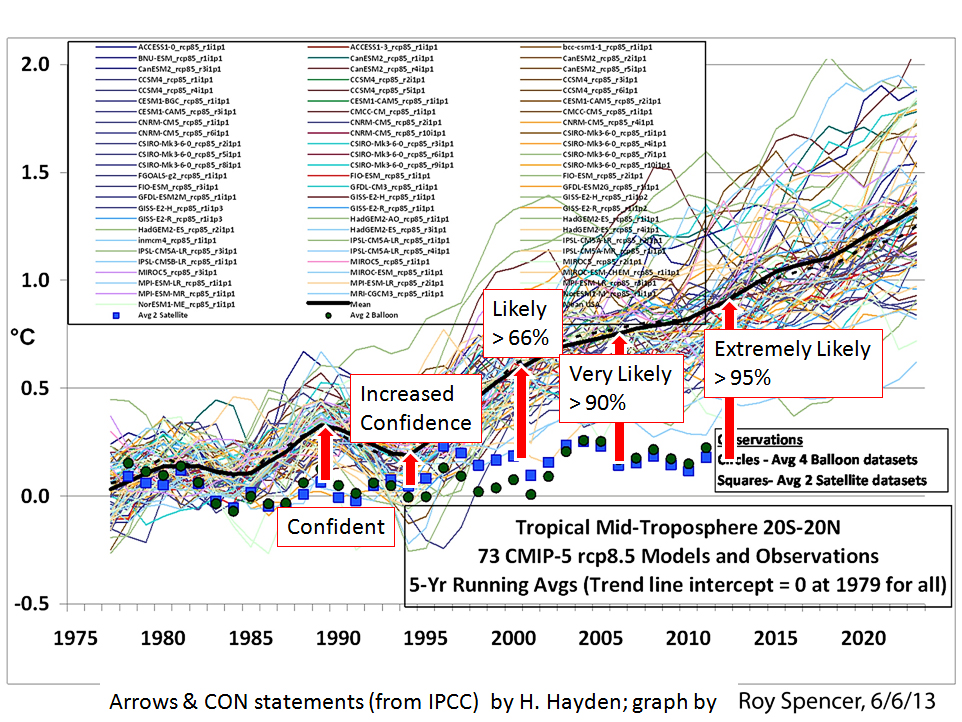
For human sources of CO2: So far there is no, none, nichts, nada, nil, zip, zilch, zero credible evidence that human sources of CO2 have had, are having, or will have a significant effect on the climate, temperature, sea level, etc. No evidence that is credible.

All the credibility was lost, blown, thrown away, destroyed by the many predictions of significant temperature increases that didn't happen, as in the well known

http://www.energyadvocate.com/gc1.jpg

As a result, the alarm, angst, anxiety, hand wringing about human sources of CO2 is irrational, foolish, irresponsible, and supporting an industry of hysteria that is just a flim-flam, fraud, scam on the backs and in the pockets of billions of people and making a few people rich.

While we know very well how to measure temperature and how to average it, we don't even have meaningful measures of climate.

For the science that might be relevant, essentially all of it fails to be science because it has long shown to have no predictive value.

In response, until there is credible evidence that human activities can do good things for the climate, we should just junk the alarmists and forget about human sources of CO2.
Re: Observation-based early-warning signals for a collapse of the Gulf Stream

#203

Earlier quoted context omitted.

It's not necessarily obvious. Planetary weather is a chaotic system and even for somewhat stable phenomenon like the gulf stream it's not a question of if it will collapse but when. Humans are likely speeding up the collapse but it will eventually happen regardless. If I had to choose between technological progress and stewardship, I'd pick technological progress because that's our only real chance at long-term survi…

The number of dimensions along which we are destroying the habitat we depend on is staggering. Deforestation (killing off one of the most efficient carbon sinks, causing soil erosion, changing the albedo, habitat destruction, change in water management), CO2 emissions, methane emissions, a ridiculously high per-capita energy budget in the western world where the only cap is how much money you are willing to spend, ki…

The number of dimensions we have improved life for humans in an environment which have always been hostile not only to humans but to the 99.9999% of all species ever existed it wiped out is quite a lot more staggering.

Nature didn't give us a safe and friendly environment we made unsafe, it gave us a hostile and dangerous environment we have made safe by using technology to impact the planet to better suit us.

All impacts have externalities but I take those any day over just waiting for some catastrophe to happen whether meteors, super vulcanos or any other real threat that is out there lurking.

Technology is the sole reason we are 8 billion people on this planet and still are most better fed than 2 billion people were 150 years ago.

Living on this planet IS life in space and we are luckily constantly improving our ability to cope.

All solutions create new problems but these problems are better problems to have.

Re: Observation-based early-warning signals for a collapse of the Gulf Stream

#204
post #130
post #36

I often hear that as individuals we can't really be held responsible for climate change and that instead we should look to our government to impose laws that restrict carbon output. This made me curious: what is the "fair" amount of carbon dioxide that the average individual can emit? According to this article[1][2] published in Nature it looks like the answer is 1.61 metric tons of CO2/year. That strikes me as close…

I live in an energy-efficient appartment, drive less than 100km/month. I rarely buy clothes. I rarely buy tech stuff (except for a new phone every 3-4 years). I don't fly. I eat no animal products. All my electricity comes from renewable sources (sweden has a lot of hydro power). There is no way in hell I am even close to 1.6 metric tons of co2, and I really tried to bring it down. Every calculator I try put me at ab…

Don't forget food etc - even as a vegetarian, in Europe, you're likely to hit that 1.6 tons number just with food, or come close to it, at least as much as my google-foo tells me. Of course, these numbers are all quite hard to estimate, and particularly for animal products (which you don't consume!) include questionable factors like land-use changes - which are questionable not because they don't matter, but because of the remarkably optimistic assumption that land use change is driven by consumption, rather than driven by the low cost of said change for those actively doing it.

But sure, it sounds like you've found a lifestyle that works for you and has at least considerably less impact, regardless of the exact number (and ignoring the exact number is likely wise anyhow). Great!

Re: Observation-based early-warning signals for a collapse of the Gulf Stream

#205
post #133

Earlier quoted context omitted.

Is it? Nuclear powered warships aren't as common as people think. There are only 12 nuclear powered carriers in the World and the US has 11 of them. I think if it were a no-brainer and "easy" (to install, maintain, safely operate) on container ships, it would be done by now. Or at very least you'd see more carriers operated by countries with nuclear capabilities. That the Russians don't operate a nuclear powered carr…

Don't the Russians run nuclear-powered icebreakers?

Evidently. Including one container ship with an ice-breaking bow. From Wikipedia: "Nuclear-powered icebreakers are much more powerful than their diesel-powered counterparts, and although nuclear propulsion is expensive to install and maintain, very heavy fuel demands and limitations on range, compounded with the difficulty of refueling in the Arctic region, can make diesel vessels less practical and economical overall for these ice-breaking duties."

No doubt that fossil fuels present an attractive option with their energy density and relative simplicity insofar as shipping in more temperate zones is concerned. Seems to get back to the question of incentives - short of artificially increasing the immediate cost of fossil fuels (and all downstream containerized goods) it may be challenging to adopt nuclear or renewables in the global shipping industry.

Re: Observation-based early-warning signals for a collapse of the Gulf Stream

#206

Earlier quoted context omitted.

It's not necessarily obvious. Planetary weather is a chaotic system and even for somewhat stable phenomenon like the gulf stream it's not a question of if it will collapse but when. Humans are likely speeding up the collapse but it will eventually happen regardless. If I had to choose between technological progress and stewardship, I'd pick technological progress because that's our only real chance at long-term survi…

The number of dimensions along which we are destroying the habitat we depend on is staggering. Deforestation (killing off one of the most efficient carbon sinks, causing soil erosion, changing the albedo, habitat destruction, change in water management), CO2 emissions, methane emissions, a ridiculously high per-capita energy budget in the western world where the only cap is how much money you are willing to spend, ki…

> Deforestation

It's not that clear-cut: https://www.weforum.org/agenda/2018/08/planet-earth-has-more...

Re: Observation-based early-warning signals for a collapse of the Gulf Stream

#207
post #66
post #52

Earlier quoted context omitted.

In fairness, we did get vaccines ready nearly from the get go.

Mobilizing scientists is easy because you don’t need to explain to them that everyone’s survival depends on it. It only becomes difficult when you have to mobilize politicians and regular folks.

We've done a great job of making everyone's life difficult enough that they don't have the spare cycles to worry about anything farther away than next week.

Re: Observation-based early-warning signals for a collapse of the Gulf Stream

#208

Earlier quoted context omitted.

The number of dimensions along which we are destroying the habitat we depend on is staggering. Deforestation (killing off one of the most efficient carbon sinks, causing soil erosion, changing the albedo, habitat destruction, change in water management), CO2 emissions, methane emissions, a ridiculously high per-capita energy budget in the western world where the only cap is how much money you are willing to spend, ki…

The number of dimensions we have improved life for humans in an environment which have always been hostile not only to humans but to the 99.9999% of all species ever existed it wiped out is quite a lot more staggering. Nature didn't give us a safe and friendly environment we made unsafe, it gave us a hostile and dangerous environment we have made safe by using technology to impact the planet to better suit us. All im…

In the short term, sure. But what if this is a local maximum which accidentally cut off all viable future branches? A bit of caution when making these irreversible decisions would go a long way.

Wiping out the rest of the planet to give us a safe habitat may have been a giant mistake, monocultures tend to end bad.

Re: Observation-based early-warning signals for a collapse of the Gulf Stream

#209

Earlier quoted context omitted.

The number of dimensions along which we are destroying the habitat we depend on is staggering. Deforestation (killing off one of the most efficient carbon sinks, causing soil erosion, changing the albedo, habitat destruction, change in water management), CO2 emissions, methane emissions, a ridiculously high per-capita energy budget in the western world where the only cap is how much money you are willing to spend, ki…

> Deforestation It's not that clear-cut: https://www.weforum.org/agenda/2018/08/planet-earth-has-more...

Number of trees is a bad metric, you need to know the amount of area available for gas exchange, which takes a long time to build up after a clearcut and 'old growth' forest is a complete ecosystem, something which a young planted forest can only aspire to become one day.

And that's before we get into the hardwood vs softwood differences in growth speed.

Re: Observation-based early-warning signals for a collapse of the Gulf Stream

#210
post #133

Earlier quoted context omitted.

That's a non-proliferation issue more than anything else.

Is it? Nuclear powered warships aren't as common as people think. There are only 12 nuclear powered carriers in the World and the US has 11 of them. I think if it were a no-brainer and "easy" (to install, maintain, safely operate) on container ships, it would be done by now. Or at very least you'd see more carriers operated by countries with nuclear capabilities. That the Russians don't operate a nuclear powered carr…

Plus 90+ nuclear subs

https://www.globalsecurity.org/military/world/ssn.htm

Post reply on HN