Earlier quoted context omitted.
I agree. To me tools.build is not a replacement for Lein at all. Lein is more intuitive to most beginners. It's much easier to tell someone to run `lein new some-app` and `lein run` / `lein uberjar`, than to tell them to configure their deps.edn file so they can run some alias with the `-X:...` / `-M` arg to create and run a new project (and who knows which dependency to use / configure to build an uberjar). For expe…
> RICH HICKEY: I think that, collectively, we are infatuated with these two notions of easy. We are just so self-involved in these two aspects; it's hurting us tremendously. Right? All we care about is, can I get this instantly and start running it in five seconds? It could be this giant hairball that you got, but all you care is, can you get it. Simple Made Easy is what attracted me to Clojure, and tools.build, tool…
Clojure builds as an amalgamation of orthogonal parts
31–40 of 99 posts
Re: Clojure builds as an amalgamation of orthogonal parts
#32Earlier quoted context omitted.
I found an old thread that examines some of the early usage of deps. Data > macros does indeed seem to be a driving force: https://clojureverse.org/t/combining-tools-deps-with-leining... tools.deps makes better choices when dependency specs conflict, so I would suggest trying https://github.com/RickMoynihan/lein-tools-deps if you otherwise want to use lein, and get the best of both worlds. By better, I mean: > Leinin…
Leinengen vs Maven dependency resolution is pretty distant to my concerns. I may be in the minority there, but I don’t think I am. I guess the thing I’m struggling to understand in the build tool differences is: Leinengen’s (defproject) takes a series of keys and values. It is declarative. You can probably get into dependency hell if your config is complex enough, and I’m almost certain it’s doing more than I underst…
also those custom hand rolled fns are … a library, which is way better than a build plugin
Re: Clojure builds as an amalgamation of orthogonal parts
#33Earlier quoted context omitted.
deps is extremely simple, which means very little time spent debugging, and it never breaks
deps can't produce stable builds as it insists dependencies are not ordered. Yet on the classpath they are. That order shouldn't matter, but it very well does. lein AFAIK produces the same classpath every time. deps: Maybe put the paths first and then let's gamble what a seq on a map produces...
Re: Clojure builds as an amalgamation of orthogonal parts
#34Earlier quoted context omitted.
Ya, this accords with my thoughts when I first saw this bubble up, I don't understand the benefit over just using lein, which is very easy and straightforward (for my use case). I thought maybe this new approach is needed by people with complicated builds? My own builds have been quite simple so far, but I'm new to Clojure.
I have worked on pretty large Clojure projects, and found Leiningen to be perfectly adequate.
Re: Clojure builds as an amalgamation of orthogonal parts
#35Earlier quoted context omitted.
> RICH HICKEY: I think that, collectively, we are infatuated with these two notions of easy. We are just so self-involved in these two aspects; it's hurting us tremendously. Right? All we care about is, can I get this instantly and start running it in five seconds? It could be this giant hairball that you got, but all you care is, can you get it. Simple Made Easy is what attracted me to Clojure, and tools.build, tool…
You forget that on the ground-floor, where programming languages compete for mind-share, easy matters. In fact easy, in terms of getting something working, trumps difficult simplicity any day of the week. Easy is part of what makes an employer want to use your technology.
Re: Clojure builds as an amalgamation of orthogonal parts
#36Earlier quoted context omitted.
> RICH HICKEY: I think that, collectively, we are infatuated with these two notions of easy. We are just so self-involved in these two aspects; it's hurting us tremendously. Right? All we care about is, can I get this instantly and start running it in five seconds? It could be this giant hairball that you got, but all you care is, can you get it. Simple Made Easy is what attracted me to Clojure, and tools.build, tool…
You forget that on the ground-floor, where programming languages compete for mind-share, easy matters. In fact easy, in terms of getting something working, trumps difficult simplicity any day of the week. Easy is part of what makes an employer want to use your technology.
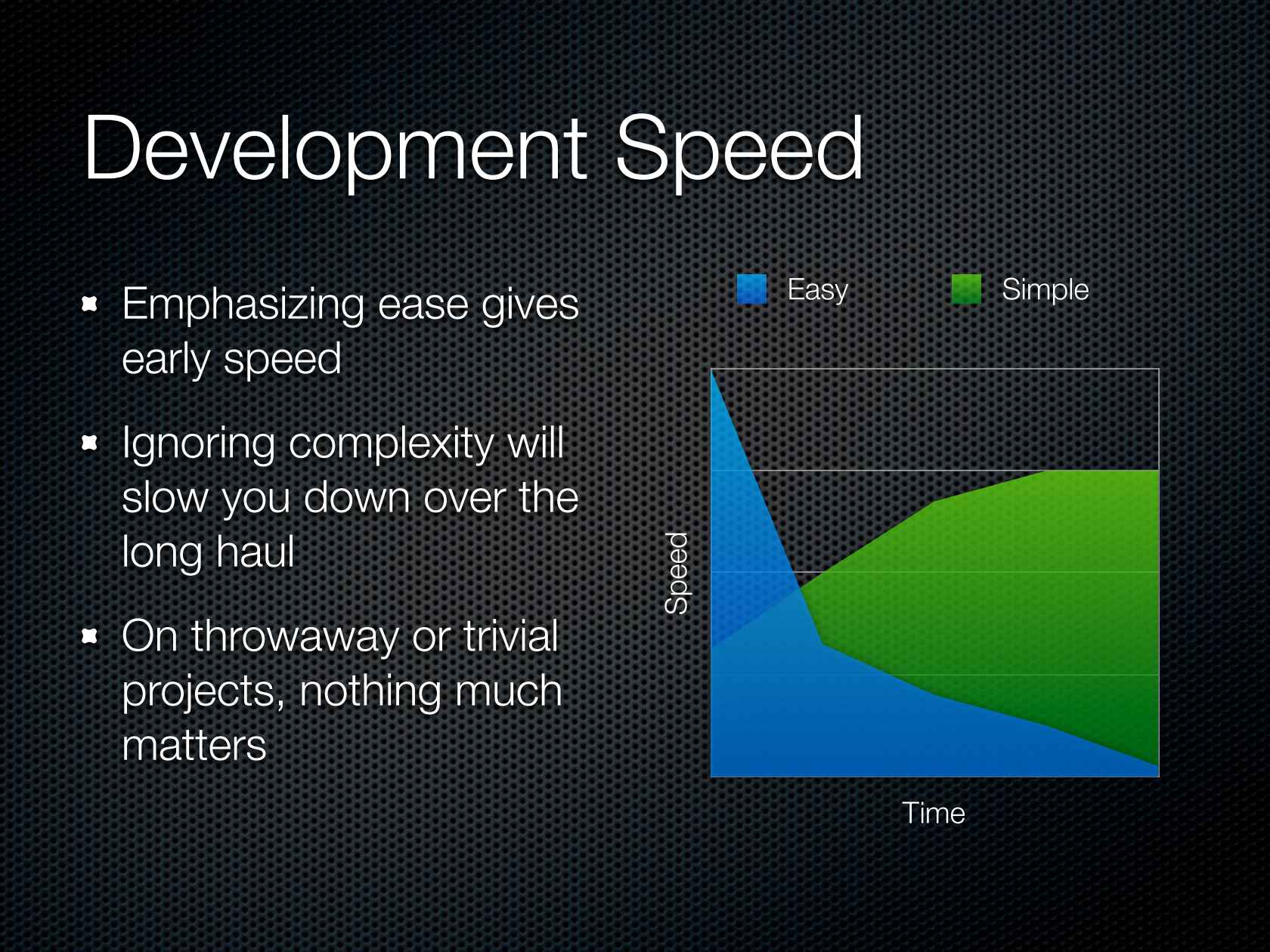
The whole point of the talk is that choosing "easy" (as in easy to get started) solutions while ignoring the complexity will be harder to maintain in the long run over choosing the "simple" solution that takes a bit more time to set up. Personally, this tracks pretty closely with my experience.
(Relevant slide from the talk: https://res.infoq.com/presentations/Simple-Made-Easy/en/slid...)
Re: Clojure builds as an amalgamation of orthogonal parts
#37What all the critics miss is that Lein is "Easy" but tools.deps, tools.build are "Simple". Rich wants all of clojure to be built from simple orthogonal parts that compose together. Ideally a multi-purpose tool like leiningen should be built on top of those simple parts. Other tools can re-use those parts in different ways. With Leiningen - its a great tool but it's a complex thing that you take on an all-or-nothing b…
Re: Clojure builds as an amalgamation of orthogonal parts
#38Earlier quoted context omitted.
Hard agree here. As a full time Clojure dev, my experience is that lein "just works". I've also used the Clojure Tools professionally, and have seen the dev team lose countless days of what would be otherwise productive time putzing with it, building infrastructure that lein has had out-of-the-box for years, and trying to make sense out of its inscrutable docs. Want a project with both Clojure and Java? Want tests th…
I agree. To me tools.build is not a replacement for Lein at all. Lein is more intuitive to most beginners. It's much easier to tell someone to run `lein new some-app` and `lein run` / `lein uberjar`, than to tell them to configure their deps.edn file so they can run some alias with the `-X:...` / `-M` arg to create and run a new project (and who knows which dependency to use / configure to build an uberjar). For expe…
We have a fairly large codebase (113K lines) in a monorepo with over a dozen artifacts built from about fifty subprojects. Leiningen really wasn't a good fit for us so we're very glad of alternatives.
Re: Clojure builds as an amalgamation of orthogonal parts
#39Earlier quoted context omitted.
Leiningen is over 10 years old and has tons of pain points. For example, I bet you're not using ClojureScript, which is a mess of plugin debugging in leiningen. The goal of tools.build is to let you code your builds as simple functions that run at the REPL, which is awesome . No more finding misplaced keys in soup like https://github.com/technomancy/leiningen/blob/master/sample.... . If leiningen works for you, great…
What pain points are those? Last I checked, doing cljs on Clojure Tools wasn't even possible. If that's still the case, then that's not a valid comparison (complex vs impossible). Also, that's the master version of project.clj, which is a superset of all possible features lein supports. Nobody's project.clj file looks like that, though I suspect you know this. Should we compare that complexity to a monster build.clj…
The README explains that and even links to a better-documented and more carefully curated set of aliases that folks might want to use instead (the Practicalli repo).
In reality, I use very, very of those aliases from that dot-clojure file, because the projects I work with already have the ones I need for working on those projects. That can be as simple as a :test alias or it can be up to a dozen aliases used in variations combinations for a variety of tasks.
You can certainly use the CLI and deps.edn for ClojureScript, by the way -- check out Figwheel Main which uses deps.edn and provides a nice workflow.
Re: Clojure builds as an amalgamation of orthogonal parts
#40Earlier quoted context omitted.
I found an old thread that examines some of the early usage of deps. Data > macros does indeed seem to be a driving force: https://clojureverse.org/t/combining-tools-deps-with-leining... tools.deps makes better choices when dependency specs conflict, so I would suggest trying https://github.com/RickMoynihan/lein-tools-deps if you otherwise want to use lein, and get the best of both worlds. By better, I mean: > Leinin…
Leinengen vs Maven dependency resolution is pretty distant to my concerns. I may be in the minority there, but I don’t think I am. I guess the thing I’m struggling to understand in the build tool differences is: Leinengen’s (defproject) takes a series of keys and values. It is declarative. You can probably get into dependency hell if your config is complex enough, and I’m almost certain it’s doing more than I underst…
For the CLI -- which uses tools.deps under the hood (not the brand new tools.build) -- all you need is your deps.edn file: a declarative hash map describing your dependencies and, under aliases, any additional tools you want to use.
The build.clj file is something some folks have already been doing in one form or another for large, complex projects (and would be familiar to anyone using Boot instead of Leiningen).
tools.build provides some common tooling and structure that should help reduce the complexity out there by providing a standard way to do a number of tasks that folks were already doing a different way (yes, including some of the core Leiningen tasks) and to provide a composable, function-based set of tools to help you write your own build scripts.
The bottom line: if Leiningen does what you need, great! Keep using it. If you find Leiningen to be restrictive and not a good fit for your project -- as we did, years ago -- then tools.build might be better. We left Leiningen for Boot many years ago and if we hadn't started to run into bugs/issues with Boot at scale we'd probably still be using it. Instead we switched to the CLI/deps.edn back in 2018 and we've just adopted tools.build which has simplified some parts of the build script we already had.