Live data from Hacker News

California breaks 1 GW energy storage milestone

pv-magazine-usa.com

51–60 of 61 posts

Re: California breaks 1 GW energy storage milestone

#51
post #39

Earlier quoted context omitted.

Amp hours is particularly annoying IMO because you can't convert it to energy without knowing the voltage.

The reason that battery capacity is measured in amp hours is that you can't know the exact voltage of the battery as it drops with lower levels of charge.

Newer large-capacity battery systems seem more likely to specify battery capacity in (k)Wh. I think this is because they come with sophisticated battery management systems that keep the battery within a narrow charge (20%-80%) range, so therefore they can be assured of the bounds of the voltage.

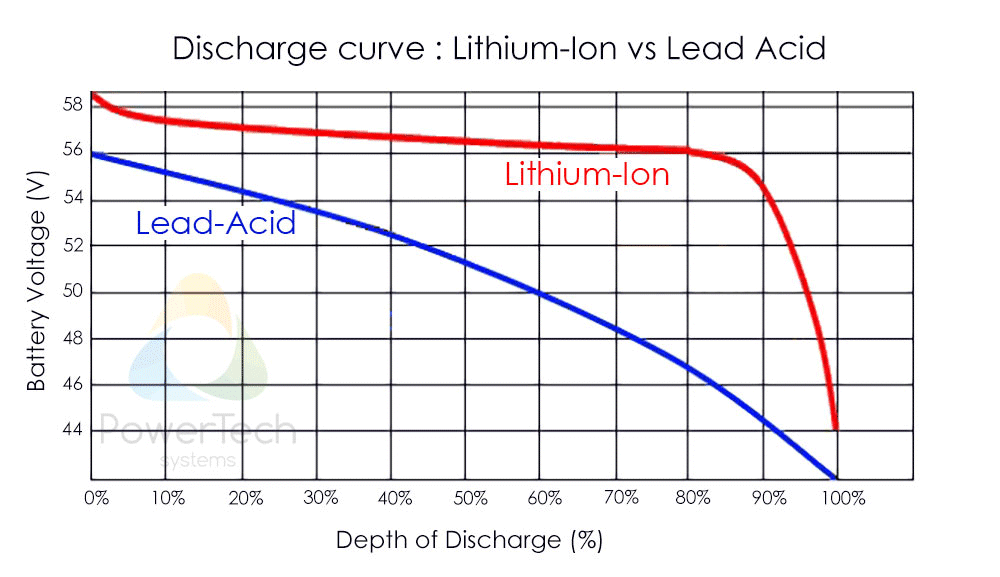
Also, Li-ion and LiFePO4 batteries have a much different discharge curve than earlier chemistries [1], with much more constant voltage up to 80% discharge.

1. https://www.powertechsystems.eu/wp-content/uploads/sites/6/2...
Re: California breaks 1 GW energy storage milestone

#52
post #31

Earlier quoted context omitted.

California still imports a large amount of power from other states (primarily Arizona and Utah, with some hydro from Oregon). So we essentially outsourced a lot of our power production to other states.

Arizona, Nevada, and Utah have quite a bit of area for solar PV. It’s fine for California to import from there as long as they use their leverage to force a move away from coal now, and natural gas later. Clean hydro from the PNW is no different than PJM and NYISO grids importing clean nuclear and hydro from Ontario, Canada (which they do).

In theory that could be the case. I was reading how the Los Angeles Dept. of Water and Power actually owns a coal generating plant in Utah. They are now converting it to a natural gas powered plant, so that's a step in the right direction.

Re: California breaks 1 GW energy storage milestone

#53
post #52

Earlier quoted context omitted.

Arizona, Nevada, and Utah have quite a bit of area for solar PV. It’s fine for California to import from there as long as they use their leverage to force a move away from coal now, and natural gas later. Clean hydro from the PNW is no different than PJM and NYISO grids importing clean nuclear and hydro from Ontario, Canada (which they do).

In theory that could be the case. I was reading how the Los Angeles Dept. of Water and Power actually owns a coal generating plant in Utah. They are now converting it to a natural gas powered plant, so that's a step in the right direction.

https://en.wikipedia.org/wiki/Intermountain_Power_Plant

https://www.latimes.com/business/la-fi-utah-coal-los-angeles...

Re: California breaks 1 GW energy storage milestone

#54

Earlier quoted context omitted.

It is a bit confusing, but it isn't wrong, there are just two capacities in question. We could call them power capacity and energy capacity. This system can deliver 2000MW for four hours, or 1000MW for eight hours, but can't deliver 4000MW for two hours, because that exceeds the power capacity.

How is it not wrong? The battery energy storage is 8GWh with a power capacity of 2GW. There is no such thing as a power storage capacity , because power is a rate. However, the storage may have a power capacity. pedantic, I know.

Well, no this is incorrect.

Watts are joules / second, so watt * hours cancels time on both sides, it's just energy. Watt-hours are more convenient than "raw" joules only because we tend to be more interested in how many hours a battery will last at a given wattage, not how many seconds it will last.

So energy capacity is correct, it's the amount of energy (not power) one can store in the battery.

Edit: I read this as though you were replying to me, not the comment I was replying to. Swimming upstream, I see that, yes, "energy storage capacity" isn't in watts, but rather watt * hours, but I agree with @renewiltord that it's easy to understand once you factor in that journalists, for the most part, never took physics.

The numbers have the units next to them, after all.

Re: California breaks 1 GW energy storage milestone

#55
post #39

Earlier quoted context omitted.

Amp hours is particularly annoying IMO because you can't convert it to energy without knowing the voltage.

The reason that battery capacity is measured in amp hours is that you can't know the exact voltage of the battery as it drops with lower levels of charge.

If voltage drops with lower levels of charge, then so does the current (assuming a load with a constant resistance). Isn't that just another reason to use Watt hours instead?

Re: California breaks 1 GW energy storage milestone

#58

Take a shot every time the article uses "GW" and "MWh/GWh" apparently interchangeably for "energy" or "power", also seemingly at random.

Actually, I thought it was very easy to understand. For instance, > Fortunately, 2,000 MW of energy storage capacity is coming online by August 1, per the California Public Utility Commission. Much of this capacity will have four hours of battery energy sitting behind it, nearly 8,000 MWh in total. That's 2 GW of power delivery backed by 8 GWh of storage.

I think this would be very understandable to someone without any of the physics knowledge, by just dumbing it down to:

> Fortunately, 2,000 MW of electricity is coming online by August 1, per the California Public Utility Commission. Much of this will have four hours of battery time sitting behind it, nearly 8,000 MWh in total.

Or alternatively, by using the correct physics terms where applicable:

> Fortunately, 2,000 MW of peak power capacity is coming online by August 1, per the California Public Utility Commission. Much of this capacity will have four hours of battery energy sitting behind it, providing nearly 8,000 MWh of energy in total.

But as is, the author provided the worst of both worlds. To me as a reader, I read "2000 MW of energy storage capacity", stumbled over that, then read on to "8000 MWh in total", understood that that is actually the storage capacity, then had to go back to "2000 MW" to understand that they meant "power", not "energy", to make sense of this whole two-sentence section.

So yes, this all does make sense. After reading it multiple times, some of which are back to front. The information is in there, but it certainly isn't clear or up-front.

Re: California breaks 1 GW energy storage milestone

#60
post #16

Earlier quoted context omitted.

No, GW -- as in the pumped storage facilities can deliver 4 GW of power continuously. The amount of energy that can be stored in California's pumped storage projects is enormous, measured in hundreds, if not thousands, of GWh, but that's mostly irrelevant to this discussion.

> but that's mostly irrelevant to this discussion. Is it irrelevant? As another thread mentioned, how long you can provide that power for that for and how fast you can replenish capacity seems relevant for its usefulness buffering solar for after hours. I'm pretty unread on the energy storage situation so your insight or any good resources are very welcome!

California uses something on the order of 1 GWh/day. If they have the ability to store up hundreds of GWh in a reservoir, then the exact amount becomes largely irrelevant. They have enough, and the limiting factor is power rather than energy.
Post reply on HN