Live data from Hacker News

Wikidata

wikidata.org

31–40 of 69 posts

Re: Wikidata

#31

Tests are a bit depressing. - "Borane" has two unlinked entries: Q127611 is "any chemical compound composed of boron and hydrogen atoms only" while Q15634214 is specifically boron trihydride. Both correct, but the latter should be labelled as an instance of the former. - "Anomalocaris" has Q37395 for the "extinct genus of radiodon" (instance of "fossil taxon") but species (e.g. Q49557506 Anomalocaris cranbrookensis)…

> There are no lists of links, for example Q936518 ("aerospace manufacturer") doesn't have a list of its instances (e.g. Boeing, Q66, or Arado Flugzeugwerke, Q624899)

This is intentional, you can construct these via the query service. There's also an optional "gadget" registered users can add to their configuration, that can do this automatically when visiting a page for every instance of some "inverse" property.
Re: Wikidata

#32

Tests are a bit depressing. - "Borane" has two unlinked entries: Q127611 is "any chemical compound composed of boron and hydrogen atoms only" while Q15634214 is specifically boron trihydride. Both correct, but the latter should be labelled as an instance of the former. - "Anomalocaris" has Q37395 for the "extinct genus of radiodon" (instance of "fossil taxon") but species (e.g. Q49557506 Anomalocaris cranbrookensis)…

> for example Q936518 ("aerospace manufacturer") doesn't have a list of its instances

You can query the database using SPARQL: https://w.wiki/3XgD

Re: Wikidata

#33
post #24

SPARQL over Wikidata is one of the closest things to magic on the Internet. It's incomplete, the runtime is slow, it dies on too much data, but it's amazing being able to think up random questions and actually ask them, however frivolous. Stuff like "who's the most successful footballer from my home town?" or "which part of India has produced the most test cricketers?" is really easy. Makes me wish I'd taken the quan…

You can download a data dump and run your own queries locally if the limitations of the online service are of concern. Full dumps of the whole Wikidata are easily available, or you can export a limited result set from the query service and run your own local queries on that data.

Re: Wikidata

#34
post #10

Wikidata is a fantastic data source for all sorts of applications, not just for the Wikimedia projects (infoboxes, templates, etc.). I'm also excited about the Wikifunctions project ( https://en.wikipedia.org/wiki/Wikifunctions ) to created a large body of executable snippets that can be applied to data types. Wikidata is one of the main data sources in my Conzept encyclopedia project: https://conze.pt ( https://twit…

Conzept looks really good! Are there some whitepapers (apart from the user guide) that I can peruse? Some information about the team? Is this an LOD based solution where we can plug in arbitrary KGs? Did you fork the UI from some existing Knowledge Graph viz tools, or is it made from scratch?

Hey, good to know you like it!

Its just me (Jama Poulsen) currently. I hope at some point to be able to work with more people on this project and also to have a base for other archives / institutions (as a B2B product and service) to use the "Conzept UI" for their knowledge base. The Conzept framework is already pretty generalized, multi-lingual and customizable, but more needs to be done. I'm aiming to be able to do a first pilot at the end of the year (or later, depending on the progress). Feel free to send me a message if someone is interested in this.

There will be better user documentation coming (the current guide is a bit dated). Still thinking how to make that more modular, UI-integratable and maintainable.

The whole main app design and UI is from scratch, but many embedded apps are developed by others (I've been donating to some of them for their great work, but more needs to be done here IMHO). No papers or anything on all that currently.

Re: Wikidata

#35
post #25
post #18

Wiki data is awesome. I’ve been considering using it for some projects, but the main thing that’s keeping me away is the concern that some moderator will decide that my data doesn’t fit and remove it. Can anyone speak to this concern? On WP for example notability is a big thing, how does this work in Wikidata?

> I’ve been considering using it for some projects, but the main thing that’s keeping me away is the concern that some moderator will decide that my data doesn’t fit and remove it. To me the greatest value of Wikidata was making me aware of RDF and SPARQL. In most cases, if you are relying on data business needs, it would be best to maintain your own RDF dataset and host it either just on HTTP, or on something like h…

RDF ingestion is problematic for Wikidata, because importing a dataset to Wikidata requires reconciling existing entities so as to avoid duplicare entries. The easiest way to achieve that is to publish your dataset online, create a linking Wikidata property for it, then ask for it to be imported in https://mix-n-match.toolforge.org where reconciliation can be done by the crowd.

Re: Wikidata

#36

Tests are a bit depressing. - "Borane" has two unlinked entries: Q127611 is "any chemical compound composed of boron and hydrogen atoms only" while Q15634214 is specifically boron trihydride. Both correct, but the latter should be labelled as an instance of the former. - "Anomalocaris" has Q37395 for the "extinct genus of radiodon" (instance of "fossil taxon") but species (e.g. Q49557506 Anomalocaris cranbrookensis)…

> There are no lists of links, for example Q936518 ("aerospace manufacturer") doesn't have a list of its instances (e.g. Boeing, Q66, or Arado Flugzeugwerke, Q624899) This is intentional, you can construct these via the query service. There's also an optional "gadget" registered users can add to their configuration, that can do this automatically when visiting a page for every instance of some "inverse" property.

I thought this is what the "What links here" link on the left was for?

https://www.wikidata.org/wiki/Special:WhatLinksHere/Q936518

Re: Wikidata

#37

Earlier quoted context omitted.

> There are no lists of links, for example Q936518 ("aerospace manufacturer") doesn't have a list of its instances (e.g. Boeing, Q66, or Arado Flugzeugwerke, Q624899) This is intentional, you can construct these via the query service. There's also an optional "gadget" registered users can add to their configuration, that can do this automatically when visiting a page for every instance of some "inverse" property.

I thought this is what the "What links here" link on the left was for? https://www.wikidata.org/wiki/Special:WhatLinksHere/Q936518

Well, "what links here" gives you a general list of related pages without telling you which is relevant to the property you care about. It's sometimes useful (esp. for items with few incoming links), but the query service is a more complete solution.

Re: Wikidata

#38

Wikidata is a great resource, but the SPARQL query language seems more annoyingly complicated and confusing than it could be. I'm using Wikidata to automatically categorize visited websites and used programs for time tracking purposes. For example, here's a query to get the entity (e.g. company) that has a specific domain (news.ycombinator.com), and get the categories that entity is in that that are a descendent of t…

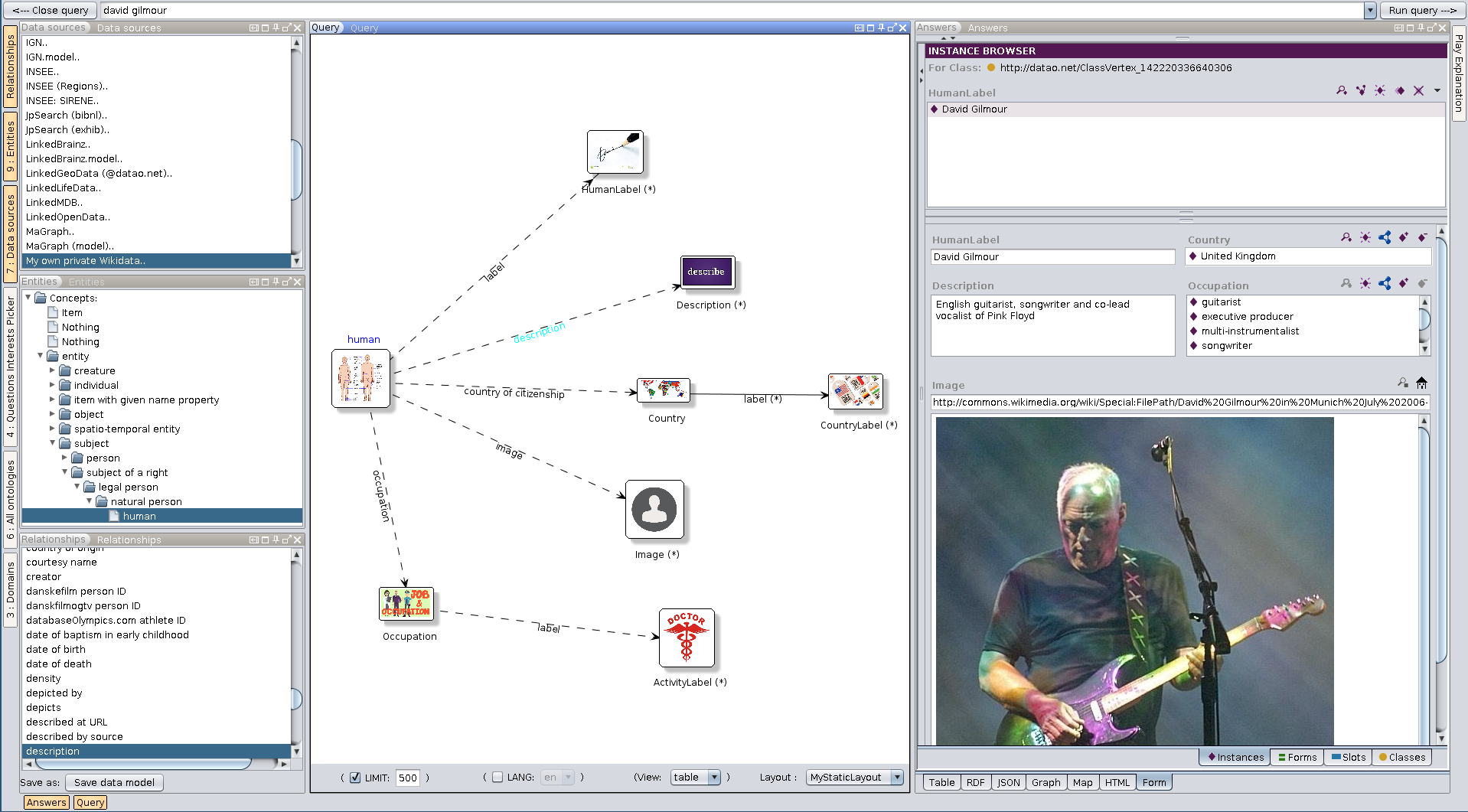
In the old days, I had made a UI for SPARQL. Even adapted it to Wikidata. But in the end, so few people cared about it that I abandonned it. (it still works fine, anyway).

http://datao.net/datao.net.png

Re: Wikidata

#39
One of the big added value of Wikidata imho is that each Wikidata page mention the identifiers for the same item in several other datasets (OSM, wikipedia, geonames, etc). Given the fact that SPARQL allows cross-DB queries, Wikipedia becomes an interesting federation dataset.

Re: Wikidata

#40
post #25

Earlier quoted context omitted.

> I’ve been considering using it for some projects, but the main thing that’s keeping me away is the concern that some moderator will decide that my data doesn’t fit and remove it. To me the greatest value of Wikidata was making me aware of RDF and SPARQL. In most cases, if you are relying on data business needs, it would be best to maintain your own RDF dataset and host it either just on HTTP, or on something like h…

RDF ingestion is problematic for Wikidata, because importing a dataset to Wikidata requires reconciling existing entities so as to avoid duplicare entries. The easiest way to achieve that is to publish your dataset online, create a linking Wikidata property for it, then ask for it to be imported in https://mix-n-match.toolforge.org where reconciliation can be done by the crowd.

Last I checked mix-n-match was using CSV, while this is okay, it still would be nicer to have direct RDF ingestion. And yes, I realize the reason why Wikidata does not have it, but it is not impossible to provide, just really difficult. I would work on it if I had more time and would likely sometime in the future.
Post reply on HN