Live data from Hacker News

It’s time to break up the Ivy League cartel

chronicle.com

21–30 of 379 posts

Re: It’s time to break up the Ivy League cartel

#21
“In 1940, the acceptance rate at Harvard was 85 percent.”

I didn’t realize that was the acceptance rate, but JFK’s application to Harvard is interesting and that acceptance rate adds context: https://www.theatlantic.com/education/archive/2013/11/jfks-v...

And maybe it’s not people pulling the ladder up behind them - it’s that the ladder has become more visible and desirable without expanding or changing.

I do have some hope with Coursera and EdX. There are now blended programs starting online that allow students to start remote and show they can do the coursework, before completing the rest on campus: https://scm.mit.edu/program/blended-masters-degree-supply-ch...

I’d argue the knowledge is becoming more open and freely available, but the network is not. Maybe the value of the network would drop if it was less personal and more people were there. There is some optimal program size and it’s possible some programs could hold more. At the same time, do we really need more Cal tech grads? Not a slam at Cal tech (I chose the smallest), but how many people with those skill sets do we need vs. graduates from other less specialized schools.

There is something special about Cal Tech’s community, and I don’t know I would want to dilute it just because other people should have the ability to go there to meet some arbitrary “fairness metric”.

The value these institutions have brought, and bring, to the country by making us the top in the world in a number of fields comes from how selective they are and their massive resources they can put toward problems. This makes them attractive to the world’s top talent and gives them the freedom to work on some things without economic constraints, and that’s a societal benefit. Pulling money away because they’ve managed it well could hurt us long term. And it’s not like the Harvard endowment of $40B is just sitting there - it is invested into the economy like other funds until it is needed for investment in the community.

Lastly - just because you didn’t go to one of those institutions doesn’t mean you can’t be successful or attend one for grad school. And I’ve found grad school admissions to be meritocratic.
Re: It’s time to break up the Ivy League cartel

#22

> recirculating resources among the most exclusive and wealthy while chanting social-justice keywords Indeed, Harvard aggressively defends its admissions program as "holistic" while rating Asians as having lower personal ratings that they define as measuring "likeability", "courage", and "kindness" [1]. You might ask yourself how an institution which claims to be anti-racist exhibits behavior of the opposite kind. [1…

What's telling is how similar the Asian admit percentage is between the top colleges except for Caltech. It wasn't always like this, but they've all (ex-Caltech) converged on almost the same number now. It appears to be collusion either of the sort discussed in the article or the informal sort where each college copies their competitors' quotas.

Re: It’s time to break up the Ivy League cartel

#23
>The economist Raj Chetty has found that nearly 40 of the country’s elite colleges and universities, including five in the Ivy League, accept more students from families in the top 1 percent of income earners than from the bottom 60 percent. The computer scientist Allison Morgan recently released a study examining 7,218 professors in Ph.D.-granting departments in the United States across the arts and sciences. She found that the faculty come from families almost 34-percent richer than average and are 25 times more likely than average to have a parent with a Ph.D. Faculty members at prestigious universities are 50 times more likely than the average person to have a parent with a Ph.D. American meritocracy has become a complex, inefficient, and rigged system conferring its graces on ambitious children of highly educated and prosperous families.

This is like the 'branch cut' equivalent of the social sciences, but rather than making the integral easier to compute, makes the argument sound more convincing than it actually is or supported by the evidence.

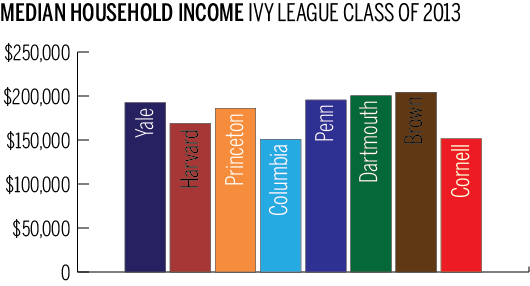
If one looks aat the actual data, admitees of elite colleges are hardly among the elite, but just somewhat wealthier than average.

http://yaledailynews.com/wp-content/uploads/2017/02/admissio...

We're not taking Rockefeller-level of wealth here.

But this holds even for non-elite colleges. It not that top colleges are biased against the lower classes, but that lower classes may just be less inclined to apply or score lower on standardized tests.

Re: It’s time to break up the Ivy League cartel

#24
post #19

> Faculty members at prestigious universities are 50 times more likely than the average person to have a parent with a Ph.D. American meritocracy has become a complex, inefficient, and rigged system conferring its graces on ambitious children of highly educated and prosperous families. What’s the ratio in other fields of top achievement for kids to follow in their parents’ footsteps? It’s entirely unsurprising that a…

From the NYT: Working sons of working fathers are, on average, 2.7 times as likely as the rest of the population to have the same job but only two times as likely to have the same job as their working mothers, according to an analysis by The New York Times, one of the first to look at mothers and daughters in addition to fathers and sons. Daughters are 1.8 times as likely to have the same job as their mothers and 1.7…

I was just going to look for data on plumbers and carpenters. One common theme to all these jobs is that they tend to be quite stable, and require a life-long set of skills.

My father did metalwork before moving to an office job in the civil service. He was the son of a die pressman. Who was the son of a blacksmith. Dad taught me how to weld and cut and so on before my teens. My intellectual interests went to math and computers early on, and he did encourage me to go wherever that might lead. Yet after university and exploring the world I end up in a job where I make circuit boards. It's nearly all automated now but I still do far more welding in my job than most people with a degree.

Sometimes it feels like our life scripts are often sketched out by circumstance and trends long before we're even born.

Re: It’s time to break up the Ivy League cartel

#25

>The economist Raj Chetty has found that nearly 40 of the country’s elite colleges and universities, including five in the Ivy League, accept more students from families in the top 1 percent of income earners than from the bottom 60 percent. The computer scientist Allison Morgan recently released a study examining 7,218 professors in Ph.D.-granting departments in the United States across the arts and sciences. She fo…

> It not that top colleges are biased against the lower classes, but that lower classes may just be less inclined to apply or score lower on standardized tests

Oh, my. This is such a straight-textbook example of not seeing systemic bias.

Re: It’s time to break up the Ivy League cartel

#26
post #21

“In 1940, the acceptance rate at Harvard was 85 percent.” I didn’t realize that was the acceptance rate, but JFK’s application to Harvard is interesting and that acceptance rate adds context: https://www.theatlantic.com/education/archive/2013/11/jfks-v... And maybe it’s not people pulling the ladder up behind them - it’s that the ladder has become more visible and desirable without expanding or changing. I do have so…

Acceptance rates are meaningless. There is no limit on the denominator.

Re: It’s time to break up the Ivy League cartel

#27
post #19

> Faculty members at prestigious universities are 50 times more likely than the average person to have a parent with a Ph.D. American meritocracy has become a complex, inefficient, and rigged system conferring its graces on ambitious children of highly educated and prosperous families. What’s the ratio in other fields of top achievement for kids to follow in their parents’ footsteps? It’s entirely unsurprising that a…

From the NYT: Working sons of working fathers are, on average, 2.7 times as likely as the rest of the population to have the same job but only two times as likely to have the same job as their working mothers, according to an analysis by The New York Times, one of the first to look at mothers and daughters in addition to fathers and sons. Daughters are 1.8 times as likely to have the same job as their mothers and 1.7…

So, looks like contacts and internal knowledge are much more important for a PHD than it is for most professions, but the situation is still much better than for politicians.

I'd say that means the PHD job market has a large problem. When politicians are the ones you can compare yourself to look good, it's because things are not good at all.

Re: It’s time to break up the Ivy League cartel

#28

>The economist Raj Chetty has found that nearly 40 of the country’s elite colleges and universities, including five in the Ivy League, accept more students from families in the top 1 percent of income earners than from the bottom 60 percent. The computer scientist Allison Morgan recently released a study examining 7,218 professors in Ph.D.-granting departments in the United States across the arts and sciences. She fo…

> It not that top colleges are biased against the lower classes, but that lower classes may just be less inclined to apply or score lower on standardized tests Oh, my. This is such a straight-textbook example of not seeing systemic bias.

Generations ago, elite colleges had quotas preventing or discouraging certain groups from applying. Those barriers have been removed. As it turns out, selecting for intelligence yields more for endowments and other benefits than selecting for prestige or lineage. This may not be completely fair, but is more fair than the old way.Tons of people apply to these schools. The SAT is still a useful despite being an imperfect filter.

Re: It’s time to break up the Ivy League cartel

#29
post #19

> Faculty members at prestigious universities are 50 times more likely than the average person to have a parent with a Ph.D. American meritocracy has become a complex, inefficient, and rigged system conferring its graces on ambitious children of highly educated and prosperous families. What’s the ratio in other fields of top achievement for kids to follow in their parents’ footsteps? It’s entirely unsurprising that a…

From the NYT: Working sons of working fathers are, on average, 2.7 times as likely as the rest of the population to have the same job but only two times as likely to have the same job as their working mothers, according to an analysis by The New York Times, one of the first to look at mothers and daughters in addition to fathers and sons. Daughters are 1.8 times as likely to have the same job as their mothers and 1.7…

Thats Indian Varna system right there.

Re: It’s time to break up the Ivy League cartel

#30

There is a large supply of scholars and teachers ready, willing, and able to work. Public universities, colleges, community colleges, and HBCUs have for decades been starved. The Biden family understands public education, and Jill Biden is an educator. With something like a Works Project Administration program to bring arts and sciences education to Americans, the administration could restore democratic education in…

I had a similar discussion with a young colleague considering grad school recently. My two cents is now, with nearly 25 years post Ph.D. under my belt, that it is a union card for some jobs, and irrelevant for others. The degrees don't make the person. The content of the character and drive do.

I got a Ph.D. as I had the goal of being a physics prof someday. I knew that was an essential milestone on the path to this. Now, my goal is to save for retirement, and do what I enjoy doing while doing this, and maybe after retirement teaching physics/math/etc. at a local uni/college.

The treadmill of credentialism is an apt phrase though. I don't need a Ph.D. in my current job. Or most of my previous ones.

Post reply on HN