Live data from Hacker News

Rich people do have trouble understanding what it's like to be poor

salon.com

251–260 of 421 posts

Re: Rich people do have trouble understanding what it's like to be poor

#251
post #183

Earlier quoted context omitted.

"Just don't have kids" is, IMO, one of the most incredibly insensitive approaches to this problem. It reminds me of all the people telling gay people to "just don't have a relationship". Having an entire class of people who work hard but are too poor to raise children is a failure of society - not a failure of financial planning.

Sterilization is usually covered by health insurance. What we are talking about here is having kids when you can’t afford them. This is mostly due to a nation-wide lack of education on the subject and rising cost of living. It does not make sense to have kids before having a stable job/house/car. Adoption/abortion is a much better option at that point, as politically incorrect to say your whole life and income-genera…

wish your parents took advantage of that
Re: Rich people do have trouble understanding what it's like to be poor

#252
post #235

Earlier quoted context omitted.

It’s not only a supply issue these days. Even areas that have basically unlimited land and building in Texas have prices going up massively. How do you explain that?

Lumbar as a whole has minimally doubled during the last year[1]. A lot of people are moving to Texas, which raises demand, which raises prices. There is also a current lumbar shortage, which makes house building unpredictable when you have to plan 1+ years out. You don't just go from 0 to a house. There is usually about a year of designing/planning which have to be approved and meet national and local code, numerous…

For future reference, “lumber” is wood and “lumbar” has to do with your lower back (e.g. “lumbar pain”)

Re: Rich people do have trouble understanding what it's like to be poor

#253
post #112

Earlier quoted context omitted.

What are you talking about?

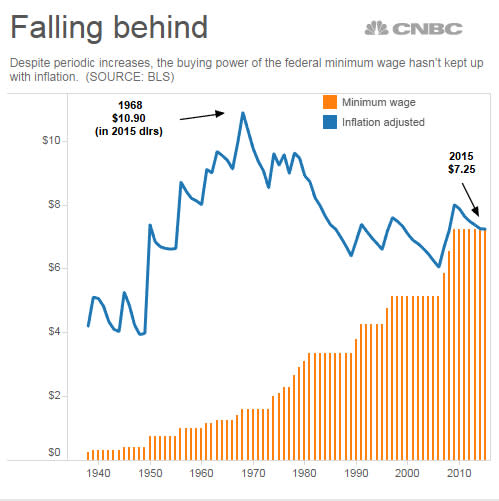
There are a lot of 'deliberate' policy decisions which both depress low-skilled workers' wages, and lead to higher property prices. On the wage side, good examples are that: 1) the minimum wage doesn't get increased with inflation 2) many jobs require a higher degree (which takes capital to pay for), or effectively require working for free via internships (which requires capital or someone else subsidizing you) 3) ma…

> 1) the minimum wage doesn't get increased with inflation

Sure it does. It's pretty much unchanged since 1980 (in a sawtooth, they build up some pressure due to inflation and then it jumps up due to legislation).

1960-1980 looks to average around 20% higher.

It's funny how these charts differ.

https://www.pewresearch.org/fact-tank/2017/01/04/5-facts-abo...

https://image.cnbcfm.com/api/v1/image/103807392-min-wage-inf...

A strong argument can be made that minimum wage should track GDP, not inflation.

Re: Rich people do have trouble understanding what it's like to be poor

#254

Earlier quoted context omitted.

People made vastly more money just sitting around in their houses in the past couple years than I made in my job as an "essential" worker over the past decade. This is not an accident. It’s a result of deliberate policy choices. The incumbent homeowners voted themselves massive returns. And they felt self righteous while they were doing it to boot.

> The incumbent homeowners voted themselves massive returns. And they felt self righteous while they were doing it to boot. We'll see. They're millionaires on paper. If there's one thing about unsophisticated people and investments, they always cash out when it's too late.

> If there's one thing about unsophisticated people and investments, they always cash out when it's too late.

There is no such thing as "too late" in urban housing. Rural areas are so far "left behind" that it will take about ten times the investment that Biden wants to put up to bring it to civilized level, and he's already getting massive resistance... no way that the rural flight trend will be reversed.

Re: Rich people do have trouble understanding what it's like to be poor

#255
post #36

Wealth is a stock measure, income is flow. You accumulate wealth out of what you can set aside out of the flow. Some of us immigrants do not come to this country with an existing stock of wealth either back home or here. We are also not in the favored group of immigrants. We have human capital which we are trying to convert to financial capital for the next generation. Then, when we sort of "make it" here, people who…

If you somehow have a high income which is guaranteed never to go away, you don't need to accumulate anything, yet live a wealthy lifestyle. In an electronic circuit, if you have an unlimited supply of current, you don't need to hoard electrons in big capacitors.

Owning a reliable income stream is an asset, which is wealth.

Either you’re working to get that income (in which case you’re probably saving for retirement) or you need to buy it.

Re: Rich people do have trouble understanding what it's like to be poor

#256

Earlier quoted context omitted.

I think this is an excellent comment. What makes me very sad is that during the past 14 months the divide between those who own assets and those who don't has reached gargantuan proportions. I mean, in my raging inferno of a housing market, over the past couple of years home prices have easily doubled. So a 400k house from 2018 now sells for 800k. Yes, if I want to move to another house in my area I'll pay similarly…

>Yes, if I want to move to another house in my area I'll pay similarly astronomical prices, but that just means it's about a wash for me, In California you may well have doubled your annual property tax bill.

Yes, and prop 13 makes all kinds of ridiculous impacts whereby one person living in a 2 million dollar home pays a tenth of the property taxes of their neighbor also living in a 2 million dollar home.

Re: Rich people do have trouble understanding what it's like to be poor

#257
> If power tends to shape the perceptions of those who have it, the implications for public policy — especially around issues like poverty, crime, education and health care — are significant. Gee like politicians who get paid a good wage with benefits who are not interested in health care and the minimum wage? Who setup themselves as exceptions for many laws?

Re: Rich people do have trouble understanding what it's like to be poor

#258
post #139

Earlier quoted context omitted.

Cheaper housing => longer and more expensive commute. Or worse job opportunities. Then people tell you to move where the jobs are. Which has really expensive housing. The free market tends to flatten this stuff out

Some people pretend the Midwest doesn't exist. Plenty of jobs and cheap housing. You don't get FAANG salaries, but if you're setting FAANG to be the standard, you are on of the "rich people who have trouble understanding what it's like to be poor". Before the pandemic, someone on a typical engineer salary in the Midwest would afford a 2000 sqft home with a nonworking spouse and a few kids. 2000 sq ft is not big over…

For the record there are FAANGs paying their salaries in the Midwest. I could transfer to Detroit or Madison fairly easily.

Re: Rich people do have trouble understanding what it's like to be poor

#259
This reminds me of a story, true or not, of a king who's jester would constantly whisper in his hear "you are human and will die some day." I think that people in power need constant bias training towards this kind of thing, especially public servants.

Re: Rich people do have trouble understanding what it's like to be poor

#260

I have both my father and my uncle who became dirt poor just by making terribly poor life choices so I've got a very different take on this. They had good jobs but couldn't help screwing it up by: gambling, buying sportcars, overall trying to bite more than they could swallow (houses too big, with monthly mortgage too expensive), etc. In both cases it ended up with foreclosures / lawyers etc. My brother and I are now…

In practice, a lot of bad choices aren't truly volitional; they are mainly the result of conditioning. Repeated bad choices reflect a reduced capacity to learn, which is a kind of disability.

It's annoying and costly that so many people make these bad choices, but I think we still have the obligation to care for each other. I expect to make at least some bad choices and I may need help.

But usually, nobody can help you as much as you can help yourself, so it's a good idea to arrange things so that people can increase their own resourcefulness and help themselves.

Be grateful for how lucky you are.

Post reply on HN