Live data from Hacker News

Project Starline: Feel like you're there, together

blog.google

361–370 of 539 posts

Re: Project Starline: Feel like you're there, together

#361
post #128

This is cool as hell, but I have to say I feel like we're solving top-level problems when most consumers don't even seem to be getting solutions to the most basic pain-points. For me, the problem with video-calling isn't the image-quality. It's all the much more mundane technological problems - high latency, lag-spikes caused by bad ISPs, failed noise-cancellation for people who don't use headsets for audio, bad wifi…

Most of that Google can't do anything about, because it's not under their control. And it's really a question of money. If you want to fix all those mundane problems you describe, literally every one can be addressed by renting a better pipe and buying and setting up better equipment. This Google product is clearly designed for high-end offices that already have all of those things under control.

Google owns one of the major consumer operating systems (Android) and a lot of videoconferencing goes via Chrome. They could absolutely be doing things like offering better connection quality metrics - look at how everyone currently ends up using a random shady "speed test" site.
Re: Project Starline: Feel like you're there, together

#362
post #333

Earlier quoted context omitted.

I want to try this just to see what happens, if I will have again the feeling something is more real than reality. Because optometrists are illegal in my country (here only medics can decide what glasses you can use), currently I don't have stereoscopic vision, although my brain CAN do it, if I had the correct images sent to my eyes somehow. (one of my eyes muscles is slightly shorter than the other side thus the ima…

Wait – I also don't have stereoscopic vision, do you have any details or sources for those magical glasses with prisms?

I first learned about this prism business when I read this article: https://www.newyorker.com/magazine/2006/06/19/stereo-sue

Back then people even were saying it was pseudoscience or a scam, but seemly there is ongoing research that shows that the article wasn't lying.

Re: Project Starline: Feel like you're there, together

#363
post #361

Earlier quoted context omitted.

Most of that Google can't do anything about, because it's not under their control. And it's really a question of money. If you want to fix all those mundane problems you describe, literally every one can be addressed by renting a better pipe and buying and setting up better equipment. This Google product is clearly designed for high-end offices that already have all of those things under control.

Google owns one of the major consumer operating systems (Android) and a lot of videoconferencing goes via Chrome. They could absolutely be doing things like offering better connection quality metrics - look at how everyone currently ends up using a random shady "speed test" site.

That exists now. If you Google search ‘speed test’ (on mobile at least) the first result is now a simple speed test provided by Google.

Re: Project Starline: Feel like you're there, together

#364
post #310
post #196

Earlier quoted context omitted.

Exactly, it's just a fancy FaceTime technology, I would be bored after few days. Tell me a problem that it solves.

Tell me a problem Instagram solves. It's just a fancy Myspace. Tell me a problem WhatsApp solves. It's just a fancy SMS. Tell me a problem X solves. It's just a fancy Y. Etc etc

If you talk to daily Instagram users, you'll find out what problem it solves. In particular, it was the lucky winner in the crowd of early photo-sharing-on-mobile apps. But the demand for that was proven by early photo sharing successes like Flickr. Realizing people would want to do that on their pocket camera device is not a big leap given what people were already doing to share photos from their mid-aughts cameraphones phones.

There's no such plausible story for 3D video calls. It's not like people are already demanding 3D displays for any of their other 3D stuff. The 3D first-person shooter, for example, has been around for decades. But 3D displays have never been popular despite being available for at least a decade.

Re: Project Starline: Feel like you're there, together

#366

Does anyone have a clue how the light field display works? Someone suggested this is the tech: https://lookingglassfactory.com/tech But it still has no explanation of what the "proprietary light field technology" is . How do you get each pixel to show up as a different color with 45-100 separate angles? I had no idea this actually existed in production!

I was curious too and found this slide deck:

http://creativity.arch.tamu.edu/_common/FoVI3D_DeepDrive.pdf

The explanation of how it works begins on p. 13.

It seems to basically just have a huge number of very dense pixels, and in front it has some tiny lenses that direct each pixel at a different angle.

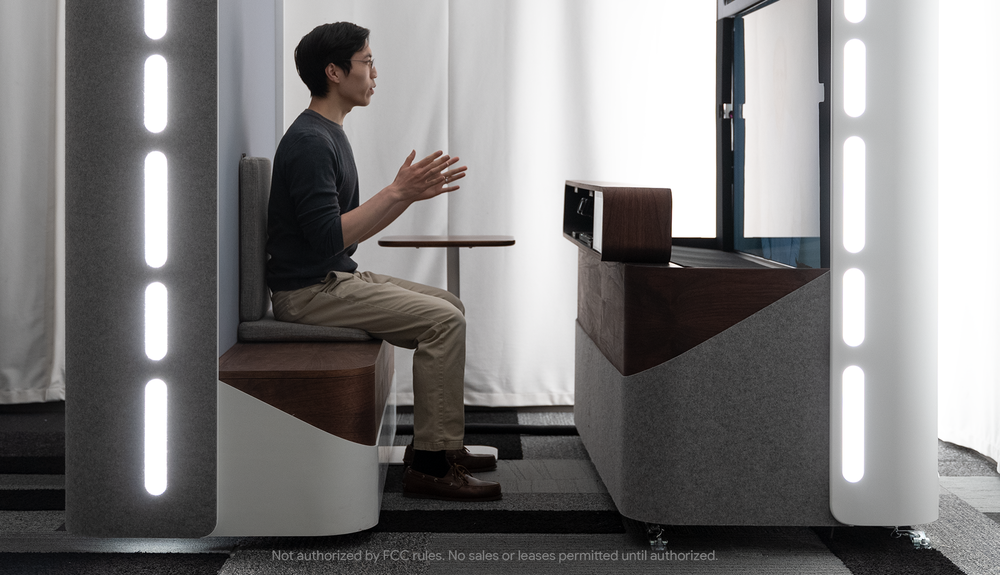
Presumably there's a maximum distance you can view from because the further you get away from the display, the smaller the angle between your eyes. I would guess it's no coincidence that Google has set it up as a booth with a back wall that would ensure you keep close enough:

https://storage.googleapis.com/gweb-uniblog-publish-prod/ima...

Re: Project Starline: Feel like you're there, together

#368
post #2

A good friend of mine at Google is the technical lead of this project (he has a Phd Princeton, and was a professor before joining Google). I've tried it in person and it was truly amazing. They used some very fancy tech when I saw the demo, so I'm thrilled it is finally being announced and possibly shared with a larger audience. Explanation of why it is amazing: It totally fools your perception. No glasses or goggles…

I've seen 3d screens in Japan 20 years ago. TVs, ad displays, mobile phones. It works really well, and it's actually very simple technology. Never understood why that never took off.

This is different. It's a light field display, so you can view things at different angles as you move around, rather than having to sit in a very exact position and only seeing one angle.

Re: Project Starline: Feel like you're there, together

#369
post #128

This is cool as hell, but I have to say I feel like we're solving top-level problems when most consumers don't even seem to be getting solutions to the most basic pain-points. For me, the problem with video-calling isn't the image-quality. It's all the much more mundane technological problems - high latency, lag-spikes caused by bad ISPs, failed noise-cancellation for people who don't use headsets for audio, bad wifi…

Normal video chat at its best is just kind of shitty though, so people don't have a whole lot of motivation to put in a bunch of work to make it still shitty, but slightly less so.

If I could get video chat that felt like real life, that'd be worth running some wires for.

Re: Project Starline: Feel like you're there, together

#370

Earlier quoted context omitted.

I've spent a decent amount of time and money to make this happen and it helps less than you would hope. Partially there are just affordance issues of things like eye contact which are physically out of alignment unless you start using two way mirrors [1]. https://hackaday.com/2020/05/29/two-way-mirror-improves-vide...

Essentially eye-contact is the missing ingredient. I believe it! Eye contact is key to a conversation feeling authentic.

There are technologies that can automatically adjust videos for eye contact today, so I imagine something similar could be implemented for this later on.
Post reply on HN