Live data from Hacker News

Microfarms come to South L.A. frontyards, bringing fresh produce to food deserts

latimes.com

41–50 of 90 posts

Re: Microfarms come to South L.A. frontyards, bringing fresh produce to food deserts

#41
post #2

Great hobby (I really mean that... my wife and I grow, process, and preserve a significant portion of our own produce in our front lawn), but ultimately, these are only marginally less wasteful than lawns. The distribution costs (environmental and otherwise) of having many small farms easily overpowers the current situation, which allows for more efficiency. Plus, it takes quite a bit of intense effort to farm enough…

meat is pound for pound more efficient at energy storage for humans Citation definitely needed here. Meat is an extremely inefficient vehicle for getting calories into humans.

There are a lot of calories in a pound of beef, I think that's what OP was saying.

The other side of the equation is it takes way more energy per calorie to produce.
Re: Microfarms come to South L.A. frontyards, bringing fresh produce to food deserts

#42
post #2

Great hobby (I really mean that... my wife and I grow, process, and preserve a significant portion of our own produce in our front lawn), but ultimately, these are only marginally less wasteful than lawns. The distribution costs (environmental and otherwise) of having many small farms easily overpowers the current situation, which allows for more efficiency. Plus, it takes quite a bit of intense effort to farm enough…

We aren't paying farmers to waste food, we are paying farmers so that big stores don't have shortages or have to increase the price of bread 10x over because there was a bad wheat season. With a 1-2 year lead time on crops, you can't afford to accidentally not produce enough food just because the midwest got a bunch of hail or flooding that year. People can't put off eating for a year while we grow more.

I agree crop subsidies are mismanaged and often way more is spent on crops that don't need subsidization, but without crop subsidization at all you end up with price shocks in the food market and potentially/inevitably shortages and famines.

Re: Microfarms come to South L.A. frontyards, bringing fresh produce to food deserts

#43
post #9
post #6

Earlier quoted context omitted.

there's really no vacant infill in south LA unfortunately, and despite it's bad rap, commercial rents in the area are nearly as inflated as everywhere else in LA. we really need to structurally discourage unproductive economic activity (like rents) to get better outcomes for all.

Or people can just leave la. The idea that were all on this team together trying to find solutions is naive, you need to do what's best for yourself and your family

The idea of literally being forced out of where you were born and raised due to richer transplants isn't particularly the best thing (in a figuratively first world/developed country that is)

Re: Microfarms come to South L.A. frontyards, bringing fresh produce to food deserts

#44
post #11
post #3

Earlier quoted context omitted.

Do you have any references to back up these claims?

For my first claim (that rapid decentralization will not achieve the climate ends), this is my own analysis based on the fact that growing enough food to feed the world requires fertilizers as inputs. Currently the fertilizers are transported in trucks to farms and spread over large swaths of land by machine. The alternative is for it to be packaged up and spread by hand or with small machines. This would require mor…

Not here to say you're wrong but I think you may be interested by the book "Farmers of Forty Centuries" if you haven't already come by it, basically describing the amount of labor it takes to feed the population dense areas of China/Japan/Korea ~100 years ago off very small plots of land.

Basically the answer is a long growing season: getting 3 rounds of crops out of the same field each season, and keeping the dirt rich by collecting everyone's "night buckets" and preparing the hu-manure to turn nutrients back into the soil.

My impression is that growing produce and composting organic matter can produce more calories per acre than industrial farming methods, but the cost is labor, selling vegetables is only profitable with the petro-fertilizer methods.

Re: Microfarms come to South L.A. frontyards, bringing fresh produce to food deserts

#45
post #31

Earlier quoted context omitted.

> Unless surface to capture rainfall is clean, it can be contaminated with animal droppings. Your going to have a bad time when you find out what most organic fertilizer comes from.

Heh, sure... but hopefully not with unneutralized disease carrying pathogens.

The only neutralization cow shit gets is the sun beating down on it and the microbes within it decomposing it. Cow and other herbivore shit is unlikely to make you sick though, it is incredibly well digested.

Re: Microfarms come to South L.A. frontyards, bringing fresh produce to food deserts

#46
post #40
post #37

I’m lucky enough to live near several grocery stores and have a high income. I eat junk and am fat. Are we sure this will work?

It's not about being sure it will work. It's about giving options for decent food to people who want it, not physically forcing it into their bodies.

$43/month for 3 pounds of veggies a week is not giving

Re: Microfarms come to South L.A. frontyards, bringing fresh produce to food deserts

#47
post #11
post #3

Earlier quoted context omitted.

Do you have any references to back up these claims?

For my first claim (that rapid decentralization will not achieve the climate ends), this is my own analysis based on the fact that growing enough food to feed the world requires fertilizers as inputs. Currently the fertilizers are transported in trucks to farms and spread over large swaths of land by machine. The alternative is for it to be packaged up and spread by hand or with small machines. This would require mor…

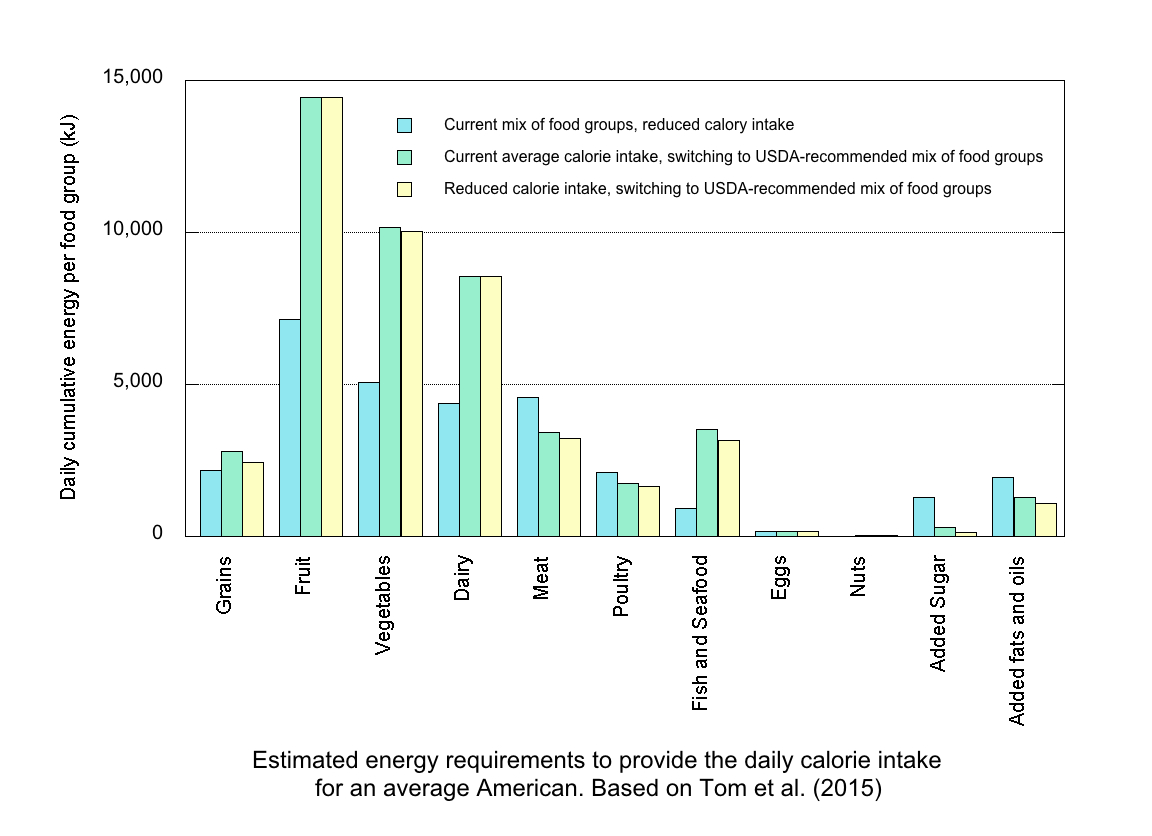
Something is seriously off with the study you cited. This image leads me to believe that the scenarios they are comparing are not remotely close in calories, which would invalidate their conclusion: https://2020science.org/wp-content/uploads/2015/12/Diet-and-...

Additionally, the study is using the USDA guidelines in their model scenarios. Those guidelines are heavily influenced by food lobbyists and are not entirely in line with what sustainability advocates have been pushing. For example, the emissions assumptions made in that paper are assuming that the replacement calories are coming from our "traditional" food system and they are not modeling in any increase in local production. i.e. replacing a chicken breast from Iowa with a bag of Apples from Chile might indeed be a net negative in terms of emissions. But that is not what food advocates are pushing for. It is more like: replace a steak with a head of broccoli from your local CSA. That would likely be very net positive in terms of emissions.

Re: Microfarms come to South L.A. frontyards, bringing fresh produce to food deserts

#48
post #2

Great hobby (I really mean that... my wife and I grow, process, and preserve a significant portion of our own produce in our front lawn), but ultimately, these are only marginally less wasteful than lawns. The distribution costs (environmental and otherwise) of having many small farms easily overpowers the current situation, which allows for more efficiency. Plus, it takes quite a bit of intense effort to farm enough…

meat is pound for pound more efficient at energy storage for humans Citation definitely needed here. Meat is an extremely inefficient vehicle for getting calories into humans.

seems fairly intuitive if you just think of fat and protein calories all being densely packed in a piece of meat vs a literal pound of lettuce? Just like people joke with celery being net negative calories, you would lose a good amount of calories just chewing all that lettuce. Almost that entire pound would be water.

Re: Microfarms come to South L.A. frontyards, bringing fresh produce to food deserts

#49
post #43
post #9

Earlier quoted context omitted.

Or people can just leave la. The idea that were all on this team together trying to find solutions is naive, you need to do what's best for yourself and your family

The idea of literally being forced out of where you were born and raised due to richer transplants isn't particularly the best thing (in a figuratively first world/developed country that is)

For all of human history people have had to move to where they can feed their kids.

The smart people are leaving, of course if you want to stay in LA and struggle your entire life you're free to

Re: Microfarms come to South L.A. frontyards, bringing fresh produce to food deserts

#50
post #40

Earlier quoted context omitted.

It's not about being sure it will work. It's about giving options for decent food to people who want it, not physically forcing it into their bodies.

$43/month for 3 pounds of veggies a week is not giving

Fixed
Post reply on HN