Live data from Hacker News

A review of correlations between big five personality types and life outcomes

dynomight.net

31–40 of 261 posts

Re: A review of correlations between big five personality types and life outcomes

#31
The question behind all of these theories of personality is "Does the measured quantity have any underlying form?" That is, are you measuring something "real" or just coming up with arbitrary classifications.

"How you answer this survey correlates this well to outcomes" is perhaps useful, but binning answers into personality types with common names is questionable.

It all seems to be a little bit too far down the road of searching for things to name and classify.

Re: A review of correlations between big five personality types and life outcomes

#32
post #21

Earlier quoted context omitted.

Is there data on that? Perceptions of intelligence are variable to practice and preparation if the measure is nonrandomized convergent standardized tests, which is not IQ but is the more accepted assessment of intelligence. IQ only seems to matter up to 135 after which other factors become more dominant in determining success.

Here's a thought. When you reach IQ 135 you start becoming "io-bound". But this is a function of the complexity of our society. As our society and technology gets more complicated the "skillcap" will shift upwards, and a higher IQ will be needed for full performance.

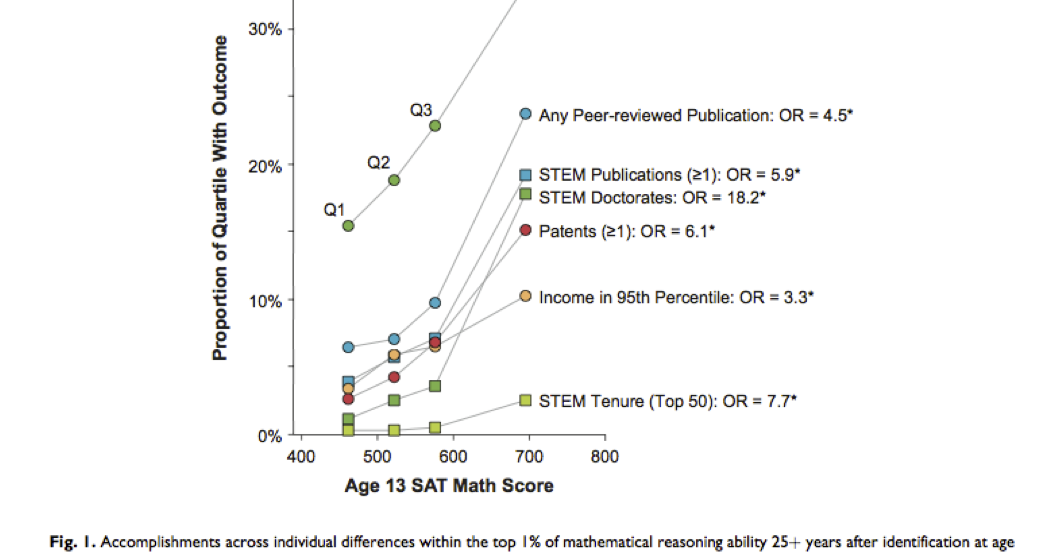
Check out SMPY - here's an image of their results showing that academic output, patents, tenure, income continues to increase well beyond IQ 135. Details in the later links.

https://4.bp.blogspot.com/-4b8ThyfDgzs/U29nQEBAQTI/AAAAAAAAE...

https://en.wikipedia.org/wiki/Study_of_Mathematically_Precoc...

https://my.vanderbilt.edu/smpy/

The obvious question is, if IQ (or whatever SAT is measuring) is irrelevant, why is it so predictive of lifetime academic output?

Also, people try to attack the SAT as nothing more than test prep - but I don't think that argument works well because it supposes you can produce kids who score 700 on the math SAT before age 13; such a training program has never been observed.

Re: A review of correlations between big five personality types and life outcomes

#33
post #9

Earlier quoted context omitted.

According to the same chart, conscientious people also seem to perform significantly better in college than everyone else. In the modern world, better GPAs are usually correlated with higher income. Interestingly, those people don't seem to do particularly well in the SAT. Perhaps their abilities are "unlocked" to the fullest only after they get into college and get a chance to make independent decisions.

> Perhaps their abilities are "unlocked" to the fullest My impression is conscientious people work within the system and don't toe the line. edit: disclosure, I am highly unconscientious, didn't finish uni etc.

“Toe the line” is pretty much a synonym to work within the system.

Re: A review of correlations between big five personality types and life outcomes

#34

Conscientiousness is by far the least popular but has the highest income. That is not at all surprising. Objectivity, right and wrong as reflected by a balance of measures, is a rare and unpopular innate personality trait that allows for making micro-decisions many people might find abhorrent, more typically based upon evidence.

I would say that's almost more disagreeable than conscientious.

Conscientious can almost be better described as 'consistent', 'doing what you say you're gong to do', 'being responsible'.

I think you might be hinting at the right thing ...

.. but 'weighing evidence in a very highly deliberative, judicial fashion' - might not be the best example of that.

Extolling the Judgment, might even land on the disagreeable side. For example, the Judge who finds a supposed murderer 'not guilty' even with the mobs of people chanting 'guilty' outside the courthouse.

I don't think 'disagreeableness' is necessarily even the right word, it's more like 'will have their own opinion even if it makes them unpopular'.

I almost think that those Big 5 could be reoriented in a way that divides people as those inclined towards populist outcomes vs. those inclined towards judicial, principled, truthful ones.

Re: A review of correlations between big five personality types and life outcomes

#35
post #16

not personality trait obviously, but in terms of success IQ probably matters more than big 5. I think personality can be improved or changed though effort but intelligence cannot. Someone who is introverted can make an effort to be extroverted in situations where it matters.

I’m just amazed that we’re still happy to condense one of the most complex phenomena, if not *the* most complex phenomenon that we were aware of into a single scalar performance value.

It seems a convenient shorthand. Intelligence is surely a multi-dimensional vector, but it’s convenient in a lot of circumstances to talk about its magnitude.

“All models are wrong; some models are useful.”

Re: A review of correlations between big five personality types and life outcomes

#36
post #9

Conscientiousness is by far the least popular but has the highest income. That is not at all surprising. Objectivity, right and wrong as reflected by a balance of measures, is a rare and unpopular innate personality trait that allows for making micro-decisions many people might find abhorrent, more typically based upon evidence.

According to the same chart, conscientious people also seem to perform significantly better in college than everyone else. In the modern world, better GPAs are usually correlated with higher income. Interestingly, those people don't seem to do particularly well in the SAT. Perhaps their abilities are "unlocked" to the fullest only after they get into college and get a chance to make independent decisions.

Getting good grades is a grind.

Being 'sufficiently smart' - plus - being organized, diligent, applying yourself consistently, will probably get you better grades than being a disorganized genius.

If everyone had the same IQ, then University grades would be actually a really, really good measure of raw conscientiousness.

Re: A review of correlations between big five personality types and life outcomes

#37
post #23

Granted this isn't a peer reviewed paper, but still, a blog that gives personality scores for historical people like presidents can't be based on data. If IQ is important, maybe it's just that intelligent people know how to take personality tests.

> maybe it's just that intelligent people know how to take personality tests Also why ADHD meds, prescribed legally, are rampant on college campuses.

While it seems that we're not in a position to discuss this issue, I am extremely interested (and worried) about the rise of prescription stimulants specifically as it relates to meritocracy and credentialing.

Re: A review of correlations between big five personality types and life outcomes

#38

Granted this isn't a peer reviewed paper, but still, a blog that gives personality scores for historical people like presidents can't be based on data. If IQ is important, maybe it's just that intelligent people know how to take personality tests.

> If IQ is important, maybe it's just that intelligent people know how to take personality tests.

What even is intelligence?

I know that IQ is what IQ tests measure, but what is intelligence?

People say my dog is intelligent, but only in response to her displays of obedience to my commands, I've noticed. I silently translate their comment about intelligence to mean "your dog is obedient."

Does an IQ test measure what makes good employees?

Does an IQ test measure what makes good employers?

Does an IQ test measure what makes good entertainers?

Does an IQ test measure what makes good leaders?

Does an IQ test measure what makes good entrepreneurs?

Does an IQ test measure what makes good spouses?

Does an IQ test measure what makes good neighbours?

Does an IQ test measure what makes good friends?

If an IQ test could measure some factor that leads to happiness, I might consider that factor to be "intelligence". But the things that make people happy vary on an individual basis, as well as over time and circumstances, so how could that be encapsulated in one static test for everybody?
Re: A review of correlations between big five personality types and life outcomes

#39
post #21

Earlier quoted context omitted.

Here's a thought. When you reach IQ 135 you start becoming "io-bound". But this is a function of the complexity of our society. As our society and technology gets more complicated the "skillcap" will shift upwards, and a higher IQ will be needed for full performance.

Check out SMPY - here's an image of their results showing that academic output, patents, tenure, income continues to increase well beyond IQ 135. Details in the later links. https://4.bp.blogspot.com/-4b8ThyfDgzs/U29nQEBAQTI/AAAAAAAAE... https://en.wikipedia.org/wiki/Study_of_Mathematically_Precoc... https://my.vanderbilt.edu/smpy/ The obvious question is, if IQ (or whatever SAT is measuring) is irrelevant, why is it…

Some amount of test prep is surely helpful in terms of understanding the test format and strategies, but it does seem (almost?) obvious that the SAT is actually measuring something other than test prep.

NB: SMPY qualifications for at least the early cohorts of the study are “before 13” (so, 12 or younger).

Post reply on HN