Live data from Hacker News

Stock Market Returns Are Anything but Average

awealthofcommonsense.com

321–330 of 433 posts

Re: Stock Market Returns Are Anything but Average

#321

Earlier quoted context omitted.

I think a lot of newcomers to stock investing in the past year have been given the wrong ideas about the stock market. When all of the headlines are about GameStop and Nokia and AMC and some kid who made it lost a lot of money on RobinHood, the stock market can feel like a place for gambling. Now that cryptocurrency prices are listed right next to stock prices, many people don’t even understand that stocks are owners…

> why stocks can have any value without paying dividends. Well, if a company was never going to issue dividends at any time in the future, or do dividend-alternatives like buybacks or a liquidation at the end of its life (not a normal option), or anything else, its shares would be worthless. I could actually imagine a tech company going out of business before its first dividend.

Many have gone bankrupt without any form of dividend. Many others have gone on for years reinvesting in the business before doing a dividend. (I'm counting as buy-back as a dividend - with modern tax code it is currently a better way to do them)
Re: Stock Market Returns Are Anything but Average

#322

Earlier quoted context omitted.

> Keep in mind that tax law highly incentivizes the avoidance of dividends. Combining Biden's capital gains tax, Federal estate tax, Biden's stepped up basis for estates, Washington state's estate tax, and Washington state's new capital gains tax, the top estate tax rate is now 70%. This ensures that tax planning will dominate investment strategies, which usually results in suboptimal investing and subsequently a low…

Whatever changes you think investors might react to need to be discounted by the likelihood of them being in a bill passed by Congress. It’s not something I know a lot about, but it seems likely that Congress will make substantial changes to Biden’s proposals?

Changes depend on time. Biden is past the early magic 100 days and now members of the house (and 1/3rd the senate) are realizing that they need to prepare for their re-election campaign in less than a year. The longer things go on the more concerned they will be.

The democrats have the government today. The most democrat heavy handed set of bills will ensure that republicans take a veto-proof majority of both houses. Different levels of watered down will have different effects. There is a reasonable chance that no matter what they do they will lose the house next election (even passing bills that the republicans would like to author but wouldn't dare!), but the exact set of laws they pass will have a big effect on both who shows up, and how voters change their votes.

Re: Stock Market Returns Are Anything but Average

#323
post #227
post #195

Earlier quoted context omitted.

There's a large difference, one of those is based on a pyramid scheme with no inherent value, and one is based on a company delivering value to customers. With the state of the stock market companies can and do go under, but generally those doing something for people dont magically disappear overnight (like any crypto certainly can.) That's it; that's the difference.

> There's a large difference, one of those is based on a pyramid scheme with no inherent value, and one is based on a company delivering value to customers. Crypto is mostly a store of wealth, similar to a currency. It's inherit value is that it is fungible, transferrable and scarce. Unlike other currencies, the supply is not at the whims of fed officials and politicians. The difference is that you can't pay taxes di…

It's surprising to me how ignorant people commenting here know about cryptocurrencies. I would have thought this group would be immune to being so confidently incorrect but once in a while a topic comes up that I know a bit more about than average and I suddenly realize the Hacker News commenters are no different than any average bunch on a Facebook group but perhaps because they are experts in their narrow field they feel it makes them an expert in any field perhaps. All the better for those of us in the know though I guess: Keep calm and HODL on!

Re: Stock Market Returns Are Anything but Average

#324
post #130

The stock market is an odd duck. What to make of it now? There's both colors of swans at work in terms of the plague, excessive money printing, per Peter Turchin (cliodynamics) a peaking cycle in civic unrest, a potential loss of reserve currency status, big changes in tech that still haven't been digested, low cost of transactions. Lotsa opportunities for froth. I'm still uncomfortable with it as a store of value. N…

I remember the banking crisis and the money printing after that, it was absolutely assumed inflation would follow, how much was debatable, but there wasn't much debate about the impending inflation. Didn't happen... for . Who knows what to make of the rules these days.

In the meltdown of 2008, about $4 trillion disappeared. The Feds pumped $4 trillion into the economy. Net result: close to zero. That was good, because the result of $4 trillion disappearing was going to be quite a deflationary crash.

The trick was going to be removing that $4 trillion that they injected at the right rate. And what actually happened is that they didn't remove it. Is it showing up now, years later, in asset inflation, because they failed to remove it all this time? I could see that.

Re: Stock Market Returns Are Anything but Average

#325

Earlier quoted context omitted.

And if you avoided the worst 10 days, your earnings double. If you avoided 20 worst days, your earning doubled again. What is the point of such trivia? That most of the profit or loss happens during the days of high volatility?

>> And if you avoided the worst 10 days, your earnings double. If you avoided 20 worst days, your earning doubled again. >> What is the point of such trivia? The point is -- it is hard to avoid/miss the 10 worst days since you dont know which ones they will be. It is easy to capture the 10 best days because the easiest thing to do is be invested all the time.

Isn’t it easy to miss the bad days because after it happens, you can buy stocks?

Re: Stock Market Returns Are Anything but Average

#326
post #102

Earlier quoted context omitted.

> depending on when you put in and take out your money the returns can be negative (even in cases where you hold up to 15 years) Sorry, but unless you're talking about truly black swan circumstances like the Great Depression or the 2008 crash, I don't believe for a second that, over a 15 year timespan, holding the S&P will result in negative returns frequently enough that a typical investor has to concern themselves…

The New York Times published the same sort of analysis in 2011: http://archive.nytimes.com/www.nytimes.com/interactive/2011/... Be sure to carefully read the description of the graph. Every time I link this, someone assumes that the green & red indicates are the yearly returns, but the entire point of this graph is that it is cumulative . If it is red 20-30 years into the line, that means that money put it at the beg…

This is an interesting visualization, but if I'm understanding it correctly it does oversimplify in a big (and potentially misleading) way:

This is what happens if you do all your investing in one big lump sum, e.g. putting one dollar in the market in 1970 and getting out less than a dollar (after inflation) in 1985.

Outside of getting a major windfall (and not dollar-cost averaging), this isn't how investing is done. Investments are typically made as income allows, over the course of decades. Yes, that means some of the dollars you put in are going to be massive losers in the long run. Others are going to be massive winners. What's important is the average over 30-year period of investing followed by a period of withdrawals spread out over another couple decades.

I'd be very curious to see a similar visualization which illustrates the same point for spans of time rather than lump-sum-in and lump-sum-out.

Re: Stock Market Returns Are Anything but Average

#327

Earlier quoted context omitted.

How do you "miss" 10 days? Unless you are a day trader (aka gambler), "normal person investing" is about trickling cash into an account slowly over time into low-cost funds/etfs, covering the grid, and pretty much never selling until retirement. Maybe a rebalance here or there over the decades, but you're never "out" unless you're paranoid and liquidate into a cash position, but refer to point A. This is the strategy…

I agree with this except I think if you know a stock or two is good, diversification is unnecessary. I’ve only had two stocks in my portfolio for the last ten years.

Ultimately it's about risk (permanent loss) control, and if you've done the research into those couple of companies, have high confidence in their continued success, and are diligent in continuing to update your views, then it sounds like you're managing risk well. There's always the chance of unknown, idiosyncratic, and potentially disruptive factors though--from a financial planning and risk management perspective, even founders are urged to diversify away from their own company's equity eventually, regardless of how successful they are.

Re: Stock Market Returns Are Anything but Average

#328
post #278

Earlier quoted context omitted.

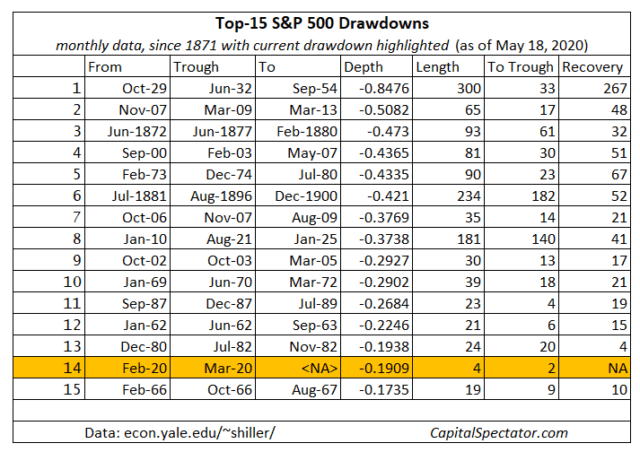
The S&P had one 22-year drawdown in its history, the Great Depression. Second place was 4 years. If people planned to contribute once in their life, the risk of buying the top before a long drawdown would be relevant. Most people spend decades of their life buying investments. Even folks with bad luck seldom buy the absolute top -- positions acquired a couple months before are out of the drawdown that much sooner. No…

> Second place was 4 years. What about mid-2000 to late-2006? And that's in nominal terms, because it underperformed cash from mid-2000 to mid-2013 (and quite longer against bonds).

Ugh, I looked at the wrong column in https://static.seekingalpha.com/uploads/2020/5/20/saupload_d... and didn't sanity check the results. Sorry for my sloppiness and misinformation.

Re: Stock Market Returns Are Anything but Average

#329
post #273

Earlier quoted context omitted.

I can attest. Beginning of covid: stocks are crashing, going down 10% every day, I read the paper from that uni in London that says we are going to be alternating light and heavy lockdowns for the next 12-18months. More than a year of lockdown? How can the economy survive this? I’m like: sell, sell, sell. Right when I sold the market went up like crazy and has more than recovered now.

Right and you probably do not follow the market very closely. Which is fine, that is most people. If you start watching it closely though (and I mean over several months to years) there are many patterns that emerge. I knew a lot of people that bought the dip last year. They weren't worried about how long it would take the economy to recover, or if it would go down further because they knew things were VERY cheap and…

That assumes you have the time to make up for bad market years like that. If you're retired and you see the market tank like that, its hard to fight the urge to not panic sell

Re: Stock Market Returns Are Anything but Average

#330

Earlier quoted context omitted.

I think this is also a reason why tables generally have set limits.

I don't think so. If you as the player make bets a series of bets, each with a negative expected value then your total expected value will also be negative. It doesn't matter if you double after every loss. The limits are mostly because the casino can't afford to take on a 20 billion dollar bet from someone like Bezos. Even if it has a positive expected value, they will still go broke the 49% of the time they lose it…

The martingale strategy works because this theoretical gambler has infinitely deep pockets to withstand the losses.

Setting bet limits can reduce the effectiveness of the martingale strategy.

Post reply on HN