Somewhere, the collective whos who of the silicon chip world is shitting their pants. Apple just showed to the world how powerful and efficient processors can be. All that with good design. Customers are going to demand more from Intel and the likes. Just imagine Apple releasing the Mx chips for server infrastructure. Intel ought to be sweating bullets now. edit: a word.
Give Mac software a few years to "catch up" and everything will feel just as slow as usual (and I'm not even joking, so far, software was always excellent at undoing any advancements in hardware very quickly).
Apple's follow-up to M1 chip goes into mass production for Mac
291–300 of 661 posts
Re: Apple's follow-up to M1 chip goes into mass production for Mac
#292Somewhere, the collective whos who of the silicon chip world is shitting their pants. Apple just showed to the world how powerful and efficient processors can be. All that with good design. Customers are going to demand more from Intel and the likes. Just imagine Apple releasing the Mx chips for server infrastructure. Intel ought to be sweating bullets now. edit: a word.
Give Mac software a few years to "catch up" and everything will feel just as slow as usual (and I'm not even joking, so far, software was always excellent at undoing any advancements in hardware very quickly).
The fact that Apple writes much of their software for iOS and MacOS at the same time means much of it is designed to run on fairly light hardware.
I know we’re all stuck with bloated stuff like Slack and some of us with MS Office, but just go native where you can it reap the benefits of the platform.
Re: Apple's follow-up to M1 chip goes into mass production for Mac
#293This would be quite an accelerated timeline if Apple ships its second-generation M-series chip only eight months after the first. Typically, they’ve followed a sort of six-month tick-tock pattern for the A-series, launching a new major revision in the fall with the new iPhone, and launching an “X” revision in the spring with new iPads. I think most observers have been expecting an “M1X” for Apple's first pro-oriented…
Having said that, Apple does have something of a history of pushing out v1 of a product that sets a high bar for everyone else to try and catch up with, then immediately pushing out a v2 that raises the bar well above where everyone else was aiming.
Overall though, it's awesome that the Macs now get to benefit from the vast investment going each year into making faster/better CPUs every year, for hundreds of millions of new iPhones.
Re: Apple's follow-up to M1 chip goes into mass production for Mac
#294Earlier quoted context omitted.
What's in it for Apple? I'm not trying to be glib, here, but unless there were some Mac only server functionality, nobody would buy an Apple ARM powered datacentre machine.
Eh, the Asahi linux people already have linux running on this chip. What's in it for Apple is money and better economies of scale for chips. But I don't really think it fits Apple's MO so I doubt they'll do it.
More specifically, people are running Linux on the CPu cores.
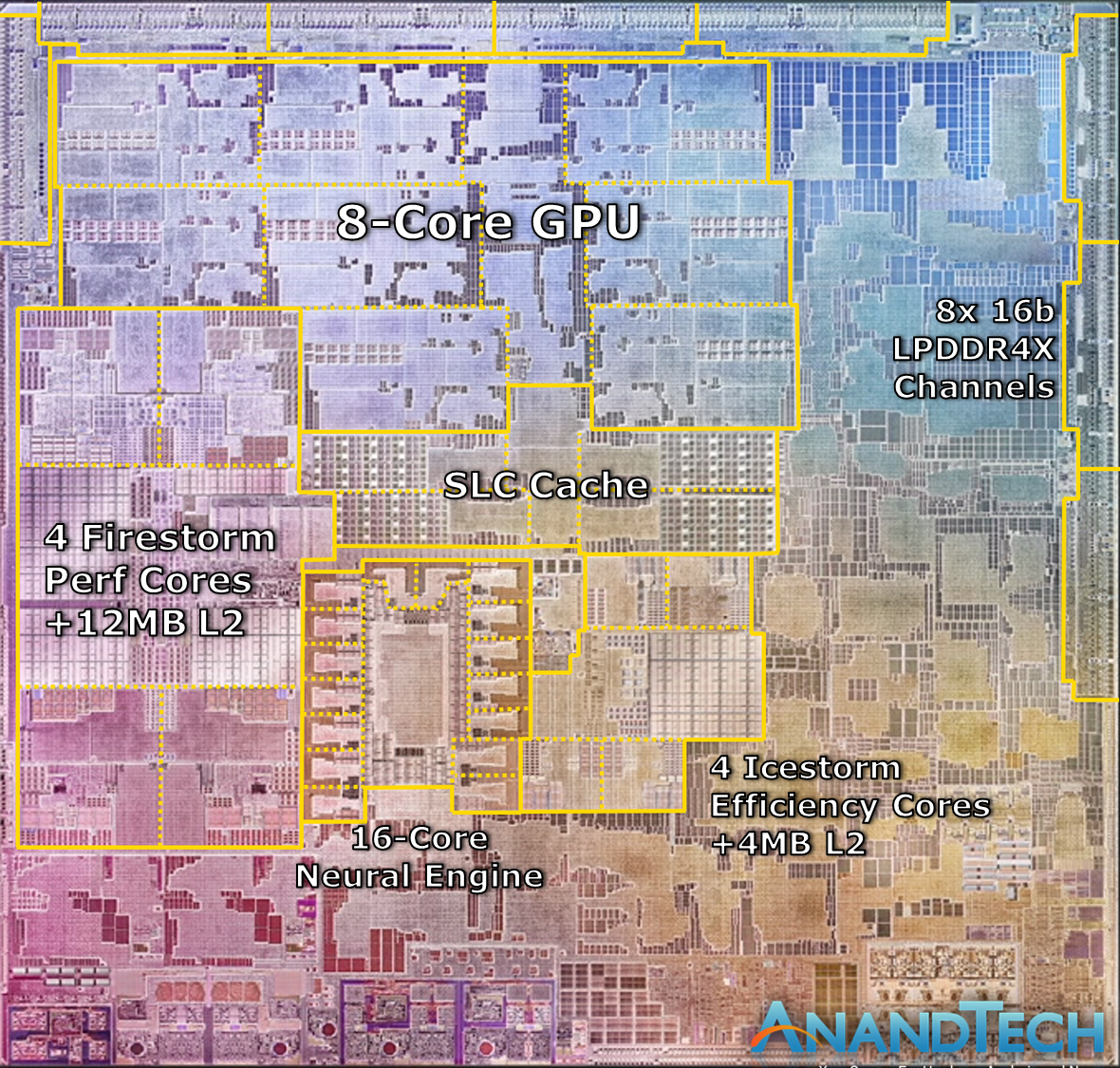
The M1 is a system-on-chip, and according to the floorplan [1], the CPUs are maybe 1/5th of the chip. There are many other features that aren't unlocked, such as GPU (which is a brand new architecture) or power management. The latter is key to exploiting the chip to its full performance envelope.
I don't expect Asahi to get anywhere further than proof-of-concept before it becomes obsolete by the march of the silicon industry.
Re: Apple's follow-up to M1 chip goes into mass production for Mac
#295Earlier quoted context omitted.
Give Mac software a few years to "catch up" and everything will feel just as slow as usual (and I'm not even joking, so far, software was always excellent at undoing any advancements in hardware very quickly).
If you don’t run Electron apps, even an older Mac will fly. My 2015 is still astoundingly fast, it just doesn’t have Chrome bogging it down.
Re: Apple's follow-up to M1 chip goes into mass production for Mac
#296This would be quite an accelerated timeline if Apple ships its second-generation M-series chip only eight months after the first. Typically, they’ve followed a sort of six-month tick-tock pattern for the A-series, launching a new major revision in the fall with the new iPhone, and launching an “X” revision in the spring with new iPads. I think most observers have been expecting an “M1X” for Apple's first pro-oriented…
An M2 name implies some architectural differences like extra cores or more external bandwidth. I'd be totally happy with an M1x with some tweaks like more external connectivity and more memory.
Which, for me, would be quite perfect. The only reason I'm holding back this purchase is the 16 GB memory limit.
Re: Apple's follow-up to M1 chip goes into mass production for Mac
#297Somewhere, the collective whos who of the silicon chip world is shitting their pants. Apple just showed to the world how powerful and efficient processors can be. All that with good design. Customers are going to demand more from Intel and the likes. Just imagine Apple releasing the Mx chips for server infrastructure. Intel ought to be sweating bullets now. edit: a word.
In a server high load environment, is this still the case? Continuous load, consistent jobs -- is the M1 still that much better or does its advantages decrease?
Re: Apple's follow-up to M1 chip goes into mass production for Mac
#298Earlier quoted context omitted.
Give Mac software a few years to "catch up" and everything will feel just as slow as usual (and I'm not even joking, so far, software was always excellent at undoing any advancements in hardware very quickly).
Maybe for some low hangers, but compiling code will still be faster, XCode and VSCode will be a bit snappier, Safari and Messages will be a bit better. These base things need to work on a broad range of products. The fact that Apple writes much of their software for iOS and MacOS at the same time means much of it is designed to run on fairly light hardware. I know we’re all stuck with bloated stuff like Slack and som…
I don't know about that, LLVM is getting slower with each new release too [1]. Same for Xcode: startup is very noticeably slower than a few years ago on the same machine. Starting into a debugging session for the first time is much slower (it used to be instant, now it's multiple seconds). The new build system in Xcode is most definitely slower than the old one, at least for projects with more than a handful compile targets. Etc etc etc... new software is only optimized to a point where performance doesn't hurt too much on the developer's machine.
[1] https://www.npopov.com/2020/05/10/Make-LLVM-fast-again.html
Re: Apple's follow-up to M1 chip goes into mass production for Mac
#299Earlier quoted context omitted.
> The real issue is not shipping the M1 with LPDDR5 support. I brought this up before but it was pointed out to me that the only manufacturer of LPDDR5 last year was Samsung, which was producing not-completely-standardized LPDDR5 at the time and probably didn't have enough spare volume for Apple anyway. Having 12GB LPDDR4X modules from one vendor (24GB total) probably is not enough reason for Apple to switch up their…
16GB is not "low memory" for the vast majority of users.
Re: Apple's follow-up to M1 chip goes into mass production for Mac
#300Earlier quoted context omitted.
> The real issue is not shipping the M1 with LPDDR5 support. I brought this up before but it was pointed out to me that the only manufacturer of LPDDR5 last year was Samsung, which was producing not-completely-standardized LPDDR5 at the time and probably didn't have enough spare volume for Apple anyway. Having 12GB LPDDR4X modules from one vendor (24GB total) probably is not enough reason for Apple to switch up their…
16GB is not "low memory" for the vast majority of users.
Everyone raves about how 8GB machines feel, but the massive SSD usage and pitiful lifespan shows that there’s not a free lunch here. 16GB (or a 24GB option) goes a long way toward preventing early death. I actually suspect they’ll be launching a free SSD replacement program in the next couple years.
I’ve also heard claims from a couple devs that side-by-side comparisons with their x86 macs show a massive increase in RAM usage for the same app for whatever reason. I’d guess that’s solvable, but could contribute even more to the SSD problem. On the bright side, all this seems to indicate a great pre-fetch and caching algorithm.