Print debugging is great but you'll pry the IntelliJ debugger from my cold dead hands.
The unreasonable effectiveness of print debugging
51–60 of 366 posts
Re: The unreasonable effectiveness of print debugging
#52I think it has most to do with way user thinks.
I need to see big picture, whole state, all the stuff and rapidly jump back and forth. I also, supposidely, have ability to keep a lot of state / scope/ abstraction in my head. So I find print debugging sufficient and fast. Rarely encounter situation I feel need for "stronger" tool.
Where other people focus on one thing, all that simultaneous output is just noise and distraction to them. And based on the continued use and popularity of step-based debuggers, these people are much more productive (and happier) using those type of tools.
It's very important to understand neither system is inherently superior. Although one or the other is superior to each individual. [btw over 35yrs of tech industry / software development I've found this true, that tools/paradigms are not universally superior but are superior based on individual) for many subjects. All the ones that have internal debates in techdom]
Re: The unreasonable effectiveness of print debugging
#53IDE vs Text editor. OOP vs Functional. Logger vs debugger. The holy wars that shouldn't be. Why can't we all be friends and accept that Vim is better than emacs.
I used to think like you, friend! For over a decade, then I discovered doom emacs :)
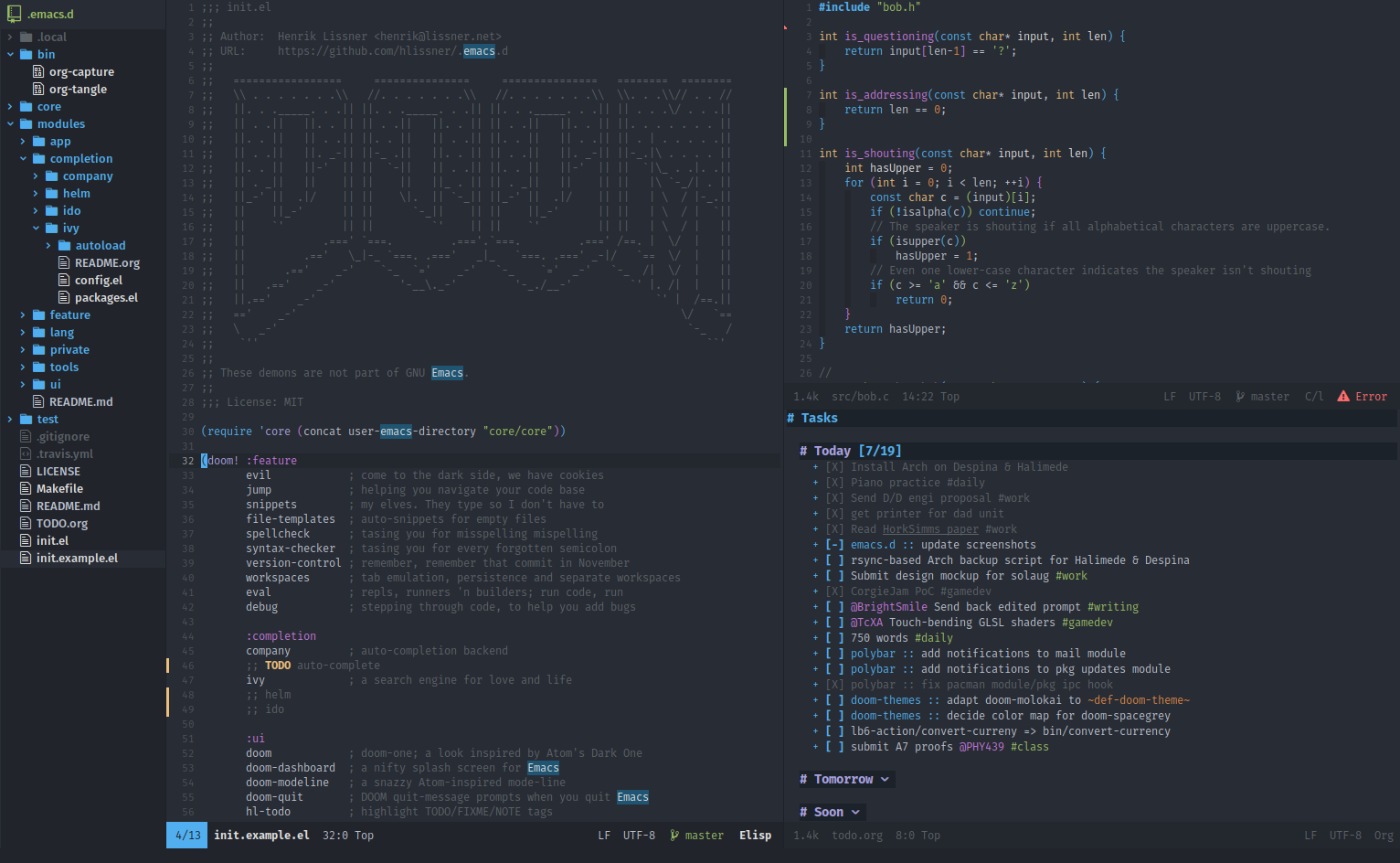
Wow, by looking at this screenshot (https://raw.githubusercontent.com/hlissner/doom-emacs/screen...), is doom emacs a terminal/console program or a GUI program?!
Re: The unreasonable effectiveness of print debugging
#54You call it print debugging, I call it a powerful experimental framework for testing hypotheses about the behaviour of the program.
Re: The unreasonable effectiveness of print debugging
#55Personally, I think my biggest reason for using print debugging is.. it works. In C++ I often find the debugger doesn't find symbols on projects built with configure/Make. If I have a Java Gradle project I have no idea how to get it into a debugger. Python debuggers always seem fragile. Rust requires I install and use a "rust-gdb" script -- except on my current machine that doesn't work and I don't know why. I'm sure…
I’m sorry but this is just ignorance, learning to use the debugger for the platform at hand is a basic skill every developer should master. So many times have seen developers use the debugger to troubleshoot and fixed issues and been perceived as a “ninja” (despise that term but that was the effect) because they knew how to use the debugger. I mean yeah keep printing lines, and keep being out performed by your debugg…
I do use debuggers when I have a hard core problem, I've found some horrible memory corruptions using RR and gdb for reverse debugging. However, sometimes someone throws a horrible gradle java project at you and asks for help, and figuring out how to debug is a pain.
I'd throw your comment back -- maybe all languages should be "debug first", make it as easy to get code into a debugger as it is to just build and run it.
Re: The unreasonable effectiveness of print debugging
#56IDE vs Text editor. OOP vs Functional. Logger vs debugger. The holy wars that shouldn't be. Why can't we all be friends and accept that Vim is better than emacs.
How's file exploring and method/class definition lookup these days in Vim?
Re: The unreasonable effectiveness of print debugging
#57A few more reasons why print debugging is used. If you are debugging multiple things at once, you’ll have breakpoints set that aren’t necessarily needed at the moment, meaning you have to continue a bunch of times to get to the right spot. Or your breakpoint needs to be in a loop that is called multiple times and conditional breakpoints are a pain and subject to code errors in the condition itself. Many debuggers are…
> you’ll have breakpoints set that aren’t necessarily needed at the moment, meaning you have to continue a bunch of times to get to the right spot.
Python: if something: breakpoint()
Js: if (something) debugger;
Much easier than breakpoint conditions in visual debuggers imho.
Re: The unreasonable effectiveness of print debugging
#58I hate coding in an environment that does not easily support step-wise debugging. And yet, I use printf 10x-100x more frequently. Printf is actually causing you to do some thinking, and writing a little bit of code to conduct an experiment that hopefully will tell you in one shot what the problem is on a simple run. Step-wise debugging instead forces you to think about the problem, but then go through carefully and run a lot of mental load at each "next step" push to figure it out.
That being said, there's almost no good reason for a platform to not support step-wise debugging, so it's a big code smell that you're going to have a bad time in general there (even if in practice you'd largely use printf anyway).
Re: The unreasonable effectiveness of print debugging
#59I disagree slightly with the emphasis on "print debugging". I think what is missing is a body of theory around logging as a methodology. When I write code, I like to be able to look at the log file and "see" what the code is doing, when on DEBUG or higher. I think logging is a difficult but very important skill, and one which we are losing over time. If anyone is aware of any good books on logging (even if very old), do let me know. Seems like "logging theory" is a missing subject in Software Engineering.
I also don't see any contradiction between liking good logs and using the debugger when needed.
Re: The unreasonable effectiveness of print debugging
#60I have never spent much time learning debuggers honestly. I'm not sure if what I want exists:
I would love to have a debugger that offers a partial text editor experience, eg. it shows my code, I move the cursor to some statement, then I press some key binding and the debugger starts printing (in another window) all the state changes in that statement. Another key binding prints all the state changes in the entire function, etc. All of this while the program is running.
Are there debuggers that can do this? I have used gdb in the past, but having to set up breakpoints by hand and remembering names makes it too tedious.