Nice, but it would be even nicer with emissions data, e.g. from ESA's Sentinel-5P satellite:
https://www.esa.int/Applications/Observing_the_Earth/Coperni...
251–260 of 436 posts
https://www.esa.int/Applications/Observing_the_Earth/Coperni...
Earlier quoted context omitted.
Almost all (80-90%?) of the human footprint is making food. To try to grow our food and ensure biodiversity on the SAME LAND is going to be less productive per acre and would mean even MORE of the Earth’s surface is needed to feed humanity. That’s a losing proposition as we’re already near land usage limits in much of the world that uses less efficient production methods. The best way to ensure biodiversity is to INC…
I agree that we should ideally minimize our agricultural footprint and turn everything else into a nature reserve. But we’ve got to work from the realities of where we are today. Consider this image: https://www.bloomberg.com/graphics/2018-us-land-use/img/2018... Notice that for the USA for example, not very much of the land is state or federal parks. The vast majority is used by humans in some way, and the reality i…
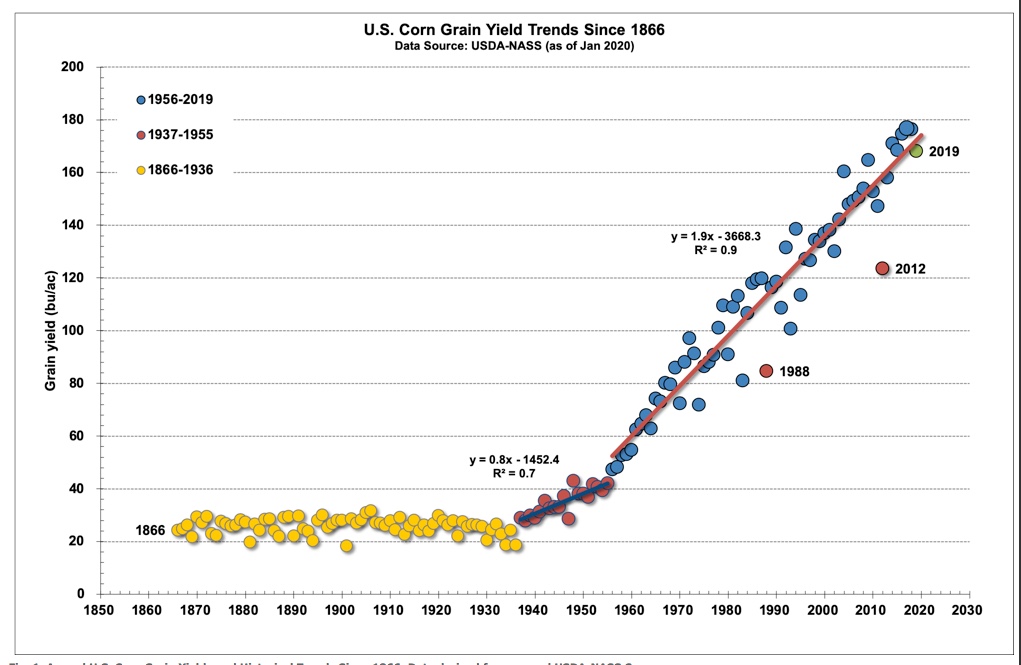
As far as actually farmed land, productivity has increased by an order of magnitude, MUCH faster than population, so we actually farm less land than in the 40s in spite of having a much larger population that eats more. We burn that corn in our cars, for goodness sake. The land area use for ethanol corn in our country is more than enough area to convert the entire nation’s electric production to solar.
Corn yields: https://extension.entm.purdue.edu/newsletters/pestandcrop/wp...
Earlier quoted context omitted.
This discussion reminds me of Isaac Asimov's favorite story, The Last Question https://www.multivax.com/last_question.html
Sorry to nitpick, but is it your favorite story of Asimov's or has he actually said it was his own favorite?
https://www.openculture.com/2015/06/isaac-asimovs-favorite-s...
Earlier quoted context omitted.
You can say the same thing about ant colonies. I think it's probably just what anything that groups and branches around resource deposits looks like. If I recall slime molds are optimal planners regarding surrounding resources so it just sounds like a natural optimality to me. I'd be more interested in what you think it "should" look like for an "advanced" species besides optimal? Looking at it is disparagingly is we…
> I'd be more interested in what you think it "should" look like for an "advanced" species besides optimal? In a word, sustainable. An advanced civilization should be able to develop in a coordinated and self sustaining way, rather than as a grand experiment in tragedy of the commons. Microbes don’t coordinate their growth, and therefore fall into boom-bust cycles that dominate and exhaust their local environment. Hu…
What's really striking to me about timelapse videos of the Earth is how, at a grand enough scale, the growth of human settlements on Earth really looks no different than the growth of bacterial and fungal colonies on Petri dishes. We think of ourself as special, as having conquered environments, technology and more - and when zoomed out you could explain everything we've built and accomplished as the achievements of…
"Every mammal on this planet instinctively develops a natural equilibrium with the surrounding environment but you humans do not. You move to an area and you multiply and multiply until every natural resource is consumed and the only way you can survive is to spread to another area. There is another organism on this planet that follows the same pattern. Do you know what it is? A virus. Human beings are a disease, a c…
Yet people breed anyway, for a multitude of selfish reasons. Everyone else is having babies so why shouldn't I, it's my right as a human to reproduce, I want to pass on my genes, I want my life to be fulfilling, I don't want to die alone, the list goes on. It is these lines of thinking that have caused our population to balloon to over 7 billion people with no end in sight.
No one is thinking of the planet.
What's really striking to me about timelapse videos of the Earth is how, at a grand enough scale, the growth of human settlements on Earth really looks no different than the growth of bacterial and fungal colonies on Petri dishes. We think of ourself as special, as having conquered environments, technology and more - and when zoomed out you could explain everything we've built and accomplished as the achievements of…
"Every mammal on this planet instinctively develops a natural equilibrium with the surrounding environment but you humans do not. You move to an area and you multiply and multiply until every natural resource is consumed and the only way you can survive is to spread to another area. There is another organism on this planet that follows the same pattern. Do you know what it is? A virus. Human beings are a disease, a c…
Earlier quoted context omitted.
"Every mammal on this planet instinctively develops a natural equilibrium with the surrounding environment but you humans do not. You move to an area and you multiply and multiply until every natural resource is consumed and the only way you can survive is to spread to another area. There is another organism on this planet that follows the same pattern. Do you know what it is? A virus. Human beings are a disease, a c…
This is why I think reproduction is unethical. We have the capacity to understand the implications of birthing new sentient lifeforms, knowing the harm it will cause to the planet and the other species we share it with. Yet people breed anyway, for a multitude of selfish reasons. Everyone else is having babies so why shouldn't I , it's my right as a human to reproduce , I want to pass on my genes , I want my life to…
What's this whole guilt shaming all about? And must the voice in the video be British and the sound of a girl on the verge of crying? Finally I don't think there is anything wrong with more farmlands in poor countries in South America. That's extremely hypocritical when the West did the same thing only a couple of hundred years ago and continues to do to this day, but oh if the poor South Americans learn how to farm…
Earlier quoted context omitted.
I agree that we should ideally minimize our agricultural footprint and turn everything else into a nature reserve. But we’ve got to work from the realities of where we are today. Consider this image: https://www.bloomberg.com/graphics/2018-us-land-use/img/2018... Notice that for the USA for example, not very much of the land is state or federal parks. The vast majority is used by humans in some way, and the reality i…
That “cow pasture/range” chunk is largely extremely low productivity scrub land owned by the federal government and leased basically for free by cattle folk. We could convert all of it to national parks without much more than a blip in food calories produced in the US. As far as actually farmed land, productivity has increased by an order of magnitude, MUCH faster than population, so we actually farm less land than i…
Agreed!
I would emphasize restoration and protection in almost every case.
Just that there’s also ways we can work towards conservation on land that is being utilized too.
You talked about farms but there’s also: managed forests, anywhere anything is grazing, private lands, fisheries, artificial reefs and kelp forests, any area we already use which we can also stack on an incidental conservation benefit ontop of (as you mentioned renewable energy infrastructure will be a big one, the book I mention is full of other surprising examples such as military bases), things like wildlife underpasses, suburban lawns, and so on. This adds up to a lot of land.
I hope we protect half of the land and ocean like Edward O. Wilson and other major biologists recommend, but also I think it’s smart to look at everything and not just protected areas.