Live data from Hacker News

How People Get Rich Now

paulgraham.com

451–460 of 941 posts

Re: How People Get Rich Now

#451
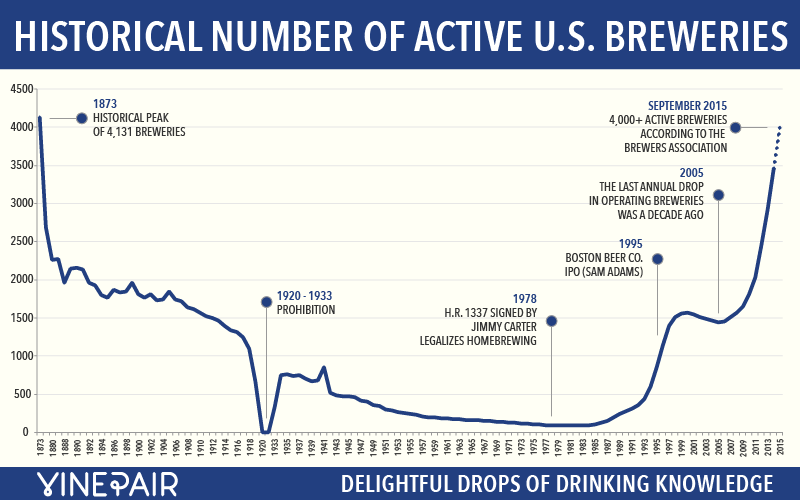
This reminds me of a graph of breweries in America over the last 100+ years.

I think the line started around 3k or 4k breweries across America around 1900, reached an all-time low in the 1970-1990s and now were back up to where we started.

Of course, the story here is refrigeration. When refrigeration was not common place, you needed a lot of breweries near consumption.

I'm also thankful for the variety of beer options we have today.

edit: this might have been the image I remember - but theres no data source mentioned: https://vinepair.com/wp-content/uploads/2015/11/historical-b...
Re: How People Get Rich Now

#452

Earlier quoted context omitted.

I hate this comparison. Stock based compensation didn't exist in 1965. It's an oranges to apples comparison. CEO salaries today are still about 20-1, depending on the business. For instance: - Doug McMillon of Walmart makes $1.2 million in salary. - James Quincy of Coca-Cola makes $1.5 million in salary. - JPMorgan's CEO Jamie Dimon has a $1.5 million salary. - Sundar Pichai of Google makes $2 million in salary. You…

Why can’t employee compensation also come from diluting Wall Street? Why do they vast majority of those benefits go to top executives?

Performance and incentive alignment. John Doe stacking pallets at the Coca Cola factory really won't produce much better top or bottom line results for the business if you offer him a stock bonus. His forklift only drives so fast, and he plays a very minute part in the direction of the business. The CEO on the other hand can have a huge impact, and it's why shareholders choose and vote on certain incentives and bonuses.

But more importantly, in other businesses this type of comp is certainly offered. If you work in a small startup in any position, you probably get stock options, because your performance on a 10 or 20 person team probably does have real noticeable and measurable impact on the business's success.

Re: How People Get Rich Now

#453

Strangely, an explanation for the increased number of wealths coming from new, tech companies and investments that is ignored in his post is the disturbing fact it was taken from the average employee cut of the profits. See this: https://www.theguardian.com/business/2018/aug/16/ceo-versus-... I quote: "The 2017 CEO-to-worker compensation ratio of 312-to-1 was far greater than the 20-to-1 ratio in 1965, and more than…

I hate this comparison. Stock based compensation didn't exist in 1965. It's an oranges to apples comparison. CEO salaries today are still about 20-1, depending on the business. For instance: - Doug McMillon of Walmart makes $1.2 million in salary. - James Quincy of Coca-Cola makes $1.5 million in salary. - JPMorgan's CEO Jamie Dimon has a $1.5 million salary. - Sundar Pichai of Google makes $2 million in salary. You…

> They come from diluting Wall Street.

Yes, until the company offers a stock buyback (which these companies collectively spent more than 50 billion on in 2020)

Re: How People Get Rich Now

#454

Strangely, an explanation for the increased number of wealths coming from new, tech companies and investments that is ignored in his post is the disturbing fact it was taken from the average employee cut of the profits. See this: https://www.theguardian.com/business/2018/aug/16/ceo-versus-... I quote: "The 2017 CEO-to-worker compensation ratio of 312-to-1 was far greater than the 20-to-1 ratio in 1965, and more than…

I hate this comparison. Stock based compensation didn't exist in 1965. It's an oranges to apples comparison. CEO salaries today are still about 20-1, depending on the business. For instance: - Doug McMillon of Walmart makes $1.2 million in salary. - James Quincy of Coca-Cola makes $1.5 million in salary. - JPMorgan's CEO Jamie Dimon has a $1.5 million salary. - Sundar Pichai of Google makes $2 million in salary. You…

You're not wrong, but the perspective feels like missing the forest for the trees. So what if stock-based compensation was uncommon in 1965? The average employee doesn't get to benefit from the very real contributions they've made to the company, while the CEO does benefit. Why didn't employee profit-sharing increase at the same rate as non-salary compensation did for CEOs? That's still relevant.

Additionally, your comment leaves out the golden parachute CEOs often have, which is orders of magnitude greater than most severance packages, if there's even a severance package in place. Financially, it's pretty hard to fail as a CEO of just about any public company; even in failure, you profit considerably.

Re: How People Get Rich Now

#455
post #155

This essay feels really dishonest. It tries to simplify the vastly complex problem of income inequality, on which there is a sea of existing, detailed research, into a simple "it's easier to start companies now" argument. And it doesn't even explore that argument in that much depth. What about bottom incomes? Why have those barely increased in real terms in the last 30 years, while the top 1% of incomes has been shoo…

It's not just dishonest -- it's gross. Paul needs to spend less time on yachts. Being a mouthpiece to try to find a morality in increasing income inequality, when so many are suffering, more each year, is simply vile.

> You would think, after having been on the side of labor in its fight with capital for almost two centuries, that the far left would be happy that labor has finally prevailed. But none of them seem to be. You can almost hear them saying "No, no, not that way."

This line is particularly disgusting. Labor has not prevailed. Labor in fact has been crushed by deregulation, union busting, automation, and most importantly globalization. Real wages have been stagnant for over 40 years while the cost of living continues to increase.

Paul Graham is delusional. He thinks that we're all getting richer because 0.01% of the population has the means to start a startup.

Re: How People Get Rich Now

#456
I've been noticing an increasingly bimodal distribution of success among startup founders, at least locally. I see more stories of unbelievably large funding rounds online every day. I read non-stop Tweets about how easy it is to secure funding. Locally, we have a few lucky founders tapping into this easy capital and raising valuations that would have seemed impossible a few years ago.

Yet outside of the lucky few founders securing this money, I see a lot of founders struggling to even get the attention of VCs. I know several otherwise successful local startups with good founders that have been failing to raise for months or even years because they don't fit the mold of a potential rocketship startup. In some ways, having established customers and a working business model with self-sustaining revenue is a negative sign for investors looking for the next 100x investment or quick flip opportunity.

Re: How People Get Rich Now

#457

Earlier quoted context omitted.

I hate this comparison. Stock based compensation didn't exist in 1965. It's an oranges to apples comparison. CEO salaries today are still about 20-1, depending on the business. For instance: - Doug McMillon of Walmart makes $1.2 million in salary. - James Quincy of Coca-Cola makes $1.5 million in salary. - JPMorgan's CEO Jamie Dimon has a $1.5 million salary. - Sundar Pichai of Google makes $2 million in salary. You…

Why can’t employee compensation also come from diluting Wall Street? Why do they vast majority of those benefits go to top executives?

The benefits should go to whoever is responsible for the success of the company. This obviously opens up a political can of worms: the Left will say the CEO can't get anything done without the workers, the Right will say the workers can't get organized without the CEO (eg: what was Apple doing before Steve Jobs came back?). The workers can obviously leave and seek employment elsewhere. So can the CEO.

For better or worse, the data presented in the parent post indicate that the market seems to be increasingly siding with the CEO-side of the above argument. I am not really sure that there's a simple regulatory move that would negate that (eg: you can cap salaries, but CEOs make most of their money from stocks. You might be able to cap how much stock a hired CEO can own, but most of the wealthiest people like Bezos and Zuck are founders).

Re: How People Get Rich Now

#458
post #324

There's some nuggets of truth in here, but I am disappointed that this article sidesteps what I feel is the most important reason for startup success in 2020: easy and abundant access to cheap capital. - Interest rates are at all time lows, borrowing is cheap - The Fed's balance sheet is at an all-time high. The economy is flush with cash, particularly the investor / VC class - This excess cash creates an (arguably a…

> - Large unicorn startups that are perpetual money losers continue to operate only because they are effectively subsidized by regular capital raises. Look no further than all the Silicon Valley darlings such as Uber, Netflix, AirBnb, Tesla, and so on. All of them would cease to exist without continued capital injection from secondary share offerings or VC raises

You should look up the financial statements of the companies in your list.

Re: How People Get Rich Now

#459

Earlier quoted context omitted.

https://www.visualcapitalist.com/the-decline-of-upward-mobil... Here's a chart that tries to show the decline of upward mobility in the U.S. with an article that explains it. While, from the reading I did while trying to find this - which was not a huge amount - it does appear down, somewhat, worldwide, it is in a much sharper decline in the U.S. on average. This, of course, is in comparison to European nations. Not…

Looking at that link, in particular I really like the 3 tier "chance of out-earning parents" chart because it shows that while average upward mobility may have gone down, there's a sharp decrease in upper classes moving up while the decrease for lower classes is much less. This means that the rich in fact get richer less so than lower class people move up, and by a huge margin, than in the mid 20th century. Also I li…

And, let's be honest, poverty and poor in the 40's and 50's was very different than poverty and poor in todays imaginations. I'm not saying it's fantastic and that the safety nets are great, but they exist. Especially for single mothers, which weren't thought of in the 40's and 50's. I'm not one who glorifies the 60's, but it did help reproductive rights (which is a big step out of a poverty cycle) and it brought in help for single mothers, from church groups to government.

Re: How People Get Rich Now

#460

Earlier quoted context omitted.

I understand the comparison, but the FSF can exist without RMS. PG on the other hand solely supports HN, I doubt he would continue to pay for a site that vilified him.

This site is mainly supported by its volunteer moderators. I doubt it cost more than a few thousand a year at most to run. So the fact that PG pays for it doesn't mean much. If the community decided to no longer be under his care, they could easily find a replacement model or benefactor and they're more than capable to arrange such an uprising/migration.

Pretty sure dang is not a "volunteer moderator".
Post reply on HN