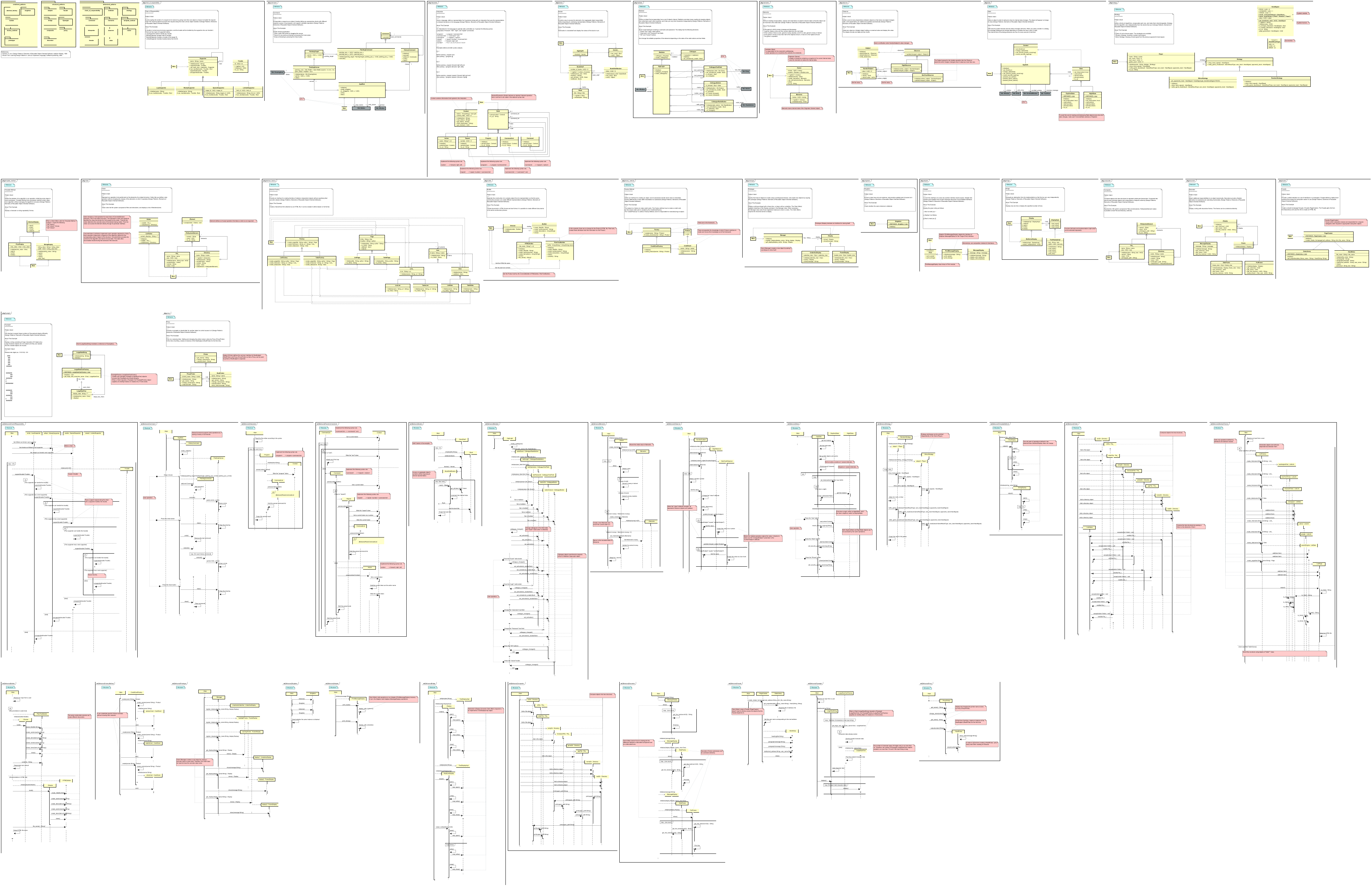
Show HN: UML model and code examples of GoF patterns in Crystal
1–10 of 19 posts
Re: Show HN: UML model and code examples of GoF patterns in Crystal
#2I guess GoF means „Gang of Four“ Design Patterns (for anyone else wondering).
Re: Show HN: UML model and code examples of GoF patterns in Crystal
#3During its heyday I was an active supporter of UML.
Nowadays, I hardly ever hear of it. Does anybody use it any more?
Re: Show HN: UML model and code examples of GoF patterns in Crystal
#4During its heyday I was an active supporter of UML. Nowadays, I hardly ever hear of it. Does anybody use it any more?
Using UML implies that someone is planning development more then a week ahead, be agile man, no plans, no docs and no time for unit tests.
Re: Show HN: UML model and code examples of GoF patterns in Crystal
#5During its heyday I was an active supporter of UML. Nowadays, I hardly ever hear of it. Does anybody use it any more?
Using UML implies that someone is planning development more then a week ahead, be agile man, no plans, no docs and no time for unit tests.
Using UML implies that someone actually studied what different arrow types mean.
Re: Show HN: UML model and code examples of GoF patterns in Crystal
#6During its heyday I was an active supporter of UML. Nowadays, I hardly ever hear of it. Does anybody use it any more?
Not really, everybody is up to their own Heuristical Modelling Language, that is simply based on custom circles/rectangles. Shockingly, works pretty well (and faster to draw) if there's some context understanding between people who read the graph.
Re: Show HN: UML model and code examples of GoF patterns in Crystal
#7During its heyday I was an active supporter of UML. Nowadays, I hardly ever hear of it. Does anybody use it any more?
Last year, I used the UML static object modeling notation for understanding and documenting an existing RDBMS schema. Also last year, I used some of the UML state modeling (or Harel Statecharts) for getting the UI right for a SwiftUI app. Earlier this year, I used DeMarco-Yourdon DFDs (but we can call it UML) for business process modeling. (And our director of marketing picked it up instantly, and even had an insight into some structure of the data flows between some processes, because of this formalism.) And I'll probably use UML imminently for a new schema, if it turns out to be nontrivial.
I used to use UML (well, OMT, but fortunately Rumbaugh's notation won over Booch's for UML) constantly, when I was doing lots of Java. I worked on high-end CASE and methodology, and on the side I made a convenient little tool to help go from OMT to Java, and keep it up-to-data (in conjunction with Rumbaugh's own OMTool): https://www.neilvandyke.org/jomtool/
One thing to know about these system analysis&design methodologies (before UML, there were maybe a dozen prominent ones) and their various diagrams is that the user bases seemed to change over time. If you were a technical developer of a large system, or maybe a certain kind of big embedded systems developer, you might use it. If you were a database architect, there was a different camp for that, and they had different needs and tools. At some point, maybe around the time that Java was adopted for corporate internal IS development, the UML I occasionally saw was usually simply as a way of visualizing class inheritance hierarchies (and summarizing their Java attribute and method signatures). Which is fine, but it's only a fraction of the benefit they could get from higher-level modeling and documenting, with even that one kind of UML diagram.
Re: Show HN: UML model and code examples of GoF patterns in Crystal
#8During its heyday I was an active supporter of UML. Nowadays, I hardly ever hear of it. Does anybody use it any more?
I use it. Diagrams are easy to grasp especially when the alternative is lots of text. UML2 is a good specification IMHO. There are tools that let's you model your solution, which makes it easy to maintain it.
https://www.omg.org/spec/UML/About-UML/
Re: Show HN: UML model and code examples of GoF patterns in Crystal
#9During its heyday I was an active supporter of UML. Nowadays, I hardly ever hear of it. Does anybody use it any more?
Just discovered plantuml and liked it - i can use some visual aid if only i do not have to draw it.
Sequence and use case diagrams are useful. Class diagrams i would rather see in code.
I also misuse use case diagrams for arbitrary graphs. It is good to see if a graph i came up with looks too much like spaghetti. Helps to untangle it. But it is not proper UML and i could use the graphviz dot itself for it without plantuml frontend.
Re: Show HN: UML model and code examples of GoF patterns in Crystal
#10Great stuff - I love the map: https://raw.githubusercontent.com/takaakit/design-pattern-ex...