Live data from Hacker News

Lithium battery costs have fallen by 98% in three decades

economist.com

241–250 of 424 posts

Re: Lithium battery costs have fallen by 98% in three decades

#241
post #143
post #86

Earlier quoted context omitted.

> Say you have an opinion piece in a news paper that says that electric cars will always be expensive toys for the rich. Well, you don't see poor people buying EVs that much. That's car manufacturer statistics, which I believe deserves a good degree of trust. In the market for new cars, poor people buy cheapest IC cars, but not cheapest EVs. I will take the point that middle class is now buying budget EVs, but you do…

Well, this is the argument against EV from the beginning. Literally people were shitting on Tesla because they started with a the Roadster. Now they have a much, much better car for significantly lower price produced at much, much higher volume. This is just gone continue, each generation produced will move down market. Poor people will never buy new cars, but 2nd hand Bolt EV are already a bargain considering what y…

Bolts are a bargain right now because of a safety issue so serious it has a STOP-SELL RECALL order, meaning dealerships aren't allowed to sell them until its fixed, which happens sometime this month.

https://electrek.co/2021/02/18/bolt-ev-recall-chevy-software...
Re: Lithium battery costs have fallen by 98% in three decades

#242

It’s remarkable what energy dense batteries have enabled. Drones and the entire quadcopter scene wouldn’t be possible without them. Some maneuvers made on a 5” quad can pull more than 100 amps on a 6S, 22V battery. That is around 2,200 watts—more than most consumer microwave ovens! The fact that a battery weighing no more than half a kilogram can supply this much power almost instantly is truly remarkable.

Zero-Point Energy Modules when?

Re: Lithium battery costs have fallen by 98% in three decades

#243

Earlier quoted context omitted.

There's an Australian expression, "If you want to go into the bush, take a Land Rover. If you want to get out of the bush, take a Land Cruiser."

Your special forces still use Land Rovers on operations! https://en.wikipedia.org/wiki/File:Australian_SOTG_patrol_Oc...

Negative, Ghost Rider. American spec ops prefer, and often use, Toyota Land Cruisers and HILUXs, for the very reason behind the Australian proverb! :)

Re: Lithium battery costs have fallen by 98% in three decades

#244

I'm pretty interested to know what parts of this cost have hit their practical limit, and which still have cost to be squeezed out? -- Mineral scarcity/cost of mining -- Cost of processing, refining lithium -- Cost of making battery chemical contents -- Cost of assembling rest of complete battery Any info on how much more advance there is to go on these aspects? And, after all that is squeezed out, is lithium still g…

> -- Mineral scarcity/cost of mining

It's one of the more common elements on earth. There is no scarcity. Just cost of extraction.

> -- Cost of processing, refining lithium

Generally dropping. Also batteries can be recycled after their decades of useful life. It's not an expended resource, unlike anything oil based. Otherwise economies of scale apply. It's getting cheaper.

>-- Cost of making battery chemical contents

Non zero. But they last long (decades) and you can recycle. Maybe compare to a gallon of diesel which you extract, refine, and transport at great cost. Then you burn it and lose the ability to recycle it. It's almost obscene how inefficient that is in comparison. So the answer is infinitely better than anything ICE.

>-- Cost of assembling rest of complete battery

Seriously?! I refer you to the latest production statistics of the likes of Tesla, VW, LG and a few other manufacturers that have failed to collapse during the recent economic crisis by virtue of doing a generally great job of growing their business in the middle of a global pandemic. Unlike some ICE manufacturers.

Lithium might eventually be displaced by something better. Better as in even cheaper to harvest, manufacturer, package and leverage. The bar is pretty high at this point.

Re: Lithium battery costs have fallen by 98% in three decades

#245

Earlier quoted context omitted.

Your special forces still use Land Rovers on operations! https://en.wikipedia.org/wiki/File:Australian_SOTG_patrol_Oc...

Negative, Ghost Rider. American spec ops prefer, and often use, Toyota Land Cruisers and HILUXs, for the very reason behind the Australian proverb! :)

> Negative, Ghost Rider

Australian, not American.

And I've literally seen it for myself, and I just also linked a photo of them doing it!

Re: Lithium battery costs have fallen by 98% in three decades

#246
post #203

Earlier quoted context omitted.

Yes, using obsolete data from when tech was bleeding edge in 1999 to imply things about cost going forward is misleading. On the other hand using improvement over the same timeline, drawing a line on a graph and saying "look how X Y is gonna be in Z years" is the same exact type of stupid but pointed in a different direction. In 1991 lithium was highly immature technology and would take about a decade to make it into…

These are not the same kind of stupid. One makes the assumption that costs will always be the same, and the other makes the assumption that cost decreases are linear, or predictable. The former is much stupider.

Agreed.

A first-order approximation leaves a lot to be desired, but it's better than a zeroth-order approximation.

Re: Lithium battery costs have fallen by 98% in three decades

#247
post #71

This is important to keep in mind when you read articles and/or studies about how electric cars or wind or solar power is impractical. A lot of the data these studies use is just obsolete. Say you have an opinion piece in a news paper that says that electric cars will always be expensive toys for the rich. It relies on a scientific paper published in a technical journal 2 years ago. The scientific paper does not perf…

This same problem has plagued climate science as well, giving munition for deniers and otherwise just confusing the public.

You want to see the real writing on the wall?

The IPCC report takes 10 year old settled science and makes models using it.

The real, more recent data is much, much worse.

Re: Lithium battery costs have fallen by 98% in three decades

#248

Earlier quoted context omitted.

Yes, using obsolete data from when tech was bleeding edge in 1999 to imply things about cost going forward is misleading. On the other hand using improvement over the same timeline, drawing a line on a graph and saying "look how X Y is gonna be in Z years" is the same exact type of stupid but pointed in a different direction. In 1991 lithium was highly immature technology and would take about a decade to make it into…

Except when you consider where each technology fits within its own S-curve of adoption (X axis over time, Y axis is % of the technology adopted by the market). When factoring in the shape of the exponential decreases in costs, and that penetration of most of these technologies is at or before the inflection point (between 5%-15% market penetration), it is more likely that the cost declines will ACCELERATE moving forw…

> Why has it felt that laptops and PCs haven’t progressed as much in the 2010s as in the 1990s or 2000s?

Because computer development is driven by network upload bandwidth. And maximum network upload bandwidth has been stagnant for almost 15 years.

And vast network upload bandwidth increases are quite technically possible--but has been politically damped rather than adoption curve damped.

Re: Lithium battery costs have fallen by 98% in three decades

#249
post #82
post #67

Earlier quoted context omitted.

No, no, the world is 25 times bigger than the US, by population. So it's ridiculous to equate houses with US houses, especially when reading a British publication.

The article uses US dollars quite a lot. That's why I posted US stats, marked as such. I did update it with a UK average as well. Also, FWIW, the North American edition of the Economist accounts for more than half the readers. UK readers are less than 20% of the total.

The Economist usually takes a worldwide perspective; that's why this article uses US dollars and French kilograms and meters, because those are the most widely recognized units, even though the article focuses mostly on developments in the US.

As for your other comment, that air conditioning and spending US$2000 isn't "representative of the world," I think you will be very surprised if at some point you travel outside the US. The rest of the world does not consist of Elbonian mud farmers as you seem to think. Air conditioning is common throughout the warmer parts of the world; the majority of the world's population has access to air conditioning, though not always at home. The gross world product is about US$17500 per person per year, PPP.

Re: Lithium battery costs have fallen by 98% in three decades

#250
post #126

Earlier quoted context omitted.

> no need for collision or comprehensive insurance, no financing interest, and nearly no depreciation But you need to maintain it and have it inspected instead! And you're also paying with your safety - ten years is a very long time in safety technology these days!

Surely you jest. What safety features on standard vehicles became indispensable in the past 10 years? Note: things like collision avoidance and adaptive cruise are still luxury features and the OG poster wouldn’t have bought those anyway.

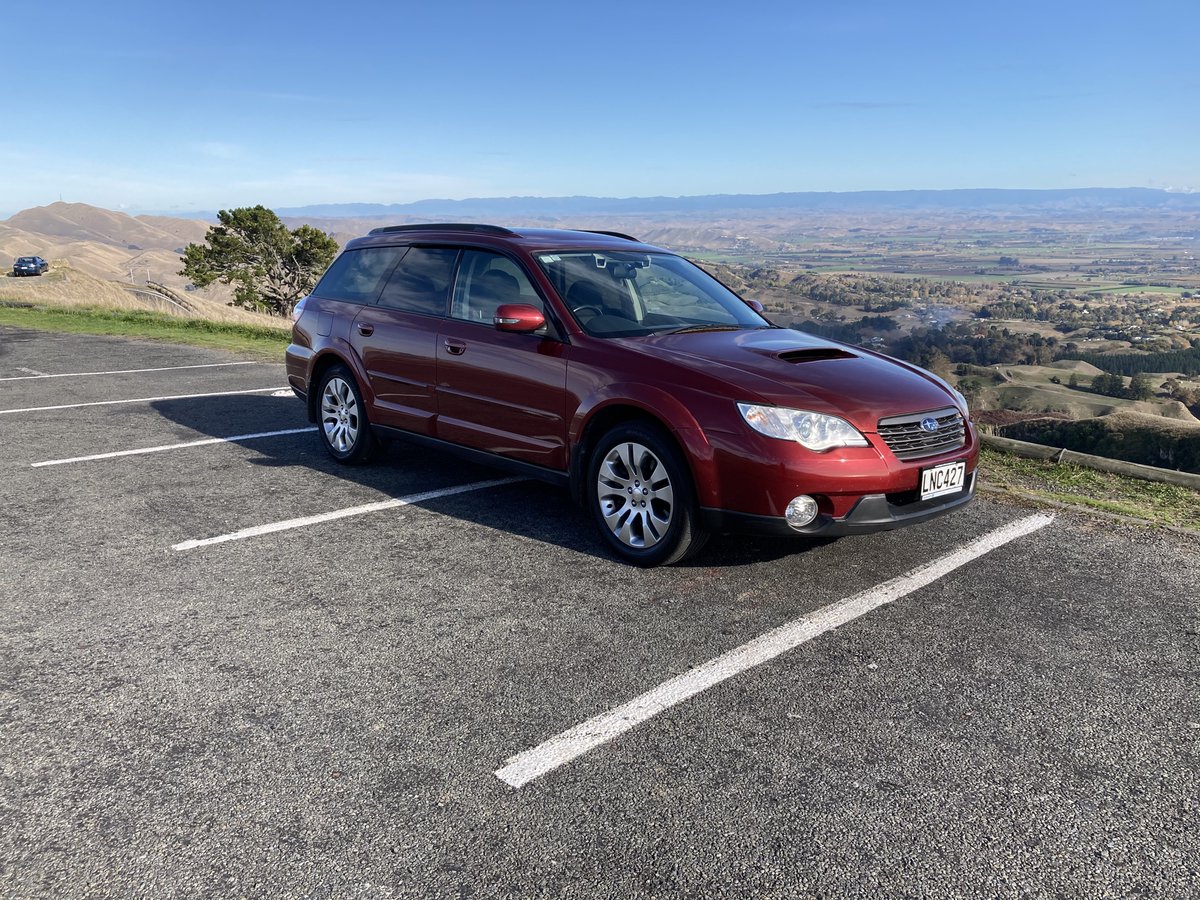
My 2008 Subaru Outback 2.5XT (JDM model) has camera-based adaptive cruise control, lane departure warning, lead vehicle start warning ("stop looking at your phone"), and pre-collision braking. Also AWD, 265 HP turbo engine. I bought it for NZ$10k (US$6000) in May last year, with 87000 km. https://pbs.twimg.com/media/EnuwXA6VcAAH9MJ.jpg
Post reply on HN