Live data from Hacker News

Why in the world would you own bonds?

bridgewater.com

341–350 of 532 posts

Re: Why in the world would you own bonds?

#341
post #218

Earlier quoted context omitted.

I don’t know a whole lot about professional investing, but if watching The Big Short has taught me anything it’s that the pros will say one thing publicly but do the opposite in private until it’s to their advantage to do a 180 and make their private stance actually public. Recently this was Jamie Dimon lambasting Bitcoin all the while a cryptocurrency trading desk was being set up at Chase. The following exchange fr…

I wouldn't rely on the Big Short for anything..

The book or the movie? Because the book was very well researched, and the film was a very accurate summation of the book.
Re: Why in the world would you own bonds?

#342

Earlier quoted context omitted.

You can do the opposite of pump and dump: there is an investment you want to buy, talk it down, buy it low.

That would be much more fitting, but does that apply to bonds? My understanding was that the whole point of bonds is that they're more or less immune to market forces, and run on their own schedule?

Actually the bond market is larger than the stock market and the bond market can impact stock prices -- sometimes an unexpected spike in interest rates i.e. a bond market sell-off can drive the stock market lower (literally happening in real-time as we speak).

Re: Why in the world would you own bonds?

#343

We seem to have an entire generation of people who think "stonks can only go up". Similar views were expressed about houses/real estate in 2007. At 47, I'm probably substantially older than the average HN poster, but having lived through the 2001 dotcom implosion and the 2008 financial crisis has given me some perspective. I'm getting some really bad vibes about the sustainability of the the economy and asset markets…

> We seem to have an entire generation of people who think "stonks can only go up" I'm not denying the existence of bubbles, busts, and crashes, but historically and on average, the stock market does only go up. This market is overvalued and will likely correct, but that doesn't mean it won't continue to rise on the aggregate.

As a counterpoint the Nikkei has not since surpassed its peak value in 1989.

Re: Why in the world would you own bonds?

#344

The more Dalio gets public, the more I'm doubting his game. His book ''principles'' is interesting, however with time its starting to look like an elaborate marketing plan. I have no doubt that he his serious about his principles and business culture, but there are second order effects to make everyting public. In the case of his firm culture (which claims to be an idea meritocracy), it will attract certain kind of p…

Ray Dalio (age 71) stepped down from the Bridgewater co-CEO position in 2017. He is now a active retiree who has time in his hand. It's typical for elderly gentlemen to focus on their legacy.

Since he moved his home office to Singapore and is heavily invested in China, he has become very careful about talking negative about China and is more prone to paint negative picture on the US and the West.

Re: Why in the world would you own bonds?

#345

Earlier quoted context omitted.

I'm definitely far younger than you; however, I agree. The problem is that there's no timing it. So positioning yourself such that you leverage other factors to make money in a market (e.g. delta-neutral positions that are long/short time/volatility) are all you can do if you want to play the game without having high directional risk.

So, I actually have an MS in Quant Finance despite having worked in tech my whole career. There's an old saying, "during a time of crisis all correlations go to 1". People found this out the hard way in 2008. There are all sorts of risks that you can't hedge for or that negate hedges you have in place for other risks, counterparty risk being one of the better known ones.

This hit home for me during the mini-crash a year ago. I was convinced assets like bitcoin or gold or bonds would hold value when the stock market tanked but instead saw everything fall at the same time.

I understand the concept of undiversifiable risk, but seeing it play out in practice was eye opening.

Re: Why in the world would you own bonds?

#346

Earlier quoted context omitted.

> We seem to have an entire generation of people who think "stonks can only go up" I'm not denying the existence of bubbles, busts, and crashes, but historically and on average, the stock market does only go up. This market is overvalued and will likely correct, but that doesn't mean it won't continue to rise on the aggregate.

Markets do seem to only go up, but the stocks on the market today are very different from 10, 20, 30+ years ago. I know that poorly performing stocks are eventually removed from indices and exchanges and they are replaced with new ones. Is it the case the market always going up in the long run is actually due to survivorship bias?

Probably has more to do with the fact that society on the whole tends to build more than it destroys.

More value is created over time than lost.

Re: Why in the world would you own bonds?

#347
For me this type of analysis is always suspicious because it doesn't consider timing. How do I know that when I buy stocks I'm not buying at a peak, or when I need to sell them I'm not going to sell at the bottom. So I ran an analysis [1] where I just used random timing and checked what distribution would be. Turns out if you are long term investor (> 10 years holding period) it is more beneficial to hold stocks than bonds.

"Even if you had to sell your stocks at the bottom of the Great Depression, but held them for more than 20 years before that, you would not suffer a loss in value of your portfolio"

[1] https://www.investingrus.com/blog/safest-bet/

Re: Why in the world would you own bonds?

#348

We seem to have an entire generation of people who think "stonks can only go up". Similar views were expressed about houses/real estate in 2007. At 47, I'm probably substantially older than the average HN poster, but having lived through the 2001 dotcom implosion and the 2008 financial crisis has given me some perspective. I'm getting some really bad vibes about the sustainability of the the economy and asset markets…

> Similar views were expressed about houses/real estate in 2007. Don't they always go up on average though? Even the much hyped 'housing crash' of 2008 only last for all of 3 yrs till 2011 after which they went zooming past the previous highs.

Though real estate has gone up on average for the last several decades, this has not always been true as you can see from historical data. [1] [2] [3]

[1]: https://www.forbes.com/sites/johnwake/2019/03/30/new-study-o... "Old Real Estate Bubbles (1582-1810)"

[2]: https://globalfinancialdata.com/seven-centuries-of-real-esta... "Seven Centuries of Real Estate Prices"

[3]: https://observationsandnotes.blogspot.com/2011/07/housing-pr... "100 Years of Inflation-Adjusted Housing Price History"

([3] is inflation-adjusted. For [2] see the second chart for inflation-adjusted prices. [1] is not inflation-adjusted but there wasn’t much inflation in Amsterdam back then.)

Re: Why in the world would you own bonds?

#349

Earlier quoted context omitted.

Gold has performed almost as well as the S&P 500 has over the past 15 years or so. Or even outperformed it depending on your starting date. This is amazing given that it’s literally just an inert metal vs the 500 biggest American Corporations. (Comparing GLD vs SPY starting around 2005.)

It looks like GLD has underperformed SPY overall, with a lower Sharpe ratio (risk adjusted return). Gold did have a good run between 2010-2013 though! https://www.portfoliovisualizer.com/backtest-portfolio?s=y&t...

When investing the same amount every month (dollar-cost averaging), the difference becomes even larger. Using your portfolios, but adding $250/month in addition to the initial investment of $10k, you end up with $128k with gold and $207k with SPY (total investment ~$85k): https://www.portfoliovisualizer.com/backtest-portfolio?s=y&t... (with QQQ, it'd be $380k)

Comparing one-off investments is very dependent on the start date, and dollar-cost averaging more accurately models what people can actually do and which returns one may be able to expect. Who has a large lump sum laying around to invest rather than investing a portion of one's income every month/quarter?

Re: Why in the world would you own bonds?

#350

Earlier quoted context omitted.

> We seem to have an entire generation of people who think "stonks can only go up" I'm not denying the existence of bubbles, busts, and crashes, but historically and on average, the stock market does only go up. This market is overvalued and will likely correct, but that doesn't mean it won't continue to rise on the aggregate.

As a counterpoint the Nikkei has not since surpassed its peak value in 1989.

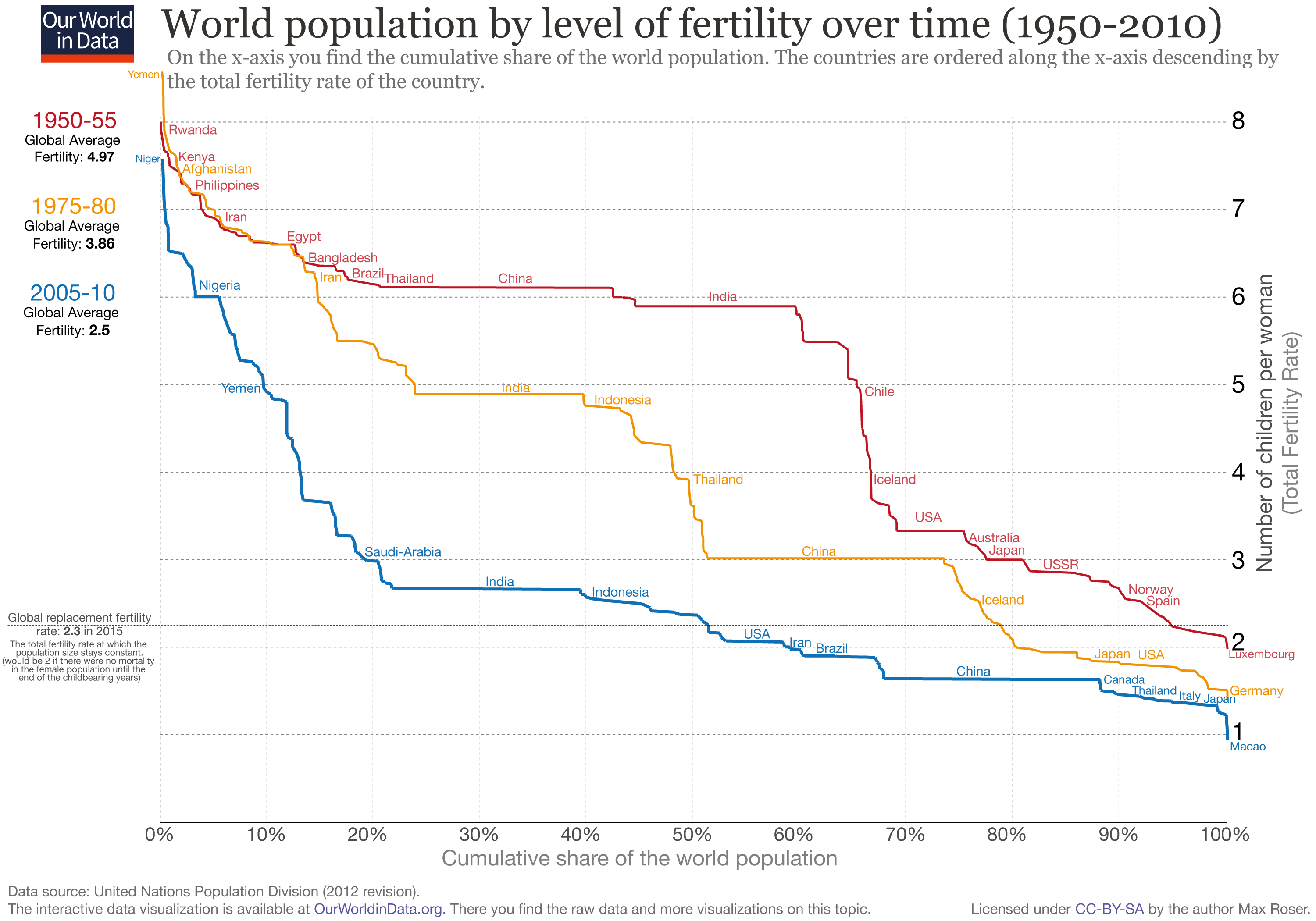
It's a good counterpoint. Every developed country will end up as Japan eventually [1], and timing won't help you; where else would you put your investment assets to get exposure to similar risk adjusted returns (developing country returns expose you to greater risk)? Waiting for values to decline will be ineffective, as central banks will acquire assets to prop them up (Bank of Japan is the largest owner of the Nikkei [2]). Returns will decline, and the cost to obtain those declining returns will rapidly increase as trillions of fiat worth of capital chases it.

Over a long enough period, stonks only go up because that is what we've collectively agreed on, and government will backstop at all costs [2] while population and productivity extracted from that population declines over time [3].

I recommend "Shrinking-population Economics: Lessons From Japan" [3] on this topic.

[1] https://ourworldindata.org/uploads/2014/02/World-population-...

[2] https://www.bloomberg.com/news/articles/2020-12-06/boj-becom...

[3] https://smile.amazon.com/gp/product/4924971189/

Post reply on HN