Live data from Hacker News

These 10 companies control all foods you buy

businessinsider.nl

21–30 of 32 posts

Re: These 10 companies control all foods you buy

#21

The combined revenue of these 10 is ~$393 Billion in 2015. The US spent $1.7 Trillion on food & beverages in 2018[0]. That's 23% of just the US market, and these are international brands, yes? Whoever said click bait was, well... we're talking about BI after all. [0] https://www.fb.org/market-intel/u.s.-food-expenditures-at-ho...

Yes and there are other major companies that are not on this list. Kraft Heinz is a $25b company much more ubiquitous than someone like Danone. Why take Danone over them? Clickbait indeed.
Re: These 10 companies control all foods you buy

#22
post #13
post #4

If you can, please buy whole (not processed) foods at a farmers' market instead of processed foods from these mega corporations. - You end up eating a much wider variety of food, depending on what is in season. - You end up eating delicious foods that may not travel well, such as amazing heirloom strawberry and tomato varieties during the summer. - You cut out the middleman, and support local businesses instead of mu…

Just be aware you will be (indirectly) emitting more CO2, and using more pesticides and fertilizer by buying from Farmers Markets. So you have to decide what's more important to you. (Small farms are less efficient, less efficient means uses more energy and other inputs.) There is a middle ground between the "processed foods from these mega corporations" (which I agree you should not buy) and farmers markets though:…

Small local farms also don't have to ship the food across the country or the ocean to get it to you. That drastically reduces the carbon footprint of such consumption.

Re: These 10 companies control all foods you buy

#23

The combined revenue of these 10 is ~$393 Billion in 2015. The US spent $1.7 Trillion on food & beverages in 2018[0]. That's 23% of just the US market, and these are international brands, yes? Whoever said click bait was, well... we're talking about BI after all. [0] https://www.fb.org/market-intel/u.s.-food-expenditures-at-ho...

Roughly half of that $1.7 trillion is categorized as "food away from home," meaning it includes the cut restaurants and such get from selling you those same brands. Further, it's unclear if that $1.7 trillion includes alcohol, but those ten companies do not.

Re: These 10 companies control all foods you buy

#24
post #6

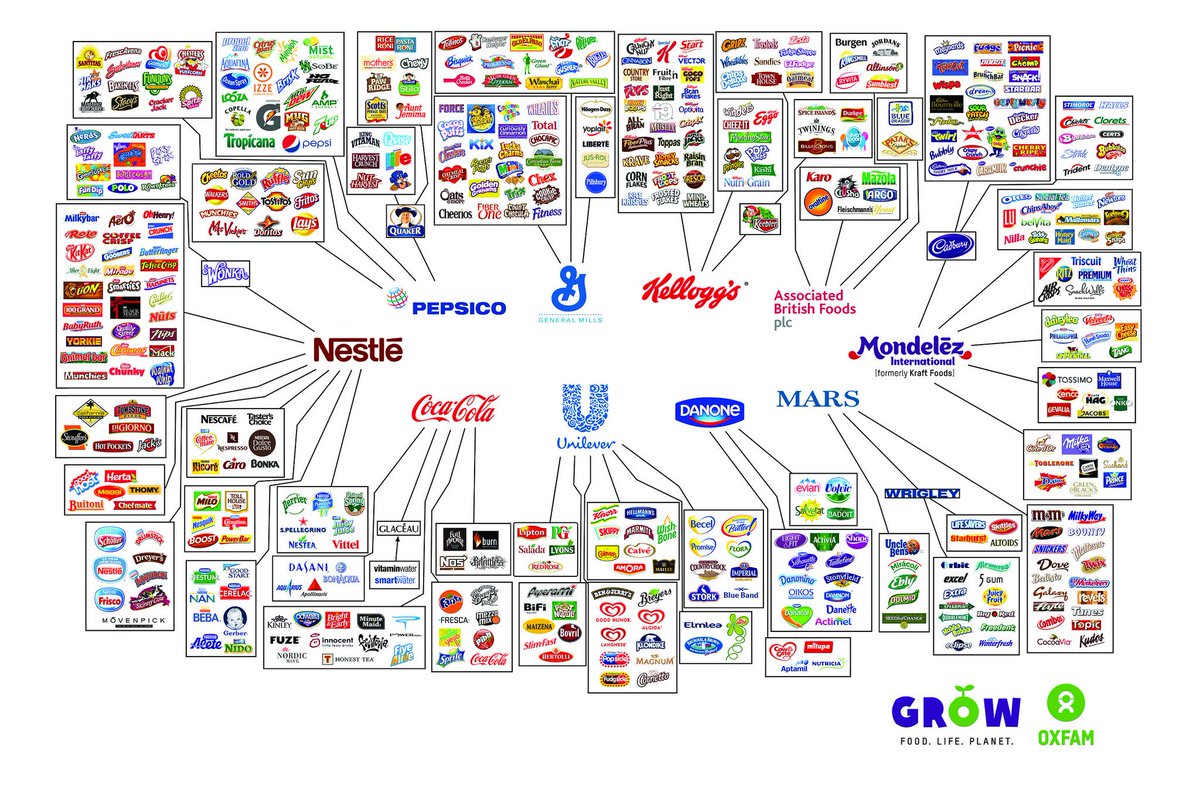
Processed foods at grocery stores, at least. Here's what I assume the oxfam infographic in the article's dead link looks like: https://www.behindthebrands.org/images/media/Images/About/be... The Behind the Brands website hasn't been updated since 2016, though, so this might be a little out of date.

slightly more HD version: https://pbs.twimg.com/media/CBPMy1DUMAAgvRP.jpg

Re: These 10 companies control all foods you buy

#25
post #22
post #13

Earlier quoted context omitted.

Just be aware you will be (indirectly) emitting more CO2, and using more pesticides and fertilizer by buying from Farmers Markets. So you have to decide what's more important to you. (Small farms are less efficient, less efficient means uses more energy and other inputs.) There is a middle ground between the "processed foods from these mega corporations" (which I agree you should not buy) and farmers markets though:…

Small local farms also don't have to ship the food across the country or the ocean to get it to you. That drastically reduces the carbon footprint of such consumption.

It actually does not. Shipping food emits very very little CO2 compared to growing it.

So the most optimum thing (in terms of CO2) is to plant food where it grows best and then ship it.

As an extreme example compare a greenhouse with regular outdoor planting. Or compare growing food where you need a lot of pesticides or fertilizer vs where you do not.

Re: These 10 companies control all foods you buy

#26
post #22
post #13

Earlier quoted context omitted.

Just be aware you will be (indirectly) emitting more CO2, and using more pesticides and fertilizer by buying from Farmers Markets. So you have to decide what's more important to you. (Small farms are less efficient, less efficient means uses more energy and other inputs.) There is a middle ground between the "processed foods from these mega corporations" (which I agree you should not buy) and farmers markets though:…

Small local farms also don't have to ship the food across the country or the ocean to get it to you. That drastically reduces the carbon footprint of such consumption.

Local farms generally consume more carbon to get your goods to you. That's because the ratio of envelope : contents for each subsequent chain in transportation goes up exponentially. eg: It takes ~0.1kg of cargo ship to transport 1kg of food, ~1kg of container truck, ~5kgs of a pickup truck from a local farm and ~100-1000kgs of your personal car, depending on how much you buy per trip.

So buying food from a local farm delivered to you via pickup truck or having a farmer's market that's just a little bit further away from you than a grocery store or buying just a little bit less at the farmers market than you would at a grocery store can negate the entire difference of having foods shipped to you from all across the world.

Re: These 10 companies control all foods you buy

#27
post #25
post #22

Earlier quoted context omitted.

Small local farms also don't have to ship the food across the country or the ocean to get it to you. That drastically reduces the carbon footprint of such consumption.

It actually does not. Shipping food emits very very little CO2 compared to growing it. So the most optimum thing (in terms of CO2) is to plant food where it grows best and then ship it. As an extreme example compare a greenhouse with regular outdoor planting. Or compare growing food where you need a lot of pesticides or fertilizer vs where you do not.

Neither of those examples support your assertion.

Re: These 10 companies control all foods you buy

#30
post #22

Earlier quoted context omitted.

Small local farms also don't have to ship the food across the country or the ocean to get it to you. That drastically reduces the carbon footprint of such consumption.

Local farms generally consume more carbon to get your goods to you. That's because the ratio of envelope : contents for each subsequent chain in transportation goes up exponentially. eg: It takes ~0.1kg of cargo ship to transport 1kg of food, ~1kg of container truck, ~5kgs of a pickup truck from a local farm and ~100-1000kgs of your personal car, depending on how much you buy per trip. So buying food from a local far…

That doesn't make sense. A cargo ship does not pick up food from a farm or slaughterhouse and does not deliver food products into my fridge.

So, it's a truck and a freight train and a ship and a truck for foreign produced food, and only a truck for locally produced food.

Post reply on HN