Live data from Hacker News

Starlink is now Accepting General Pre-orders

starlink.com

241–250 of 541 posts

Re: Starlink is now Accepting General Pre-orders

#241

Earlier quoted context omitted.

Do you think it's TDMA? I just assumed it would be whatever the latest CDMA technology is. The download probably doesn't really matter much one way or another since there's so much space between receivers that there's no practical chance of collisions. The satellite certainly must be able to receive multiple uplinks simultaneously, even in order to maintain a modest 15Mbps for multiple customers.

Satellite typically doesn't use cdma. See dvb-s

There's no reason to assume starlink works like a typical satellite, though. Digital video broadcast in particular is in one direction from geostationary orbit. Latency is on the order of several seconds due to all the forward error correction that's necessary to tolerate bit errors in reception. There's not really any need for a "multiple access" scheme because "channels" are statically allocated frequency bands.

I would think the radio technology in starlink should more closely resemble modern LTE and 5G cell networks, whether you want to call that CDMA, OFDM, or whatever the specific techniques these days are called.
Re: Starlink is now Accepting General Pre-orders

#242
post #201

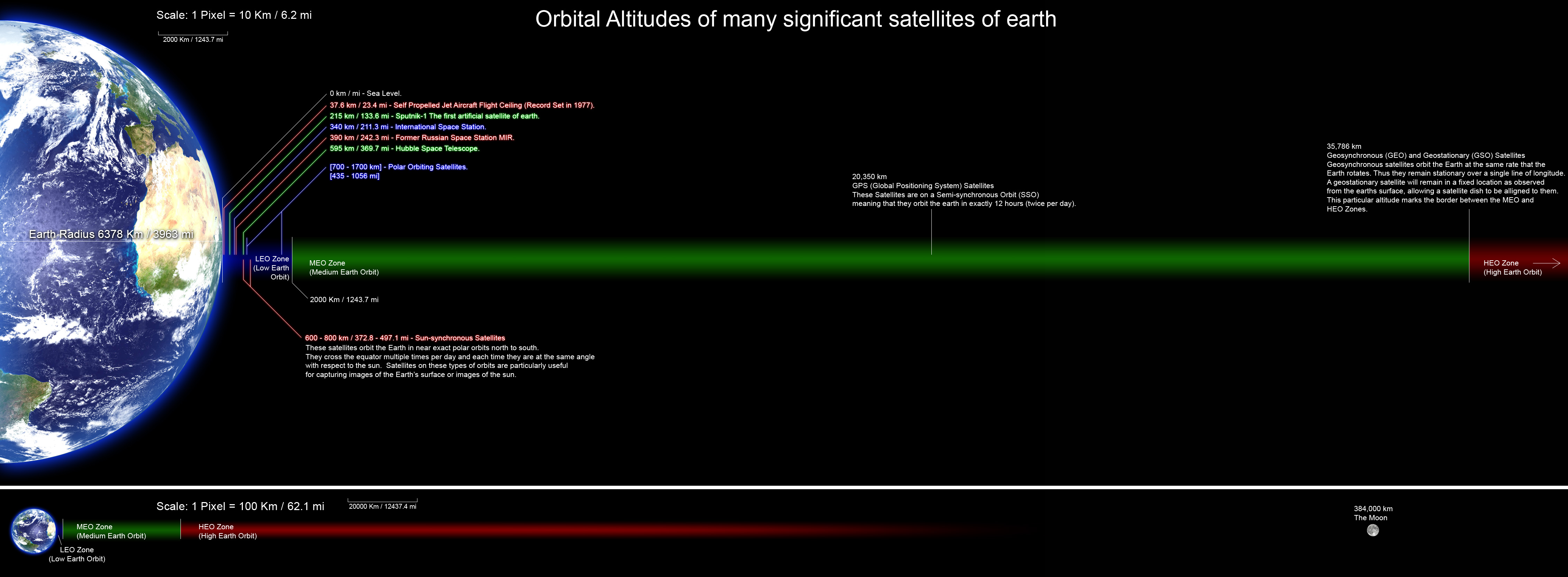
”Starlink satellites are over 60 times closer to Earth than traditional satellites ” Goodness! I really need to learn more about satellites! For some reason that statement really strikes me. I wonder what the ‘band’ of distance from earth most satellites fall into. The range of area a satellite can orbit earth must be pretty wide if this is the case. Now I need to look up what is the closest & furthest distance a sma…

https://upload.wikimedia.org/wikipedia/commons/8/82/Orbitala...

Re: Starlink is now Accepting General Pre-orders

#243

I live in a remote town in the North Cascades in Washington State in the US and know about a dozen folks who have had Starlink for a few months now. I'm lucky enough to have line of sight to a tower on a mountain 6 miles away so I can have consistent service from a local ISP and haven't had to rely on sats. But it's a game changer for those who aren't as lucky as I. It still drops a lot which obviously causes problem…

> A lot of local folk are now worried that our area will turn into the next Jackson Hole or Sun Valley as real estate prices skyrocket and longtime locals are priced out.

You can calm their fears by reminding them that Starlink is rolling out _nationwide_, so remote workers are going to move to lots of different places.

Re: Starlink is now Accepting General Pre-orders

#244
post #201

”Starlink satellites are over 60 times closer to Earth than traditional satellites ” Goodness! I really need to learn more about satellites! For some reason that statement really strikes me. I wonder what the ‘band’ of distance from earth most satellites fall into. The range of area a satellite can orbit earth must be pretty wide if this is the case. Now I need to look up what is the closest & furthest distance a sma…

Starlink roughly orbits at 1200km. The most common orbit for internet sats is geostationary orbit, which means that the satellite is stationary with regards to an observer on Earth. It works because a satellite on a circular orbit at that height moves at the same speed as the rotation of Earth. This way you can have a simple, pointed antenna and not an obscenely expensive phased array like Starlink. That being said,…

Starlink currently orbits at 550 km. 550*60=33000 so that puts it slightly more than 60 times closer than GEO. There are other shells planned at different heights, but the current satellites, and ones launched in the near future, are all orbiting at 550km.

Source: https://en.m.wikipedia.org/wiki/Starlink -- in the table of launches there's a column for orbit height.

Re: Starlink is now Accepting General Pre-orders

#245

I'm currently in the middle of trying to help loads of human rights defenders in Myanmar plan to deal with the internet shut downs that are happening. Satellite stuff like Iridium is too crazily expensive to be useful. I really wish some thing like this was available.

Almost every military in the world already has the ability to jam the frequencies used by Starlink.

Re: Starlink is now Accepting General Pre-orders

#246
post #180

Earlier quoted context omitted.

DOCSIS 3 latency is 8ms in my experience; fiber is 1.5ms.

I had to try my fiber connection. I get 0.6 - 0.8 ms within our town which is not that big, To Stockholm, which is only 80 or so km away if you measure straight line, is 3.5 ms away. Iv'e always been curious as to what adds so much latency and what I did read was that its the network equipment itself mostly. The inherent latency in the fiber should be on the order of much less than 1 ms as far as I understand. 3.33 u…

> 3.33 us per km

Signals in fiber do not travel at c. They travel at lightspeed in glass. Light speed in a material is c/(the refractive index of the material). For commercial glass fiber, 1.5 is a reasonable estimate for it's refractive index. So the actual time for 1 km is ~5 us.

Re: Starlink is now Accepting General Pre-orders

#247
post #63

Earlier quoted context omitted.

> So are the early adopters subsidizing the masses down the line? "Subsidizing"? No, they're paying for a service. It may or may not get cheaper over time... but that's rather irrelevant. SpaceX isn't a charity, they are in this to make money. It's also not like SpaceX is making a ton of money off of the early adopters. The satellite dish almost certainly costs the vast majority of those 600 dollars to produce, and t…

Estimates for the satellite dish from people in the industry are well over $1000 (see e.g. [1] https://spacenews.com/news-analysis-spacex-has-a-lot-riding-... ) Unless SpaceX has made a huge unannounced breakthrough in phased arrays they're actually taking large losses on the up-front cost at this point.

Dead industry projects incompetence onto disruptive newcomer, news at 10.

More seriously, the phased array antennas seem to be a big part of Starlink’s innovation. Launching tons of satellites cheaply by itself isn’t a super protected moat because if they block competitors from using the launch platform at a reasonable price, they risk antitrust action.

Re: Starlink is now Accepting General Pre-orders

#248

Earlier quoted context omitted.

One of the big issues I’ve had with anything but wired ISPs is latency. They specifically talk about 20-40ms latency being expected in most locations, but don’t specify to where. I currently get about 20 +/- 4 ms from me to 8.8.8.8 consistently. Is their latency to my first hop? Also, what is their IPv6 support like? Can I get a routable /60 or similar? Static IPv4/IPv6? And do you need to use their router or can you…

a. absolute lowest latency I've seen to a major IX point in seattle is about 15.8ms. More often it's 22-23ms. On a longer term, averages between 20-30ms. That's for the combined total of four 550km paths through space plus terrestrial latency from their earth station to seattle. Keep in mind that on something like a DOCSIS3 cable coax last mile segment can have a minimum latency of 12-16ms from just the cablemodem to…

> b. no ipv6 yet. They have people who know what they are doing for neteng so I am sure it is planned.

Some individuals in /r/starlink have started reporting being assigned globally routable ipv6 addresses. So right now it's probably being tested.

Re: Starlink is now Accepting General Pre-orders

#249
For people hoping to get overseas latency better than fiber: not now, and probably never without a huge premium. When they finally get inter-satellite comms, low-latency transport will probably be reserved for huge-premium tier accounts.

For everybody else, you can assume the satellites will aggressively dump packets to the nearest downlink terminal to feed into fiber. After they get laser links going, when there is no downlink terminal in view, packets might move to the next satellite ahead or behind on the same orbit, and then, if possible, down, or repeat. There will be no attempt to send packets to satellites in other orbits. They might sometimes delay traffic so as not to match performance of their premium tier, if it would otherwise be reliably fast.

For future super-high-premium tier accounts, packets will step through satellites to get to a terminal near the destination, and downlink there. Packets sent via this route will arrive whole milliseconds ahead of terrestrial fiber. Despite small amounts of traffic bouncing between orbit tracks, these accounts will constitute a substantial fraction of Starlink's total revenue.

In the eventual future, we can expect satellites to carry a few TB of on-board storage to proxy blockbuster media properties; and, to broadcast select real-time traffic, e.g. World Cup video. These will be done mainly to free up bandwidth.

Those are my predictions. If yours differ, explain.

Re: Starlink is now Accepting General Pre-orders

#250
post #220

Earlier quoted context omitted.

> b. no ipv6 yet. > c. all IPs are in cgnat IP space Interesting, this is more like an internet proxy than connecting devices to the internet. Hope they fix it soon. Does the TOS forbid running eg ssh or remote desktop services? Or VPNs?

It is a consumer internet eyeball service. Having an assigned routable address is not a thing in many countries, and you really shouldn't expect it as a "feature" in the future. Eventually the Comcasts of the world will sell off the majority of the IPv4 they hold to the AWSs of the world.

> Having an assigned routable address is not a thing in many countries

citation needed

Post reply on HN