Typing, RSI, and what I do differently
senryu.pub
Typing, RSI, and what I do differently
1–10 of 112 posts
Re: Typing, RSI, and what I do differently
#2I had a brief but serious bout of RSI in my right wrist in my early 30s. Ergo keyboards and novel typing layouts didn’t help at all, nor did a wrist brace. What eventually relieved it was a trackball (which the author of this article also used) and a wrist pad for that hand. I avoided normal mouses, trackpads, and the IBM/Lenovo “mouse nipple,” going so far as to bring my trackball with my laptop.
I’ve switched back long since, for precision, but the RSI never returned. Definitely check out trackballs if keyboard mitigations aren’t helping.
Also, buy wrist rest pads!
Re: Typing, RSI, and what I do differently
#3Copying an older post that I wrote (https://news.ycombinator.com/item?id=20665338) in case it helps anyone (as the OP writes, there's "no universal solution for everybody"):
----
I (25yo), also had pain in my right pinky and wrist, starting about 2 years ago.
I spoke with a friend who had surgery for Carpel Tunnel Syndrome, and knew a lot more about this than me. What he told me:
* Carpel Tunnel Syndrome affects the thumb/index-finger; pain in the pinky side of your hand could be caused by the ulnar tunnel or the cubital tunnel.
* He does sets of 10 of these stretches every hour https://2.bp.blogspot.com/-cl-rpkmgPqI/UeUWdH4oMUI/AAAAAAAAA... https://i.pinimg.com/originals/8a/a4/2c/8aa42cc5c059cabf9aeb...
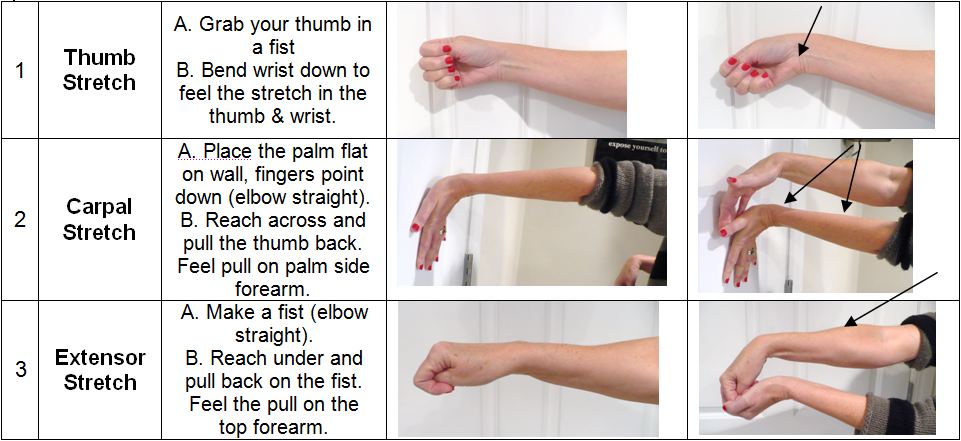

* "One of the biggest things you can do is splint your wrist at night. This is one of the best wrist braces I've found: https://www.amazon.com/Mueller-Fitted-Wrist-Brace-Number/dp/... "
My experience:
- I got a foot pedal, and put Alt, Ctrl, Shift, and Enter on it (and for a while pulled those keycaps off the right side of my keyboard, to force myself to learn to use the foot pedal). This allowed me to keep using a computer while I recovered, and allowed me to avoid stressing my pinky after I recovered. I wrote a bit about that on Reddit https://reddit.com/r/emacs/comments/7remed/has_anybody_used_... .
- The tendon gliding exercises were very helpful. The other stretches didn't seem to make much difference. While I was recovering, I tried to do them hourly. I now only do them if it's acting up.
- I second his endorsement of those wrist braces. When using them, I wear them at night, and when typing if I can (I can use a desk keyboard with them, but can't use my laptop with them). While I was recovering, I used them all the time, now I only use them if it's acting up.
- More recently, I got a Keyboardio Model 01, which puts the modifiers on the thumbs, not the pinkies. The foot pedal is entirely unnecessary with it; it puts much less strain on my hands.
Nowadays, my wrist acts up maybe once a month or two.
Re: Typing, RSI, and what I do differently
#4First saw this Using Python to Code by Voice almost 8 years ago.
I’m disappointed that we’ve gone nowhere in that time.
Anyone with early symptoms could use voice as an option, or partial option.
Re: Typing, RSI, and what I do differently
#5Copying an older post that I wrote ( https://news.ycombinator.com/item?id=20665338 ) in case it helps anyone (as the OP writes, there's " no universal solution for everybody "): ---- I (25yo), also had pain in my right pinky and wrist, starting about 2 years ago. I spoke with a friend who had surgery for Carpel Tunnel Syndrome, and knew a lot more about this than me. What he told me: * Carpel Tunnel Syndrome affects…
IME wrist braces don’t help, they just lead to muscle atrophy.
I picked up rock climbing and my RSI hasn’t come back since.
Re: Typing, RSI, and what I do differently
#6My physical therapist's best guess is that I have pinched radial nerves in both arms. Things that have helped the most:
1. Stretches and nerve glides every couple hours.
2. Ergo keyboard[0], focused on separation so my arms are more squared with my body, and on keys that are easy to press (no more mechanical keyboard for me).
3. Foot pedals for CTRL/SHIFT/ALT. I hacked together[1] a custom solution with an arduinio and a couple industrial pedals.
My advice is start working with a PT as soon as you notice any pain or numbness in your arms or hands. I'm to a sustainable point now but I should have taken action months before I did. Maybe I could have beat it completely. Still hoping I will at some point. You're probably going to need to take some serious rest. It can be hard with deadlines or other work pressures, but try to think long term.
A gram of prevention is worth a kg of cure.
Re: Typing, RSI, and what I do differently
#7I developed some RSI in my right followed by both wrists/fingers last fall due to overuse and poor body/hand/arm posture. Thankfully it relieved with lots of rest, but heed your body's warnings lest it become permanent!
I took 4 days off in the middle of reaching a deadline just to correct my ergo setup, and the rest combined with learning really helped.
1. Take breaks! I know it sucks, I was on a deadline. But you'll be cursed with 0 deadlines later (out of work) if you push it too far.
2. A vertical mouse is better than a standard mouse because it moves the pressure from your sensitive, soft tissue under your wrist to the side. But your arm/wrist isn't immune there either. This prevents strain in my wrist now, but during an intense period, it doesn't help. Assuming you get the right trackball, trackball > vertical mouse > standard 'flat' mouse.
3. The best sources I've found are a little outdated in terms of webpage but in the end helped me immensely! The Cornell Human Ergo lab [0] is a big site with lots of useful information, namely a quick snapshot of roughly idealized setup with points like negative keyboard tilt [1], and a checklist for yourself [2].
4. A trackpad is in some ways better for your arm position than a mouse, because it's closer to your body's midline. Of course, a track pad can be worse on your fingers/hand.
5. Your ergo setup and body is a system. Even if you make one objectively positive change, this may result in undue pressure on another part of your body. Watch your aches and pains and adjust each accordingly. This usually takes iteration, or changes throughout the day (i.e. time split standing vs. sitting; time split using mouse, trackball, pen tablet).
Edit: #6 it goes without saying but is worth emphasizing: get regular exercise, sleep, and eat a balanced diet. These 3 go a long way. IME even brief brisk walks during breaks were better than simple breaks away from the keyboard.
[0] http://ergo.human.cornell.edu/ [1] http://ergo.human.cornell.edu/DEA6510/dea6512k/ergo12tips.ht... [2] http://ergo.human.cornell.edu/CUVDTChecklist.html
Re: Typing, RSI, and what I do differently
#8> In my personal experience I found home-row typing to actually be unergonomic mostly because of the additional bend required from moving both hands closer together.
I've always thought this too.
I've been typing a lot since about 1996 and never got into home row typing. It never felt natural or comfortable and I don't have abnormally sized hands either. It just felt like going against the system.
I don't want to jinx myself but over the decades I've experienced no pain or issues with any joints or muscles but I've always made sure no matter what desk I used my forearms were parallel to the floor and my wrists were effortlessly resting in front of the keyboard. I think this aspect cannot be ignored, especially for long sessions.
Then for typing style I mainly move my hands around while I type with my all of my fingers except pinky fingers. Where like 80% of typing is done with thumbs, index and middle fingers. Overall I have lots of hand movement and can type without looking for just about all key presses (except some combos) at about 70-75 wpm with good accuracy.
Based on his video, my hands move probably 2x more from side to side but the overall style is kind of similar. It's also similar in the sense that my right hand moves more than my left.
Re: Typing, RSI, and what I do differently
#9This is not excellent advice regarding the keyboard used. Instead:
- learn about the risk factors: https://kinesis-ergo.com/solutions/keyboard-risk-factors/ Keep in mind that there are hundreds of tendons in our hands, so the pattern of inflammation is very personal. Anecdotes are not your friend.
- use split keyboards (or any ergo keyboard with enough space between hands) with inclination to limit pronation
- use ortholinear (aka matrix) key layout
- use the Dvorak layout
- avoid hard/mechanical keys
- exercise and stretch every 30 mins
Re: Typing, RSI, and what I do differently
#10A lot of people really underestimate the impact that mobility and strengthening can have addressing issues with RSI. If you're struggling with RSI, consider going to physical therapy as your condition may be caused by a wide variety of issues that aren't obvious based on the pain you're having.
My own experience was that I dealt with ulnar nerve RSI for about a year. During that time I wore braces at night and tried just about every keyboard and keyboard layout imaginable, and at best I managed to keep it at bay. When I finally made up my mind to go to physical therapy I learned that:
1. I had postural issues which led to trapping the ulnar nerve in my shoulder (not my wrist, that was just where the pain referred to)
2. I had deep myofascial issues that were preventing my muscles and nerve from moving freely in my arm
3. I had poor mobility which was contributing to decreased function overall
Where I thought I had a localized problem in my wrist, it turned out I had a systemic problem which required strengthening through my entire arm, shoulder, back, neck, and core. I resolved these issues through physical therapy and my ulnar RSI hasn't returned since, though I now maintain an exercise routine that focuses on mobility. I still use an ergonomic keyboard, but I'm now convinced that the issue can't really be solved with gear.