Live data from Hacker News

Offline Algorithms in Low-Frequency Trading

queue.acm.org

61–70 of 106 posts

Re: Offline Algorithms in Low-Frequency Trading

#61
post #16

Earlier quoted context omitted.

Reading more about things you haven't read about before will increase your total knowledge and therefore make you better off in a holistic sense, yes. In a purely monetary sense, no it will probably not have any effect on your life.

Knowledge is not infinitely accretive

I was making the gamble that people who compulsively ask "Will it make me better off?" without having read the article are not yet at the point where they've hit the diminishing returns on additional knowledge.

Your statement is correct though, username checks out as well.

Re: Offline Algorithms in Low-Frequency Trading

#62
post #29

If low frequency trading interests you, here's a project some people might want to check out: https://github.com/brndnmtthws/thetagang It's designed to sell option premium on major indices (like the S&P500 or NASDAQ-100) to generate mostly passive income, with a fairly reasonable risk-adjusted return. It uses a combination of strategies that involve selling naked puts and covered calls, which both have the same risk…

Generally speaking, a seller of naked puts is looking to supplement income via a stock they are willing to own at a lower level. If you are not willing to take delivery, it is probably better to sell a vertical spread so that there is a built in stop out. Here I'm speaking of transactions of a reasonable premium amount, not 5 or 10 cents. While it is true that the upside is unlimited against a naked call (and the dow…

This is why skew exists, and should not deter anyone. The vast majority of people should buy a 20-30% dip, and so the fact that 99% of the time you're not going to be assigned means that it's a good idea in most scenarios.

I suggest most retail to be short straddles against a core underlying position for yield enhancement. Yes, over a number of decades you will have something go against you, but under the current monetary and fiscal regimes, you should be hoping for the day that you can buy the dip or sell the rip via a systemic short vol overlay.

Re: Offline Algorithms in Low-Frequency Trading

#63
post #25

Earlier quoted context omitted.

None of the kinds of people you listed are good at trading (esp economists). From experience, professional traders do tend to use passive indices for part of their PA, but also actively trade a portion. But you're right in that if you don't have a passion for it, you'll never be able to truly outperform spy on a risk adjusted basis. However, if you do have the knowledge and the passion, I definitely think you can. In…

While I always preached just buying the S&P one risk i've been seeing with it is if, a majority of investors just buy the S&P index, since the index is market cap weighted, it would just make the largest stocks in the index more expensive. This would make the stocks that have less weight in the index or stocks outside the index relatively cheap and obviously offer better returns. Anyone disagree?

Assuming the amount of tradable shares for each stock is proportional to the free float capitalization (which is not a particularly good assumption), each stock in the index should be pushed up by the same amount, since the weight of each stock in the index is proportional to the market cap of the stock. I don't think this is actually true (i.e the number of shares on the market is not proportional to the market cap), which would imply that some share prices would be affected more than other. Do higher weight stocks in spy get pushed up more? I don't know. But it is certainly possible.

With respect to the stocks just outside the index, I think you could argue that they are probably undervalued and thus should offer better returns. This is what an academic would say. However, the actual reality could be a lot different: if returns are dominated by flows instead of fundamentals (like they are now), maybe going with the crowd is the best investment strategy. Or maybe not, I haven't done the research.

One thing that every market professional is worried about right now is just how dysfunctional valuations and returns seem to be in the modern era. Stocks seem to go up for no reason and returns have been disconnected from both fundamental and quantitative risk premia.

What I can say for sure is that we are in a period of intense change in the financial system. No one knows what the future of finance will look like, 10 years, 20, or 30 years out. Will crypto defi take over? Will traditional finance be disrupted? No one knows, but it is certainly an exciting time to work in the capital markets!
Re: Offline Algorithms in Low-Frequency Trading

#64
post #56

Earlier quoted context omitted.

The problem is the books don't really tell you. They're written in this mathematical way that kinda obscures how to actually think about them practically. If you're more into math maybe stochastic calc will be just fine for you. Here we go anyway: Hull: Futures, Options, and Other Derivatives Natenberg. Don't recall the name, but this is maybe the closest to practical. Paul Wilmott, Quantitative finance. Taleb, Dynam…

Someone with a strong math background should cut Wilmott and go directly to Shreve: Stochastic Calculus for Finance II (or Björk: Arbitrage Theory in Continuous Time).

What does "strong math background" mean in this context? Would the equivalent of an undergrad degree in math be sufficient, or are we talking about graduate level analysis and stats here?

Re: Offline Algorithms in Low-Frequency Trading

#65
post #56

Earlier quoted context omitted.

The problem is the books don't really tell you. They're written in this mathematical way that kinda obscures how to actually think about them practically. If you're more into math maybe stochastic calc will be just fine for you. Here we go anyway: Hull: Futures, Options, and Other Derivatives Natenberg. Don't recall the name, but this is maybe the closest to practical. Paul Wilmott, Quantitative finance. Taleb, Dynam…

Someone with a strong math background should cut Wilmott and go directly to Shreve: Stochastic Calculus for Finance II (or Björk: Arbitrage Theory in Continuous Time).

I think that given the question about "how these instruments work in some depth" Hull is more appropriate.

Re: Offline Algorithms in Low-Frequency Trading

#66
post #28
post #21

Unzipped the code and put it here for easy viewing: https://github.com/breck7/drillBits (Note: if author wants to create a GitHub I'll edit this link and point to theirs!)

Given the clear copyright statement, > Copyright (C) 2020-2021 Terence Kelly. All rights reserved. did you happen to get the author's permission to put that up? I don't even like IP law that much, but its funny to me how much no one gives a shit. This was a crime, albeit a silly and small one.

Copyright infringement is not a crime in and of itself. It's only criminal when it's done for commercial purpose with financial gain which is clearly not the case here.

Re: Offline Algorithms in Low-Frequency Trading

#67
post #29

Earlier quoted context omitted.

Generally speaking, a seller of naked puts is looking to supplement income via a stock they are willing to own at a lower level. If you are not willing to take delivery, it is probably better to sell a vertical spread so that there is a built in stop out. Here I'm speaking of transactions of a reasonable premium amount, not 5 or 10 cents. While it is true that the upside is unlimited against a naked call (and the dow…

This is why skew exists, and should not deter anyone. The vast majority of people should buy a 20-30% dip, and so the fact that 99% of the time you're not going to be assigned means that it's a good idea in most scenarios. I suggest most retail to be short straddles against a core underlying position for yield enhancement. Yes, over a number of decades you will have something go against you, but under the current mon…

> The vast majority of people should buy a 20-30% dip, and so the fact that 99% of the time you're not going to be assigned means that it's a good idea in most scenarios.

So "people should buy a 20-30% dip" but should not be invested already? Because if they are, selling puts may not be a good idea.

Re: Offline Algorithms in Low-Frequency Trading

#68
post #29

If low frequency trading interests you, here's a project some people might want to check out: https://github.com/brndnmtthws/thetagang It's designed to sell option premium on major indices (like the S&P500 or NASDAQ-100) to generate mostly passive income, with a fairly reasonable risk-adjusted return. It uses a combination of strategies that involve selling naked puts and covered calls, which both have the same risk…

Generally speaking, a seller of naked puts is looking to supplement income via a stock they are willing to own at a lower level. If you are not willing to take delivery, it is probably better to sell a vertical spread so that there is a built in stop out. Here I'm speaking of transactions of a reasonable premium amount, not 5 or 10 cents. While it is true that the upside is unlimited against a naked call (and the dow…

> Generally speaking, a seller of naked puts is looking to supplement income via a stock they are willing to own at a lower level.

The problem is that they may be willing to own at a lower level today. But it may happen that when they have to own it the price is lower for a good reason.

Re: Offline Algorithms in Low-Frequency Trading

#69
post #25

Earlier quoted context omitted.

None of the kinds of people you listed are good at trading (esp economists). From experience, professional traders do tend to use passive indices for part of their PA, but also actively trade a portion. But you're right in that if you don't have a passion for it, you'll never be able to truly outperform spy on a risk adjusted basis. However, if you do have the knowledge and the passion, I definitely think you can. In…

While I always preached just buying the S&P one risk i've been seeing with it is if, a majority of investors just buy the S&P index, since the index is market cap weighted, it would just make the largest stocks in the index more expensive. This would make the stocks that have less weight in the index or stocks outside the index relatively cheap and obviously offer better returns. Anyone disagree?

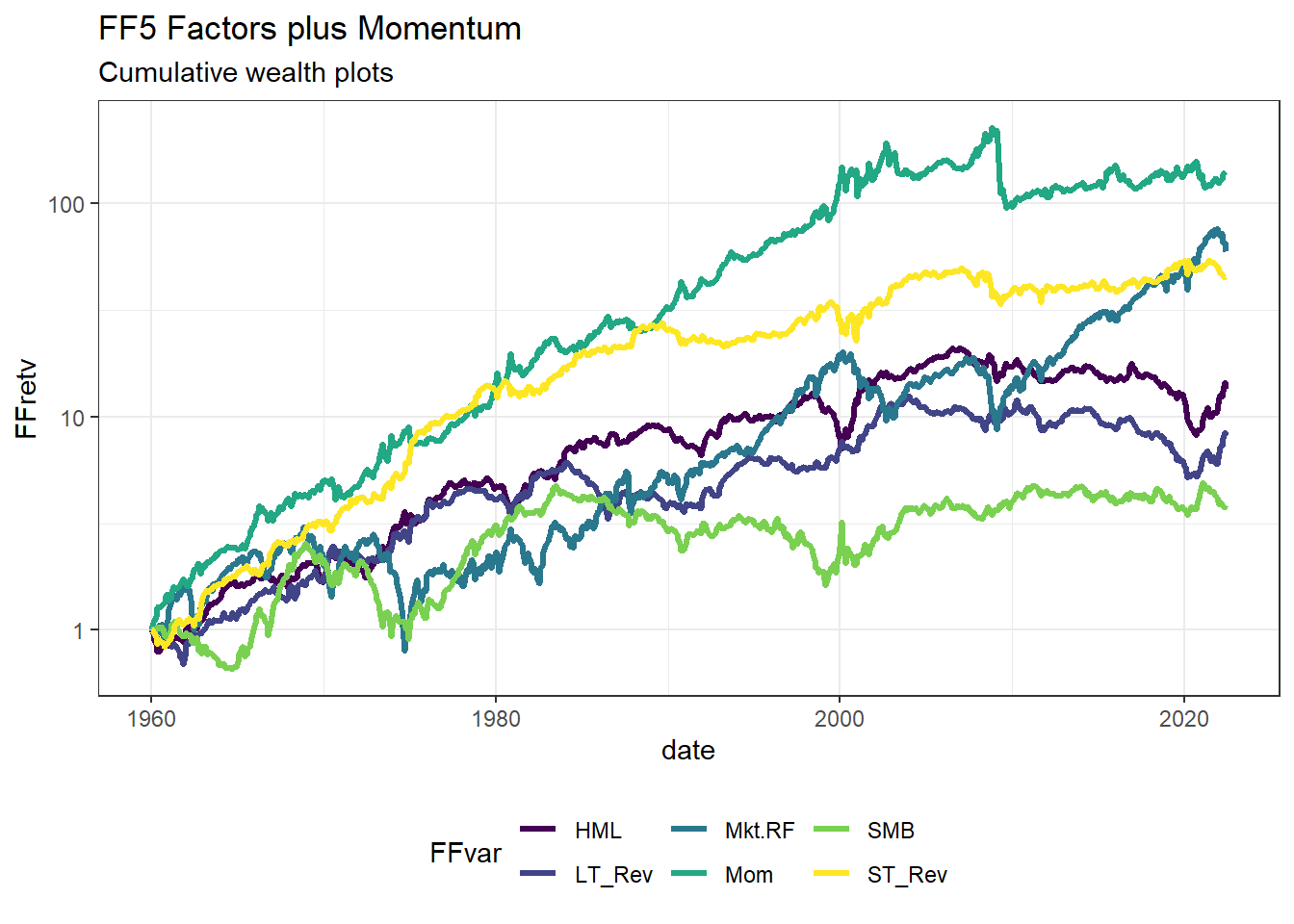
Reality seems to disagree: https://www.sebastianstoeckl.com/post/ffdownload/index_files...

https://en.wikipedia.org/wiki/Fama–French_three-factor_model...

SMB stands for "Small [market capitalization] Minus Big" and measures the historic excess returns of small caps over big caps.

Re: Offline Algorithms in Low-Frequency Trading

#70

If low frequency trading interests you, here's a project some people might want to check out: https://github.com/brndnmtthws/thetagang It's designed to sell option premium on major indices (like the S&P500 or NASDAQ-100) to generate mostly passive income, with a fairly reasonable risk-adjusted return. It uses a combination of strategies that involve selling naked puts and covered calls, which both have the same risk…

Genuine question, does this strike others as immensely off-topic? I'm curious if the parent commenter even opened the link. I'm sure there are applications of generalized knapsack problems (or dynamic programming generally) in options trading, but this isn't it.

This always happens. Post about X. Somebody replies with, "look at my Y". Usually off topic and trying to take advantage of the posts visibility.
Post reply on HN