Live data from Hacker News

The Battle of GameStop

paranoidenough.com

401–410 of 583 posts

Re: The Battle of GameStop

#401

Earlier quoted context omitted.

Melvin Capital lost Billions last week alone. They needed to get bailed. You have been sold the narrative by the same people who screwed you in 2008. The bubble is the consequence of Hedge Funds getting greedy and repeatedly screwing a "dead company", by overshorting the shares. Don't take my word for it, take Louis Rossmann's, somebody known to stand for the little guy. https://www.youtube.com/watch?v=4EUbJcGoYQ4

I wonder if there is a systemic risk behind this. Kind of like, if one domino falls, then the rest will tumble.

https://www.youtube.com/watch?v=lMUtU0tOmNE (The Pyramid Scheme that Collapsed a Nation)
Re: The Battle of GameStop

#402
post #383

Earlier quoted context omitted.

Exactly. I first heard the bull thesis from Michael Burry. Hardly a gambler. GME was comically over shorted in a console release year. Burry predicted a short squeeze way before WSB picked it up.

>Exactly. I first heard the bull thesis from Michael Burry. Hardly a gambler. The problem with this argument is that there's always an "expert" that can justify your speculative positions.

But we’re comparing it to a lottery.

We can find plenty of experts rationalizing some stocks or history, all with convincing narratives. But can you find a expert explaining the numbers which came up in lottery last night with such a believable narrative (wrong or right)?

Re: The Battle of GameStop

#403
So succinctly:

Put frankly, Millennials are tired of getting fucked by the man. When you’re underemployed with $100,000 in student loan debt, your financial situation feels overwhelming. You really don’t want to take the advice of your parents or CNBC talking heads [5] to invest 10% of your salary for a 4% annual return. At that point, what’s another $5,000? Might as well buy some short-dated GME calls

Re: The Battle of GameStop

#404

Earlier quoted context omitted.

It costs nothing to hold. They have to choose between a hail Mary and closing.

This is not right. There is a daily fee to borrow any stock. It varies by issue and it changes over time.

I was referring to 'us' holding the stock not costing us. They need to pay millions on holding their position open.

Re: The Battle of GameStop

#405
post #62

Earlier quoted context omitted.

this is exactly it. people say the market is a melt up.. another bubble. but i think that's wrong. It's like the show Billions, actual wallstreet does what wsb is doing ALL THE TIME. You make money when someone else loses money, it's simple. Except this time, the money isn't staying in the fraternity, it's being distributed out to the common folks. Can't have that it seems.

There's a significant difference in the willingness to enact change between the Legislative branch and the Executive branch. Where Congress (legislative branch) has been unwilling to pass any new regulations upon social media, the SEC (executive branch) is going to shut down these sorts of forums when they become disruptive. Having worked in this field, while the SEC can sometimes be slow to act, the fact that it mad…

I mean it's just a small forum, can they really have the same amount of influence on the market than a hedge fund or a market maker? What does the SEC care about a bunch of trolls on the internet?

Re: The Battle of GameStop

#406
post #62
post #15

I've wrote this elsewhere. The thing that's clicked for me after reading the comments on wsb is that populism, amplified by the modern internet, is going to radically change the finance world in a similar way to how it radically changed our political landscape. These people aren't just investing in GME to enrich themselves. They are doing it to spite the people who they percieve as rigging the game. They are doing it…

this is exactly it. people say the market is a melt up.. another bubble. but i think that's wrong. It's like the show Billions, actual wallstreet does what wsb is doing ALL THE TIME. You make money when someone else loses money, it's simple. Except this time, the money isn't staying in the fraternity, it's being distributed out to the common folks. Can't have that it seems.

That's not really true. So long as stock indexes generally move up, everyone can make money. The battle is over who makes more and more quickly. I'm a passive investor just plowing savings in index funds and making like 12% a year. All the mechanics of day trading vs working for a bank are pretty similar, but the difference is scale. And the ability to hedge bets.

Re: The Battle of GameStop

#407
post #187

Earlier quoted context omitted.

> partied through college, skipped classes, hardly worked, majored in women’s studies / art history / literature / Some of those things are not like the other. I studied computer science, plenty of people partied and as far as I can tell, people who studied humanities like literature had to work more. It was not easier major in terms of how much you have to work. I liked computer science, so I am always surprised abo…

My point about degrees wasn’t that some are more or less rigorous (although I haven’t heard of many rigorous women’s studies or art history programs), but rather that they aren’t going to pay well on the other side. I’m very skeptical of the claim that these programs are comprised mostly of the independently wealthy. > Majority of students go for practically sounding degrees - like various business related degrees. T…

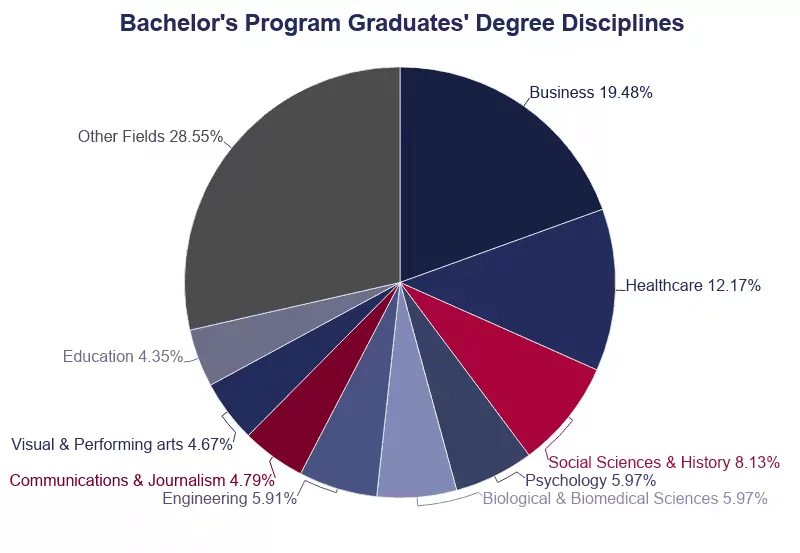
Was interested also so I looked it up.

Source: https://educationdata.org/number-of-college-graduates

For bachelors degrees: 432,077 STEM 386,201 business 244,909 healthcare 44,262 liberal arts 82,621 education

So business is approx 9 times more popular than all of liberal arts combined with the vast majority of the rest being made up of degrees that would seem to be things that make money.

Looking at the pie graph breakdown by field business is the largest section not including "Other fields": https://educationdata.org/wp-content/uploads/76/bachelors-pr...

So appears the person you're responding to is exactly right.

Re: The Battle of GameStop

#408

I’ve made millions on WSB options plays. I can finally quit my job and stop being a cubicle slave. The visceral reaction from the media on this is disgusting. Major hedge funds got caught on the wrong side of this, and have been making a huge stink about it. CNBC to the rescue, demonizing young middle class Reddit investors. This whole thing has opened my eyes to how even my FAANG compensation is peasant money, it’s…

I won the lottery and you can too! https://xkcd.com/1827/

Re: The Battle of GameStop

#409
post #383

Earlier quoted context omitted.

>Exactly. I first heard the bull thesis from Michael Burry. Hardly a gambler. The problem with this argument is that there's always an "expert" that can justify your speculative positions.

But we’re comparing it to a lottery. We can find plenty of experts rationalizing some stocks or history, all with convincing narratives. But can you find a expert explaining the numbers which came up in lottery last night with such a believable narrative (wrong or right)?

> But can you find a expert explaining the numbers which came up in lottery last night with such a believable narrative (wrong or right)?

Isn't that what fortune tellers are? The only difference is that most people know that trying to predict the lottery is bullshit, but most don't think that's the case for stocks despite evidence to the contrary (eg. that actively managed funds underperform passive funds on average).

Re: The Battle of GameStop

#410
post #369

Earlier quoted context omitted.

Does anybody truly believe that this is a good thing? The stock market is detached from reality. It creates its own universe. The efficiency we're talking about here is self-referential - it's not efficiency in producing object-level value, it's efficiency in enriching participants of the stock market. Which depends as much on the company itself as it depends on the hype the funds and the shareholders can make around…

> it's efficiency in enriching participants of the stock market. Proponents would say that it is efficienct in funding ideas that are more likely to succeed, with the partecipants in the stock market taking a commission for the transactions.

My point is that "success" on the stock market isn't always a function of doing anything useful in the real world.
Post reply on HN