Live data from Hacker News

Why do people resist the idea that carbs are worse than fat?

scientificamerican.com

121–130 of 186 posts

Re: Why do people resist the idea that carbs are worse than fat?

#121
These anecdotal arguments back and forth are interesting, but they're not science. I mean, where's the details on the methodology? Where are the data? Why do we listen to/argue about the various experts, instead of digging into the actual research that's been done?

If you're looking for studies on the topic, check out these two videos:

http://video.google.com/videoplay?docid=-847196066367535747

http://video.google.com/videoplay?docid=-1719204869171202407

It's basically a survey paper in video form, presented by one of the researchers. It has actual graphs! With error bars!

The corresponding book is pretty good too, it's called the China study.

Personally, I trust statisticians on health much more than biologists. It's nice that there's a biological basis for the conclusion, but trying to argue diet based on the metabolic process seems like a stretch, especially when it conflicts with what's observed.
Re: Why do people resist the idea that carbs are worse than fat?

#122

I'm always surprised at the theories people are willing to believe about obesity, particularly people on hn. It really sounds reasonable to so many of you that the cause of the obesity epidemic is people actually listening to nutrition advice from the medical establishment and following the food pyramid? My view of what has happened is this: technologies and ingredients were invented by food manufacturers over the pa…

"It really sounds reasonable to so many of you that the cause of the obesity epidemic is people actually listening to nutrition advice from the medical establishment and following the food pyramid?"

Who said this?

The anti-nutritional establishment claim being made here is that the incorrect demonization of fat led people to replace dietary fat with carbohydrates (see, e.g. http://en.wikipedia.org/wiki/SnackWells). You can complain all you want about food manufacturers making tasty/addictive foods which are bad for you, but they were responding to the public's demand for "low fat" driven by bad science.

On a slightly more meta note, it's probably bad form to be fake "surprised" that people have differing opinions for yours, especially when the theory being discussed is a summary of actual research and history and your counter is a "my view"-style list of anecdotes.

Re: Why do people resist the idea that carbs are worse than fat?

#123
The agriculture industrial complex is invested deeply in corn/soy/wheat processed foods and chemicals. Mega billions are at stake. The options for "low effort" and "low price" food are virtually all unhealthy from a diet standpoint. Yet, these foods have been engineered to be nearly addictive. That is why there is rampant obesity. Any diet that largely avoids these foods and maintains reasonable variety is going to be vastly more healthy.

Re: Why do people resist the idea that carbs are worse than fat?

#124
post #97

I'm always surprised at the theories people are willing to believe about obesity, particularly people on hn. It really sounds reasonable to so many of you that the cause of the obesity epidemic is people actually listening to nutrition advice from the medical establishment and following the food pyramid? My view of what has happened is this: technologies and ingredients were invented by food manufacturers over the pa…

While I have to agree with you, your theory fails to explain why people in Europe (who have the same access to calorie dense and convenient food) are less obese (in proportion) than North Americans. I believe that culinary customs AND some additives used in industrial food play an important role. Just check out High Fructose Corn Syrup : this is in very product in the USA and is (almost) never used in Europe.

Picking a nit, but: I generally agreed with you up until you referenced HFCS. HFCS is a bogeyman and is nearly identical to sucrose (to be precise, HFCS-55 was formulated to replace sucrose by providing a nearly identical mix of fructose and glucose (yes, it's 55/45 rather than 50/50; blow); see http://en.wikipedia.org/wiki/High-fructose_corn_syrup).

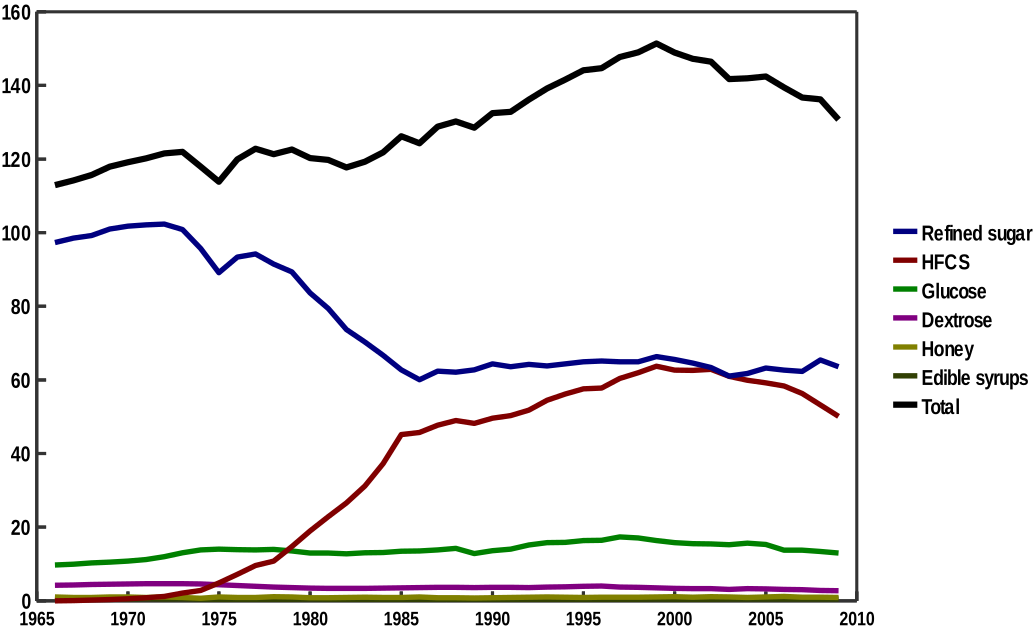
The problem with HFCS is not HFCS, it's that the US government has subsidized corn production, lowering the price of corn, lowering the price on a sucrose-analog and increasing the total amount of sucrose-analog in the American diet. See Earl Butz [ http://en.wikipedia.org/wiki/Earl_Butz ].

Fascinating charts. Compare: http://upload.wikimedia.org/wikipedia/commons/5/5e/Usda_swee... and http://upload.wikimedia.org/wikipedia/commons/c/c1/USObesity...

Re: Why do people resist the idea that carbs are worse than fat?

#125
post #107
post #97

Earlier quoted context omitted.

While I have to agree with you, your theory fails to explain why people in Europe (who have the same access to calorie dense and convenient food) are less obese (in proportion) than North Americans. I believe that culinary customs AND some additives used in industrial food play an important role. Just check out High Fructose Corn Syrup : this is in very product in the USA and is (almost) never used in Europe.

Your portions are bigger. (Seriously.)

For myself and my wife, typical US serving sizes constitute 3 meals, though nowadays, we generally only eat out occasionally, and at local non-chain restaurants that serve decent quality food.

Re: Why do people resist the idea that carbs are worse than fat?

#126
post #97

I'm always surprised at the theories people are willing to believe about obesity, particularly people on hn. It really sounds reasonable to so many of you that the cause of the obesity epidemic is people actually listening to nutrition advice from the medical establishment and following the food pyramid? My view of what has happened is this: technologies and ingredients were invented by food manufacturers over the pa…

While I have to agree with you, your theory fails to explain why people in Europe (who have the same access to calorie dense and convenient food) are less obese (in proportion) than North Americans. I believe that culinary customs AND some additives used in industrial food play an important role. Just check out High Fructose Corn Syrup : this is in very product in the USA and is (almost) never used in Europe.

Great question, I've often wondered about the same thing. I think it's probably a combination of factors, the most important being, in my view, culture. I suspect that other countries may have more homogeneous eating traditions than the U.S. If most people around you are eating the same sorts of foods, and eating occupies the same space in their lives, its probably less likely to occur to you to go buy a bag of fritos or a pizza or something.

If everyone around you is behaving in varied ways with respect to food, you may be more likely to make decisions based on price, convenience, or the "food buzz" you get from eating something. It may also be that buying everything based on price and convenience is itself a cultural norm in the U.S.

It might be economic factors as well. If the U.S. is the world leader in corn production and industrial-scale agriculture, the market for food products in the U.S. might just be very different from what exists in Europe.

Finally there is the possibility that the U.S is not alone in the obesity epidemic, merely ahead. I'm not totally sold on that, but it's a possibility.

Re: Why do people resist the idea that carbs are worse than fat?

#127
post #89

There are many reasons why people resist the idea that carbs are worse that fat. For one thing, no one has proved that "carbs are worse than fat." It's a silly, over-simplified assertion. Also, fats are the most calorie-dense macro-nutrient. If your calorie intake is greater than your calorie expenditure you will gain weight. You could easily supplement your diet with a 300 calorie bar of chocolate twice a day and yo…

It is possible for a person who is unaware that insulin promotes glycogenesis and lipogenesis to write what you just did. However, I'm not convinced that a person who IS aware could do so. Can you help me out?

Re: Why do people resist the idea that carbs are worse than fat?

#128

Earlier quoted context omitted.

One of the major parts of the Paleolithic diet is consuming at least 65% meat. With this in mind, you can see how your diet is very much not like theirs.

You'll note that I stated explicitly that I'm not following standard paleo. I gave the following as one of the resources I like: http://www.archevore.com/get-started/ (formerly panu.com, for Paleo Nu).

I understand that.

My point is why call it Paleo-anything (2.0, etc.) if it only resembles it in a maximum of 35%? And that's not even counting that you eat cheese, butter, yogurt and chocolate.

I'm not criticizing your diet, I'm criticizing how you label it.

From the little that I've read in your post, it sounds like you're just a healthy ovo-lacto vegetarian.

Re: Why do people resist the idea that carbs are worse than fat?

#129

Earlier quoted context omitted.

You'll note that I stated explicitly that I'm not following standard paleo. I gave the following as one of the resources I like: http://www.archevore.com/get-started/ (formerly panu.com, for Paleo Nu).

I understand that. My point is why call it Paleo-anything (2.0, etc.) if it only resembles it in a maximum of 35%? And that's not even counting that you eat cheese, butter, yogurt and chocolate. I'm not criticizing your diet, I'm criticizing how you label it. From the little that I've read in your post, it sounds like you're just a healthy ovo-lacto vegetarian.

Well, depends how you define 'healthy', but most vegetarians eat plenty of grains and legumes, if not sugar.

Re: Why do people resist the idea that carbs are worse than fat?

#130
post #73

Earlier quoted context omitted.

I'll listen when I have some time later. Does he also address the dose dependent problem in his cited studies? Of course if I'm drinking 6-7 sodas a day that's generally going to be a problem, but it doesn't mean sugar is evil. Too much water can kill me also, but I don't see people saying water is evil.

Like I said, he talks about metabolic pathways, which are independent of dose, though not your body's current state of glycogen deficiency. He also speaks to the effect of insulin resistance, and how the very rapid metabolism of fructose in the liver (7x faster than glucose) can lead to insulin resistance. Insulin spikes redirect calories eaten directly to fat, without them ever being metabolized into energy. As a re…

Thanks for giving such a great summation. This was the key point for me from Lustig's presentation.

Essentially, if you treat sucrose and fructose as a condiment, rather than as a key source of kCal, you will be consuming simple sugars, protein and fat, food that actually nourishes and sates you directly, versus sucrose and fructose that in high doses simply transform to fat.

Per Lustig, it's important to differentiate between starches found in bread, potatoes etc., that break down to simple sugars like glucose that are metabolized directly by the body, and added sucrose and fructose that are metabolized in the liver to fat. For people saying that our carb consumption was the same back in early 20th Century, take a look at how much of that was likely breads and the like, versus the highly sweetened cereals of today.

edit: added a para on why looking at 'carbs', misses Lustig's point.

Post reply on HN