Live data from Hacker News

No meetings, no deadlines, no full-time employees

sahillavingia.com

61–70 of 543 posts

Re: No meetings, no deadlines, no full-time employees

#61
In regards to the health insurance thing, there is a good middle option. I'm not affiliated but I use Savvy (https://www.gosavvy.com/).

They take advantage of a law that just started in 2020 that lets a company owner offer tax free insurance payments without having a health plan.

Basically you set a budget, and then the employee chooses any health plan they want from any provider and pays with tax free money. If they spend more than your budget it just comes out of their paycheck, so you could theoretically set the budget to $0 and at least let them have tax free health care payments.
Re: No meetings, no deadlines, no full-time employees

#62
I worked for a very large company you would all know, not tech, where deadlines are the start of any project, even before the details are more than vague ideas, meetings happen every day on multiple projects the same team has to work on overlapping, and full time is a dream (hint its a lot more). Living the dream.

Re: No meetings, no deadlines, no full-time employees

#63
post #2

anti-overtime, interesting! > We also have an “anti-overtime” rate: past twenty hours a week, people can continue to work at an hourly rate of 50 percent. This allows us to have a high hourly rate for the highest leverage work and also allows people to work more per week if they wish.

Quick note from my HR friends: beware that there may be local labor laws that conflict with this scheme.

They're all contractors, not employees, so it's just a different rate depending on the number of hours you bill. Your advice is sound in general of course, I just doubt that any jurisdiction that accepts them as contractors will have a problem with that detail.

Re: No meetings, no deadlines, no full-time employees

#64
post #37

Earlier quoted context omitted.

Process is one of those things you have whether you think about it or not. It's up to you collectively to decide if it is BS or not, too heavy, too light, etc. I'm not suggesting everyone has the influence to change process much at the place they work, but they idea that there is a single "thing" called process and some places have it and some don't is just dangerously misleading. It is true that process tends to nat…

> but they idea that there is a single "thing" called process and some places have it and some don't is just dangerously misleading. Is that what I said? No. I got into computers because I dislike people: leave me alone and let me work.

Work on what, though? Work how? What gets prioritized? How are things released? How are issues handled?

Without process, more employees just increase entropy. The process brings everything together.

What’s described in the OP is a process. I run a very similar process myself - contractors, minimal friction, weak deadlines, no stand ups and all. Supremely effective.

Re: No meetings, no deadlines, no full-time employees

#65

Let me understand this. Gumroad raises $8m from VCs, isn't able to grow fast enough, so the VCs agree to give up any claim on the company. Sahil fires all of the employees, hires a cheap contracting firm and some of the employees back as part-time contractors. The company now does $11m in revenue, most of which is profit and Sahil keeps. That's amazing. For Sahil. Not so great if you were one of his investors or form…

Their revenue is a bit misleading since most of it goes to CC processing fees. This tweet says net profit was 214k in 2019:

https://twitter.com/shl/status/1215673023472140289

Probably triple that this year with the Covid bounce. So obviously doing well for himself, but not quite as good as you think.

Re: No meetings, no deadlines, no full-time employees

#66

I work at Gumroad, mentioned in this article. Sometimes, I read things by CEOs about how a company works on the inside and I wonder if it really looks like that, or if it is a view from the top that doesn't reflect what it's really like. This article, with its discussions of the upsides and downsides, is accurate to my experience and my understanding of other people's experiences. For many people, Gumroad wouldn't be…

Are you willing to provide any additional clarity on "very competitive rates as contractors"? I understand if not but would be useful to help some of us externally think about this model.

Re: No meetings, no deadlines, no full-time employees

#67

Earlier quoted context omitted.

> but they idea that there is a single "thing" called process and some places have it and some don't is just dangerously misleading. Is that what I said? No. I got into computers because I dislike people: leave me alone and let me work.

Work on what, though? Work how? What gets prioritized? How are things released? How are issues handled? Without process, more employees just increase entropy. The process brings everything together. What’s described in the OP is a process. I run a very similar process myself - contractors, minimal friction, weak deadlines, no stand ups and all. Supremely effective.

Exactly. Good process is there to protect you, bad process slows you down.

For example, in companies that deal with medical data/PHI/PII, having to go through processes is necessary because of liability, no way of getting around it.

Re: No meetings, no deadlines, no full-time employees

#68

Let me understand this. Gumroad raises $8m from VCs, isn't able to grow fast enough, so the VCs agree to give up any claim on the company. Sahil fires all of the employees, hires a cheap contracting firm and some of the employees back as part-time contractors. The company now does $11m in revenue, most of which is profit and Sahil keeps. That's amazing. For Sahil. Not so great if you were one of his investors or form…

You know, I often feel like the success of a business is set at the beginning. There is certain trajectory created by initial starting conditions (founding team, vision, talent, timing), market fit, and external forces and events, and it is very hard to escape that. As CEOs and founders we like to think we have a lot more control than we actually do.

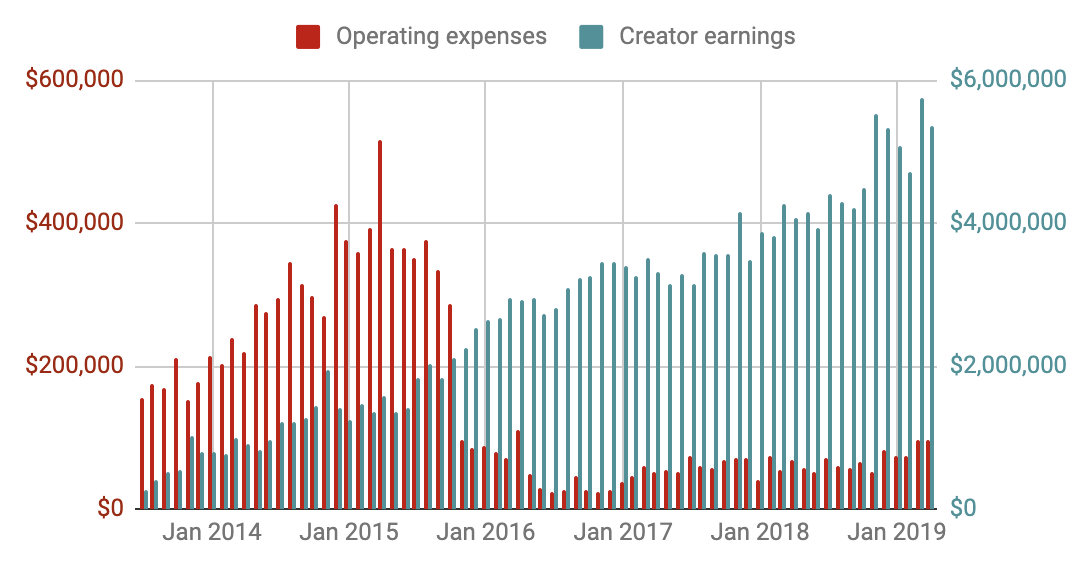
The point of VC is to inject money to achieve hypergrowth. But how much of that growth is achieved because of VC money, and how much because of the "natural trajectory" of the business? Or to ask another way, what portion of the VC money actually affects the trajectory and what portion makes no measurable difference?

This graph shows exactly what I mean. If you only had the "Creator earnings" part of the graph, would you be able to tell where spending was cut?

https://sahillavingia.com/operating.png

I've often felt this way, but this is the first time I see it summarized so succinctly in one image.

Re: No meetings, no deadlines, no full-time employees

#69
post #66

I work at Gumroad, mentioned in this article. Sometimes, I read things by CEOs about how a company works on the inside and I wonder if it really looks like that, or if it is a view from the top that doesn't reflect what it's really like. This article, with its discussions of the upsides and downsides, is accurate to my experience and my understanding of other people's experiences. For many people, Gumroad wouldn't be…

Are you willing to provide any additional clarity on "very competitive rates as contractors"? I understand if not but would be useful to help some of us externally think about this model.

I won't discuss other people's rates but I personally earn ten thousand USD per month.

Re: No meetings, no deadlines, no full-time employees

#70

Earlier quoted context omitted.

Quick note from my HR friends: beware that there may be local labor laws that conflict with this scheme.

In the US, it makes sense for the company to be required to pay a higher overtime rate if they're requiring the employee to work more than 40 hours. If the company is saying they don't want you to work more than 40 hours, then it seems like the law is going against the spirit of its intentions.

[deleted]
Post reply on HN