I'm gonna be honest I do not understand the economics and logic of vertical farming. You're basically putting plants in expensive, complicated buildings operated by extremely expensive and complicated robots, then you turn energy from the sun into electricity and back into light so you can grow the plants when you can just... farm in sunny places instead? Plants have the ability to turn sunlight into tasty nutrients…
Food sovereignty is a thing - an open air farm in Africa has geopolitical and weather risks. Not to mention the shipping carbon footprint and freshness issues.
Europe's Biggest Vertical Farm Will Be Powered by Wind and Planted by Robots
11–20 of 224 posts
Re: Europe's Biggest Vertical Farm Will Be Powered by Wind and Planted by Robots
#12I'm gonna be honest I do not understand the economics and logic of vertical farming. You're basically putting plants in expensive, complicated buildings operated by extremely expensive and complicated robots, then you turn energy from the sun into electricity and back into light so you can grow the plants when you can just... farm in sunny places instead? Plants have the ability to turn sunlight into tasty nutrients…
You can also significantly decrease water use, which matters in places like the Middle East that may want to reduce their dependence on food imports, and that already use desalinization to get water.
Singapore doesn’t have a lot of space but could also want to decrease its dependence on imports.
You can eliminate the risk of crop failures from drought / pests / freezes, and grow crops year round with lots of light, so yields can be quite high.
Local produce can be sold at a premium to high-class consumers, similar to the organic food industry.
And thinking farther out, this is an enabling technology for space colonization, so there’s a lot of growth potential in this technology.
Re: Europe's Biggest Vertical Farm Will Be Powered by Wind and Planted by Robots
#13I'm gonna be honest I do not understand the economics and logic of vertical farming. You're basically putting plants in expensive, complicated buildings operated by extremely expensive and complicated robots, then you turn energy from the sun into electricity and back into light so you can grow the plants when you can just... farm in sunny places instead? Plants have the ability to turn sunlight into tasty nutrients…
Also, instead of using 1 meter square to grow 1 meter square of crops, you can use the same space to grow 14x the amount of crops.
Re: Europe's Biggest Vertical Farm Will Be Powered by Wind and Planted by Robots
#14I'm gonna be honest I do not understand the economics and logic of vertical farming. You're basically putting plants in expensive, complicated buildings operated by extremely expensive and complicated robots, then you turn energy from the sun into electricity and back into light so you can grow the plants when you can just... farm in sunny places instead? Plants have the ability to turn sunlight into tasty nutrients…
Do we really need a repeat of the supply chains breaking down again to answer this question? African farmers were dismayed when their bumper crops were rotting in their fields because they couldn't export the crops or even sell the excess locally [0].
Livestock farmers also saw this as well [1].
It's hard to imagine that people haven't learned the value of having a robust local food supply chain, which is the one thing that I had hoped we had learned after the shortages and panic buying created during the 1st wave of COVID.
I agree that vertical farming has limitations, but it could be a useful adjunct to meet demand the typical soil based farming cannot deliver. Moreover, much like Holland's greenhouse farming the chances are most of it will be exported in exchange for other goods. Also, remember Denmark has a limited growing season that could in theory help them plan for larger scale operations, which they can partner with for Mars colonization as things develop in both sectors.
> I imagine it would work quite nicely in Iceland, with abundant energy and little (any?) arable land. It’s arguably better than mining Bitcoin with that energy.
Why not both? The excess heat from the mining could be used to have heated greenhouse/nurseries while still utilizing the excess heat and energy. This was working rather well in Canada [2].
0: https://allianceforscience.cornell.edu/blog/2020/04/ghana-fa...
1: https://www.vanguardngr.com/2020/10/covid-19-has-ruined-pig-...
2: https://inhabitat.com/bitcoin-mining-powers-canadian-mans-in...
Re: Europe's Biggest Vertical Farm Will Be Powered by Wind and Planted by Robots
#15I'm gonna be honest I do not understand the economics and logic of vertical farming. You're basically putting plants in expensive, complicated buildings operated by extremely expensive and complicated robots, then you turn energy from the sun into electricity and back into light so you can grow the plants when you can just... farm in sunny places instead? Plants have the ability to turn sunlight into tasty nutrients…
I imagine it would work quite nicely in Iceland, with abundant energy and little (any?) arable land. It’s arguably better than mining Bitcoin with that energy. You can also significantly decrease water use, which matters in places like the Middle East that may want to reduce their dependence on food imports, and that already use desalinization to get water. Singapore doesn’t have a lot of space but could also want to…
Re: Europe's Biggest Vertical Farm Will Be Powered by Wind and Planted by Robots
#16I'm gonna be honest I do not understand the economics and logic of vertical farming. You're basically putting plants in expensive, complicated buildings operated by extremely expensive and complicated robots, then you turn energy from the sun into electricity and back into light so you can grow the plants when you can just... farm in sunny places instead? Plants have the ability to turn sunlight into tasty nutrients…
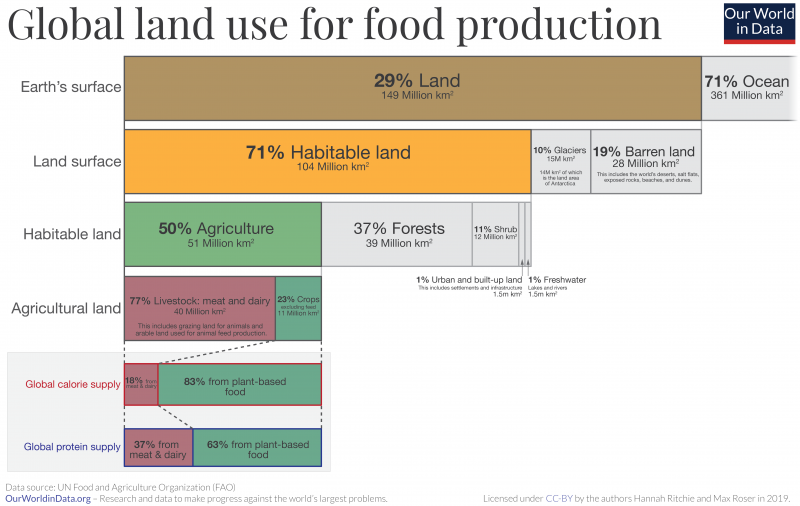
Land: 71% Habitable, 29% Not
Agricultural: 2.3% of all habitable land
Livestock: 8% of all habitable land
Looking at the stats, your question is very valid. We can drastically increase food production by marginally decreasing land dedicated for livestock and/or utilizing unused habitable land.
Source: https://ourworldindata.org/uploads/2019/11/Global-land-use-g...
Re: Europe's Biggest Vertical Farm Will Be Powered by Wind and Planted by Robots
#17I'm gonna be honest I do not understand the economics and logic of vertical farming. You're basically putting plants in expensive, complicated buildings operated by extremely expensive and complicated robots, then you turn energy from the sun into electricity and back into light so you can grow the plants when you can just... farm in sunny places instead? Plants have the ability to turn sunlight into tasty nutrients…
I'm lucky enough to live in one of the most food secure countries in the world, but not everyone is in the same position. There's value in having a food source near big population centres.
Re: Europe's Biggest Vertical Farm Will Be Powered by Wind and Planted by Robots
#18Earlier quoted context omitted.
I imagine it would work quite nicely in Iceland, with abundant energy and little (any?) arable land. It’s arguably better than mining Bitcoin with that energy. You can also significantly decrease water use, which matters in places like the Middle East that may want to reduce their dependence on food imports, and that already use desalinization to get water. Singapore doesn’t have a lot of space but could also want to…
Already exists: https://vaxafarm.is/pages/english . They are growing for the local market only.
Very cool!
Re: Europe's Biggest Vertical Farm Will Be Powered by Wind and Planted by Robots
#19I'm gonna be honest I do not understand the economics and logic of vertical farming. You're basically putting plants in expensive, complicated buildings operated by extremely expensive and complicated robots, then you turn energy from the sun into electricity and back into light so you can grow the plants when you can just... farm in sunny places instead? Plants have the ability to turn sunlight into tasty nutrients…
- Sun/heat/light maybe needs to be converted but it's always used in the right amount for each crop
- Controlled environments protected from plagues, floods, fires... Crops are not lost due to uncontrollable events and a lot of savings in chemicals to protect them from bugs
- Saving the cost of SCM (transport and intermediaries) which is sometimes much bigger than producing. In farming is actually almost always the case, to my knowledge
- 365 days a year of efficient production
- Good for the environment to save so much in transport
- Independence from other countries. Very important for small ones like Denmark that wouldn't have alternative to planting on their own soil.
To be honest, the only con I see is that this perfectly automated gardens produce much less tasty food because they are given the exact amount of water and minerals needed to generate the product, but the real soil somehow must add a lot of flavor, even if it's not relevant to produce the fruit, because I really feel a big difference of taste between hydroponic food and classic farming.
Re: Europe's Biggest Vertical Farm Will Be Powered by Wind and Planted by Robots
#20I'm gonna be honest I do not understand the economics and logic of vertical farming. You're basically putting plants in expensive, complicated buildings operated by extremely expensive and complicated robots, then you turn energy from the sun into electricity and back into light so you can grow the plants when you can just... farm in sunny places instead? Plants have the ability to turn sunlight into tasty nutrients…
Investing in Africa adds transportation costs and with perishables a lot of tariffs and restrictions will apply that are much easier to solve on shorter distances.
Finally, there are non-economic reasons such as independence for food production, water efficiency, energy efficiency (including transportation) and quality control.
Personally I think that food should be grown as close to the point of consumption as feasible, if that's Africa for Europe then so be it but if it can be done closer then that's better.