"We’re so spoiled today. Every week a newer, faster processor is released. Hardware gets cheaper and we can just throw more chips at the problem." I've been running a 3.5GHz CPU (with 4 HT cores) for nearly 10 years. That's a lot of weeks. Surely, today, I should be able to buy a 10GHz CPU, right? :D
You pretty much summed up the major misconception of how CPUs work (and get faster) these days. It's not about cores or clocking speed.
What would happen if computers never got any faster?
41–50 of 183 posts
Re: What would happen if computers never got any faster?
#42Just recently I got a Pentium 90 up and running using modern software (NetBSD 9.0). Doing a side by side speed comparison against my 3970x threadripper you can see the AMD is ~200-500x faster on a given task. The P90 creeks along running the modern kernel. mpv and mplayer can't play anything smoothly (not even as a .wav file) and mpg321 fires up pulseaudio before it starts playing so that's not happening. In this who…
What kind of P90 did you find that has 128 MB of RAM? My P100 had 16... It could play (and encode!) mp3s just fine, though.
Re: What would happen if computers never got any faster?
#43I think the author is misguided by saying "we need more thoughtful, and more creative humans". It's as if the author is lamenting some lost productivity that we would have otherwise achieved as a society by now. Just like how human work naturally fills up the time allotted to it [1], programmers tend to use up the hardware resources to make their apps usable. If time was spent hyperoptimizing, it would not change the…
Re: What would happen if computers never got any faster?
#44Earlier quoted context omitted.
You pretty much summed up the major misconception of how CPUs work (and get faster) these days. It's not about cores or clocking speed.
Can you elaborate on how CPUs work then? I'm curious what matters if clock speed and core count doesn't.
Re: What would happen if computers never got any faster?
#45The final products of those amazing programs that show up late in the platform's lifetime are indeed running on the same hardware, but aren't those programs often developed using faster computers of later periods? For instance, Donkey Kong Country does run on an unmodified SNES purchased on its launch day, but its creation shouldn't have been possible were it not for the Silicon Graphics workstations used to create t…
First of all, just because computers stopped advancing doesn't mean all computers will be the same. You'll still be able to use big, powerful machines as workstations where you write and deploy software for smaller machines. At the same time the N64 came out, there were MUCH more powerful machines you could use.
Secondly, there's really nothing in principle that would stop you from creating the late N64 games on less powerful computers. Certainly it would be more clunky to compile and deploy from an older, less powerful machine, but you could still do it.
Re: What would happen if computers never got any faster?
#46Just recently I got a Pentium 90 up and running using modern software (NetBSD 9.0). Doing a side by side speed comparison against my 3970x threadripper you can see the AMD is ~200-500x faster on a given task. The P90 creeks along running the modern kernel. mpv and mplayer can't play anything smoothly (not even as a .wav file) and mpg321 fires up pulseaudio before it starts playing so that's not happening. In this who…
If you mean command line tools, this is a bit surprising (assuming no pulse audio).
>As machines have progressed, the great wins of the past have become nearly unmeasurable noise.
I bet they are measurable when you get the cloud bill...
Re: What would happen if computers never got any faster?
#47The final products of those amazing programs that show up late in the platform's lifetime are indeed running on the same hardware, but aren't those programs often developed using faster computers of later periods? For instance, Donkey Kong Country does run on an unmodified SNES purchased on its launch day, but its creation shouldn't have been possible were it not for the Silicon Graphics workstations used to create t…
They are developed on faster computers but that was already the case at the heyday of these games, so the difference might be less than you would expect.
What is a huge difference though is access to information. Back in the day I got my weekly homeopathic dose of assembly language from a local home computer magazine. That's all there was. Today every ever so obscure detail is just few searches away. I cannot stress enough what difference this makes in learning and development speed.
Re: What would happen if computers never got any faster?
#48The final products of those amazing programs that show up late in the platform's lifetime are indeed running on the same hardware, but aren't those programs often developed using faster computers of later periods? For instance, Donkey Kong Country does run on an unmodified SNES purchased on its launch day, but its creation shouldn't have been possible were it not for the Silicon Graphics workstations used to create t…
Re: What would happen if computers never got any faster?
#49...
Wait a minute.
Re: What would happen if computers never got any faster?
#50Earlier quoted context omitted.
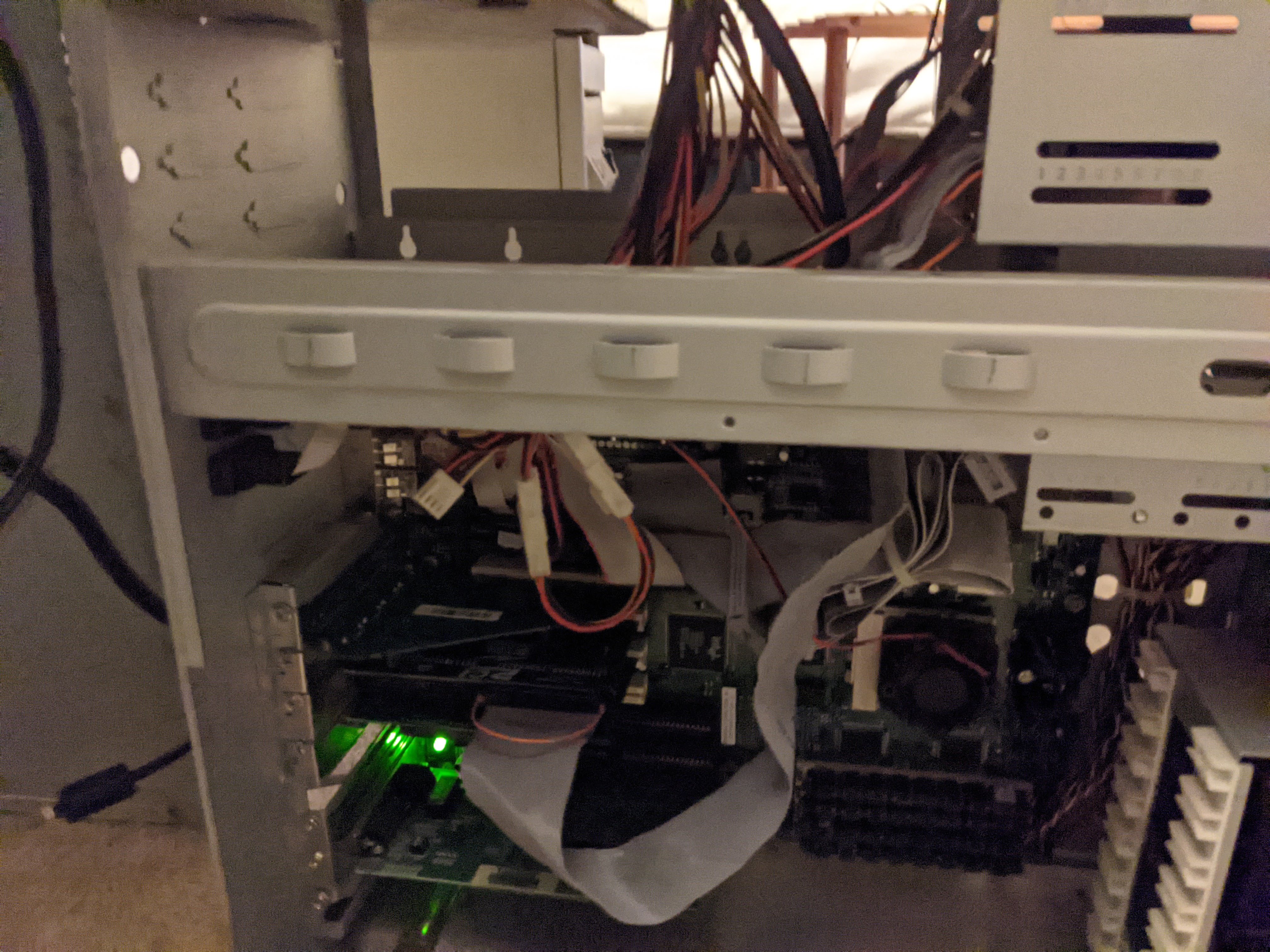
it was a server class machine. It's a Micron tower. I'm using 4 32MB 72 pin EDO modules. I can get a model number if you really want. It also has a PATA card to support the larger disk (I'm using 20GB) and has a PCI USB card to support well, basically anything (it's kinda fun using a wireless keyboard on it).
Oooh, beefy.