Live data from Hacker News

WTF Happened in 1971? (2019)

wtfhappenedin1971.com

201–210 of 477 posts

Re: WTF Happened in 1971? (2019)

#201
post #148
post #60

Earlier quoted context omitted.

The thing is, there was a lot going on in the 1968-1971 period. Everything from civil rights to the moon landings. The collapse of Bretton Woods is important, but we have to ask why and what pressures led to that point.

I find Yanis Varoufakis' account of the history leading up to the collapse of Bretton Woods very telling: As the combined costs of the Vietnam War and the Great Society began to mount, the government was forced to generate mountains of US government debt. By the end of the 1960s, many governments began to worry that their own position, which was interlocked with the dollar in the context of the Bretton Woods system,…

We are generating mountains of debt yet again, unfortunately.

Re: WTF Happened in 1971? (2019)

#202

Earlier quoted context omitted.

> "... more credence with mainstream economists" Do you follow main stream economists today? Ray Dalio (Bridgewater), Jeffrey Gundlach (Double Line), Raoul Pal (Real Vision), and Warren Buffet (Berkshire) have made very big bets for Gold and Gold stocks because our currency is being debased at a rate we have never seen.

> our currency is being debased at a rate we have never seen. Looks at $1 gasoline. Looks at $2 eggs. Looks at $3 gallon of milk. Debased. Sure thing. (Maybe gasoline is an unfair example, but essential good prices are largely unchanged in the last decade. The point stands)

Sounds like you are going down with the ship. Its completely irrational to believe you can print yourself into prosperity. I could just as easily point to Tech stocks, Tesla, gold, silver, bitcoin or any other inflated commodity as a counterpoint.

Re: WTF Happened in 1971? (2019)

#204

Graphs like these serve to suggest to people that there's a single, operative reason at their core instead of it being a complex, multivariate issue. They also tend to cause people to over-attribute the effects of the story told in the graph(s) to the majority of the population instead of a minority with disproportionate impact. Regardless, taken together the graphs are compelling. The real cause will likely remain f…

I came to this conclusion as well as it seems like a lot of extremely pivotal economic events took place around 1971. It was basically the year the modern economy was born.

Re: WTF Happened in 1971? (2019)

#205
Reading through all these comments, I think the answer is basically that a LOT happened around 1970. We started trading with China. We ended the gold standard. The OPEC oil crisis. The Greatest Generation retiring and the boomers being the main workforce. Shipping changes with container standardization. Maybe the answer is the world changed, in a huge way, in many ways at once.

Re: WTF Happened in 1971? (2019)

#207

The author obviously wants you to believe that it was the abandonment of the gold standard, but there are several other theories that have more credence with mainstream economists. The early 70's was the start of a horrible period of stagflation: stagnation coupled with inflation. Some do blame the loss of the gold standard, but the leading theory is the OPEC oil crisis. Others blame market regulations, the EPA was p…

I find the great decoupling fascinating and I don't think it gets enough study. There are a couple other things that I think contributed: The massive increase of women joining the labor market in the US just after 1970 largely as a consequence of the widespread adoption of oral contraceptives in the young population. [1] The People's Republic Of China was formally admitted to the UN in 1971, and following that in 197…

I wonder if this chart is also relevant: https://commons.m.wikimedia.org/wiki/File:Global_Temperature...

Re: WTF Happened in 1971? (2019)

#208

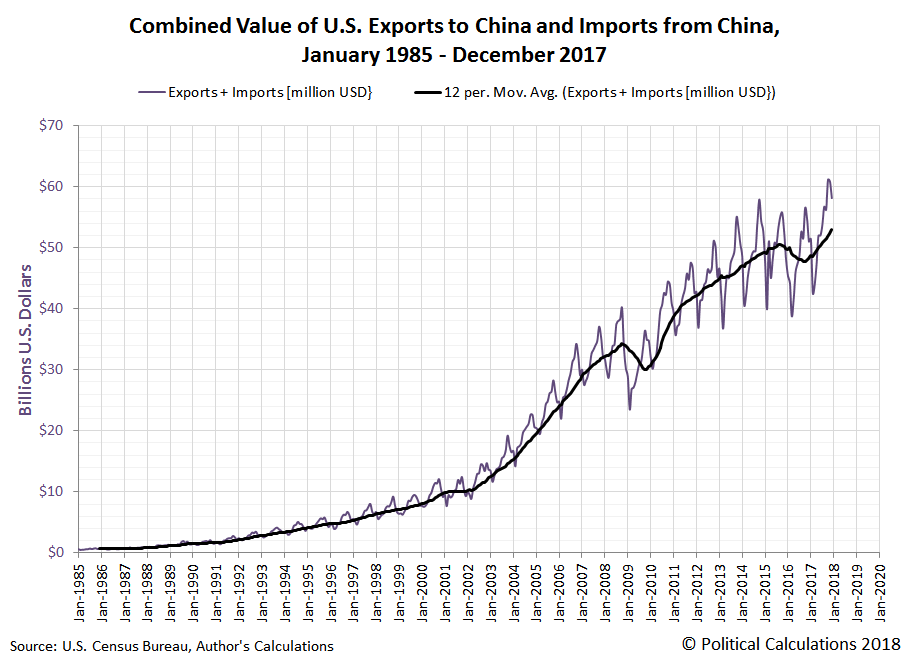
The biggest reason for the wage drop is the trade with China. The US and China started trading in 1971: https://apjjf.org/2013/11/24/Dong-Wang/3958/article.html As with any economic question, it's usually not due to one reason. The combination of energy price and workforce age comes into play. But the biggest trigger of all was the trade with China. That put a serious pressure to job competition, and led to significa…

Total US trade with China was vanishingly small well into the 1980s, and didn't start to become significant relative to total US trade until the mid-to-late 90s[1].

I think there's a better argument for trade at large, since ~1970 was a turning point for many _other_ Asian countries, in particular Japan, Taiwan, South Korea, Singapore, etc. There wasn't a clear, sharp line, though.

[1]https://static.seekingalpha.com/uploads/2018/2/15/saupload_c...

Re: WTF Happened in 1971? (2019)

#209

Earlier quoted context omitted.

People always underestimate the cost of regulations. Even when good, the cost is big. Health care is a good example. Keeping patient data private is a good thing. However it’s also absolutely crushing in its impact in the industry. Tiny projects can take months or years. HIPPA terrifies so many IT people. Driving away top developers.

I think you're underestimating the cost of not having good regulations. Not all regulations are bad, and not all barriers (cost or otherwise) imposed by regulation is bad -- often it's been judged that the alternative has more, often externalized, costs. What do healtcare costs and deaths look like if we removed all our environmental regulations? What's the cost in terms of people not getting treatment for things bec…

Regulations usually don't do what those who advocate for them say they do. They are generally created to benefit some corporations at the expense of consumers and/or other corporations.

I'm not convinced environmental regulations are a global net benefit to the environment and I can't see how privacy regulations could possibly be beneficial as customers who want privacy protections create a market demand for them. Even in the extremely unfree healthcare market in the US, provides would improve their data security if they thought people were not getting treatment because they worried about their privacy. Regulations create a false sense of security, incentivize companies to keep data breaches and past vulnerabilities secret, and make developers spend time complying with ineffective or harmful requirements instead of actually improving security.

I think one should be very sceptical of regulations and other coercive alleged solutions from governments, especially as politicians have a very strong incentive to serve the corporations who fund their campaigns rather than the voters who rarely even get to hear the name of a candidate who is not supported by corporate spacial interest and wouldn't vote for them anyway as to not "throw away their vote".

Re: WTF Happened in 1971? (2019)

#210
post #184

The author obviously wants you to believe that it was the abandonment of the gold standard, but there are several other theories that have more credence with mainstream economists. The early 70's was the start of a horrible period of stagflation: stagnation coupled with inflation. Some do blame the loss of the gold standard, but the leading theory is the OPEC oil crisis. Others blame market regulations, the EPA was p…

> And energy is a massive component in the price of almost everything we consume. Is it really? What would be different if energy was much cheaper? Would we have more advanced rockets or robots or phones? Better CPUs? More and cheaper housing built in dense cities? Cheaper education or medicine? More job security? Even more food? I realize that energy is an important input into some industrial processes, but I don't…

It was only a single point of the OP's that you're targeting but I have to agree (I agree with other OP points though).

Would a lower energy cost bring wages up? No reason to believe that would be the case.

Would it lower the cost of goods so that at least the working poor could have a better standard of living?

Perhaps, but how much of the cost of a good is the energy, how much labor and raw materials? Would we see even more job loss due to lower cost of energy as it becomes even cheaper still to automate?

(Edit: to be clear, OP wasn't saying lowering energy costs would do anything more than lower the cost of goods. But that statement alone, coupled with the article showing declining wages, etc. suggests OP was implying lower energy costs could reverse or stop the trends shown.)

Post reply on HN