Live data from Hacker News

British hackers: stop voting for lizards; start voting for people today

reprog.wordpress.com

71–80 of 103 posts

Re: British hackers: stop voting for lizards; start voting for people today

#71
post #24

Earlier quoted context omitted.

The Tory stance seems ridiculous to me (as an outsider) considering that the UK's devolved assembly elections use PR-STV or other similarly "complicated" systems. FWIW we use PR-STV in Ireland and are currently going through a debate about conceivably switching to a "list" system, or possibly a hybrid list system tempered as they do in Germany.

It IS ridiculous. But people have been TOLD that AV is too complicated for their simple little minds, and too many of them seem to have accepted this statement uncritically. It breaks my heart.

Unless it's something they care about (and not everyone cares about voting reform!), being told "Don't worry about it, it's too hard to explain" is often met with "Oh, okay."

The trick is to get people to care about it so they become curious and reject the assertions of "it's too hard". The Yes campaign attempted this initially but did a poor job, in this case it turns out much easier to explain the thing than to pose half-truth arguments why people should care!

Re: British hackers: stop voting for lizards; start voting for people today

#72
post #47

Earlier quoted context omitted.

The converse view: Surely people who are so stupid/ignorant that this system would stop them voting, are too stupid/ignorant to be able to vote effectively in any election. You may argue that it sounds a bit elitist, but personally, I want an electorate capable of making informed choices in the voting booth.

I agree with your last point entirely, but unfortunately it's a politically unacceptable one. Passing some sort of civics exam before having the right to vote would be fine by me.

It's the same justification given for not letting minors vote.

If it's acceptable to de-juris disenfranchise the under-18s on the spurious grounds that they are incapable of voting effectively, surely we can de-facto disenfranchise any adults incapable of operating an AV ballot paper. (which only requires the ability to count up to 1)

Re: British hackers: stop voting for lizards; start voting for people today

#73
post #50

Earlier quoted context omitted.

Why are those the only choices? Why not switch to proportional representation instead, using D'Hondt or Saint-Laguë? Or is there such strong support for the current single-winner system in the UK that noone wants to change the base idea?

Neither of the main political parties (Labour, Conservatives) want to support STV because it will greatly diminish their power in Parliament, therefore there will be no possibility of it being on the agenda either in this Parliament or at any other time in the next twenty years. As it stands, the "No" campaign merely for AV has, for a number of reasons, managed to convince more than enough people that this is a hatef…

"It's undemocratic", the rallying cry of anti-progressives in these sorts of situations. The Conservative Party of Canada was calling coalitions undemocratic. (But suspending parliament when coalitions against them are being discussed... apparently not undemocratic.) Conservative supporters were calling voting strategically (voting for whoever had the likeliest chance of lowering the odds of a Conservative majority) "undemocratic".

Re: British hackers: stop voting for lizards; start voting for people today

#74
post #60

Earlier quoted context omitted.

It's described under the 'simulation method' heading. Unless you have a reason to suggest otherwise, it's reasonable to assume voters' preferences follow a normal distribution.

Voters get polarized. In fact that's what All the candidates try to do. Are any elections normal?

You are implying that there are no moderate (or 'swing') voters, which is foolish when the big parties actively reach out for these people.

Instead, issues get polarised. Both parties and candidates have several different issues, so voters' actual preferences depend on which issues are important to them.

You also get tribal voters ("My family has always voted conservative") who are unlikely to care about the issues in any election, but these cancel each other out somewhat in a plurality or AV/IRV vote.

Nevertheless, I hope we can agree that accurately modelling voting habits is complicated, not simple.

Re: British hackers: stop voting for lizards; start voting for people today

#75
post #2

I still don't understand why the referendum is on AV and not PR. Most votes get thrown away because of this silly county-based system. If you live in a county which is heavily weighted towards a particular party, you do not have a meaningful vote .

udp, some people prefer PR over AV (for the record, I prefer AV because it keeps the one-representative-per-constituency link), but since PR is not on the table, voting for AV is the way to go. (Or voting to keep British politics the way it is, of course.)

A PR system maintaining one representative per constituency is already in use in the United Kingdom - in both Scotland and Wales.

Re: British hackers: stop voting for lizards; start voting for people today

#76

Earlier quoted context omitted.

Unfortunately we haven't been offered a suggestion box, just a choice between AV and FPTP - personally, AV seems like an improvement on FPTP, even if it's not the best possible system overall.

Well if we vote in AV, can we then have an AV referendum next year on voting reform? "Please rank the following voting systems in order of preference."

Apparently this is how New Zealand selected their voting method (with a qualifying question beforehand, "Do you want to change the system? Y/N").

Very reasonable. So we'll never see it here. ;)

Re: British hackers: stop voting for lizards; start voting for people today

#77

AV, or IRV (Instant Runoff Voting), is arguably the worst form of preferential voting in existence. Take this example of IRV totals for four candidates ordered by preference: 30% a; b; c; d 35% c; b; d; a 20% d; b; a; c 15% b; d; c; a Given the voting breakdown, most people would agree that candidate b should win, because no candidate got a majority of first preference votes and b got a sweeping majority of second pr…

IRV is substantially better than FPTP. The choice today is a FPTP choice: the alternatives are A and B, not some mythical third choice that you just invented. Voters in the UK should vote for the best choice of those available, which is clearly IRV. Even your statement is simply silly. You're assuming that a voting system ought not eliminate a candidate when he was the least favorite of the voters, and you proceed fr…

In the example given, "a" seems the least favorite, unless you ignore all preferences except the "first choice" preference. However, voting systems that take into account second and third choices (or more) cannot be perfect, since groups do not really have preferences in the same way that individuals do: a group can legitimately prefer every candidate to every other candidate, as Condorcet voting shows.

Re: British hackers: stop voting for lizards; start voting for people today

#78

Earlier quoted context omitted.

This probably sounds terrible, but if you are too "stupid/ignorant" to write your preferences in order 1-5, are you really competent enough to be voting? I really don't expect there are many people (or any, I mean, really?) who are that stupid - that's just doesn't seem a valid reason to be against it. If you just write "1" instead of an "X", it's exactly as easy as the current system. Could you do it? Can you really…

Perhaps this comes from living in the north, but the people I associated with are less sophisticated than you give them credit for. My wife has next to zero understanding about any of this and is not voting because she has no understanding of the issues involved. Ditto for my parents. And my in-laws. Assuming that everyone's an intellectual and will research and consider the options and then make an informed choice i…

Well, that's a bit depressing. :/ But half my family live in the north, and I don't think you give them enough credit :)

Also, you seem to be talking about the decision making process of assessing whether to vote for AV or FPTP, not the not the complexity of voting using an AV system.

I'm not convinced that the AV voting method is too difficult to understand, though. Ranking things in order of preference is not hard for anyone to do. The finer points of the difference in electoral outcomes given different voting statistics might be more sophisticated, but that could be applied to any of the voting systems.

Voting itself though is no more complicated saying "I'll have a pint of Stella. If they don't have Stella, I'll have Fosters."

The No campaign has made the AV system out to be more complicated than it is as a scare tactic to put people off voting for it. That seems to have worked, which is deeply unfortunate, but indicative of political campaigns across the world. Fear and doubt are excellent motivators, and seem to be far more effective than a clear, reasoned and 'intellectual' argument.

Call me an unrealistic idealist, but I would much rather people research and consider the options before making an informed choice. Making a case for FPTP because it encourages more people who are uninformed and unconsidered to vote isn't going to win me over, though :)

However, as I say, the AV voting mechanism really isn't complicated at all - my wife is an early years teacher. Voting under an AV system is so easy that - literally - a five-year-old can understand it. I don't see anyone being put off by it.

Moreover, I think more people will be enthused by i) their ability to vote for the candidate that they believe in, ii) the greater accountability of their elected MPs to engage with their constituents and more accurately reflect their views and iii) their ability to express their opinions in a more meaningful way through the ballot box, that turnouts would be greater, not smaller. Low turnout and voter apathy has a multitude of causes, but the ones that I hear most often are "lack of accountability" and "my vote doesn't count anyway."
Re: British hackers: stop voting for lizards; start voting for people today

#79
post #22

Earlier quoted context omitted.

The German system sounds good. But the UK Conservative Party's argument against simple AV has been "it's too complicated for people to understand". Trying to get people to vote for something that genuinely IS a bit complicated would be a complete non-starter at this point. Anyway, right now it's AV or Continue As You Were. That's the choice we Brits have to make TODAY, and I do hope that any of you reading this will…

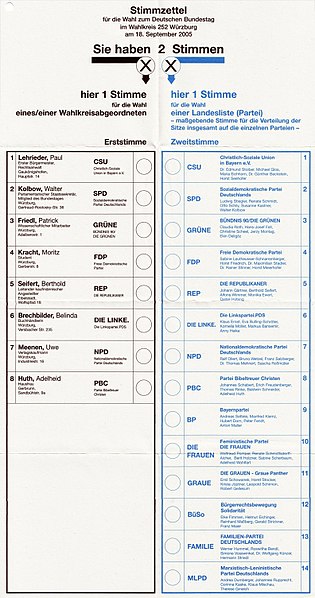
The German system can be presented more simply. First, here are your local candidates. Which one do you want? Second, here are the global parties. Which one do you want? That's pretty simple.

I agree. Here is the ballot: http://upload.wikimedia.org/wikipedia/commons/thumb/7/7e/Bun...

Voters have two votes: one on the left and one on the right. "Hier 1 Stimme" means "Here 1 vote". It is still just an X in a circle but twice instead of once. Most people when shown this grasp it immediately.

A similar Scottish ballot is on the left here: http://image.guardian.co.uk/sys-images/Guardian/Pix/pictures...

Re: British hackers: stop voting for lizards; start voting for people today

#80

AV, or IRV (Instant Runoff Voting), is arguably the worst form of preferential voting in existence. Take this example of IRV totals for four candidates ordered by preference: 30% a; b; c; d 35% c; b; d; a 20% d; b; a; c 15% b; d; c; a Given the voting breakdown, most people would agree that candidate b should win, because no candidate got a majority of first preference votes and b got a sweeping majority of second pr…

Condorcet is also an undesirable property: http://rangevoting.org/FishburnAntiC.html

Condorcet just points out that group preferences are not necessarily consistent. This is a property of group preferences, not merely of some voting systems; the voting systems just allow the inconsistency to be noticed.
Post reply on HN