Live data from Hacker News

Apple Silicon M1 chip in MacBook Air outperforms high-end 16-inch MacBook Pro

macrumors.com

801–810 of 1001 posts

Re: Apple Silicon M1 chip in MacBook Air outperforms high-end 16-inch MacBook Pro

#801
post #699

There were talks of splitting Google and other huge companies due to their size ( https://arstechnica.com/tech-policy/2020/10/house-amazon-fac... ). Wouldn't it be awesome if Apple's CPU/IC design segment became a separate company and sold these CPUs and maybe SoC by themselves? I think that would make a big dent into AMD/Intel market shares. Since Apple's part/die should be quite a bit smaller than most of the x86 d…

No, it wouldn't be awesome. This thing ONLY EXISTS in the first place because of Apple's continual vertical integration push, and because other parts of the business were able to massively subsidise the R&D costs necessary to come up with a competitive SOC in an established market that's otherwise a duopoly. If their CPU/IC design segment were its own company, the M1 would never have seen the light of day. Period. Fu…

>This thing ONLY EXISTS in the first place because of Apple's continual vertical integration push, and because other parts of the business were able to massively subsidise the R&D costs necessary to come up with a competitive SOC in an established market that's otherwise a duopoly. If their CPU/IC design segment were its own company, the M1 would never have seen the light of day. Period.

Eh, that's some very biased thinking.

In the real hardware world of both mechanical and electrical. I can approach a company and say "we want something with these specs, we'll buy 10 million pieces per month, what can you do you us?" and that kicks off R&D efforts after some ground contractual agreements to commit both parties.

You know, exactly what Microsoft did with AMD when they commissioned unique SOC designs for their consoles with a host of never before implemented features such as direct gpio ssd io.
Re: Apple Silicon M1 chip in MacBook Air outperforms high-end 16-inch MacBook Pro

#802

Earlier quoted context omitted.

That's not really true. Every modern Intel, AMD, and Nvidia GPU does actually include hardware to accelerate encoding video, it's just that software solutions end up being preferred in a lot of cases because they produce better output and can be continually improved. A large body of encoding software is however, perfectly capable of taking advantage of them. The comparison is kind of silly.

> The comparison is kind of silly. I disagree. Sure we have things like NVENC for accelerated H.265 encoding but that is an additional hardware expense and means only the machines you have that hardware in benefits. This will literally be all Macs from a $699 Mini and up. I don't know enough about Intel QuickSync to compare but it clearly isn't used on the iMac in that video for some reason (perhaps the software does…

At the risk of going in circles, let me try to explain one last time:

All modern GPUs already have HW-accelerated encoding, including integrated Intel GPUs, and Nvidia and AMD dedicated ones.

Despite that, HW-encoding is not used that much by video professionals because CPU encoders produce better compression given enough time. You only have to do compression once, while the video will be watched who knows many times, therefore there is no real point in making your encoding faster if the file size goes up.

Your HW encoder is absolutely useless for anything else. It does not make your FX rendering faster, and cannot be used for any other codecs.

Even if say, your HW matches CPU-based encoder at first, it is fixed and cannot be updated unless you buy new HW which takes millions to design. Meanwhile any old dev can contribute to x265 and figure out new psychovisual enhancements that will enhance the quality while minimising the file size.

Specialized HW (i.e. ASICs) has been in existence for decades, yet despite that, there are very good reasons as to why we still use general-purpose CPUs (and GPUs) for most computing applications.

Re: Apple Silicon M1 chip in MacBook Air outperforms high-end 16-inch MacBook Pro

#803

Earlier quoted context omitted.

A modern mobile CPU with a TDP of 6 watts is beating a modern desktop CPU with a TDP of 125 watts? Is it just me or this seems too good to be true?

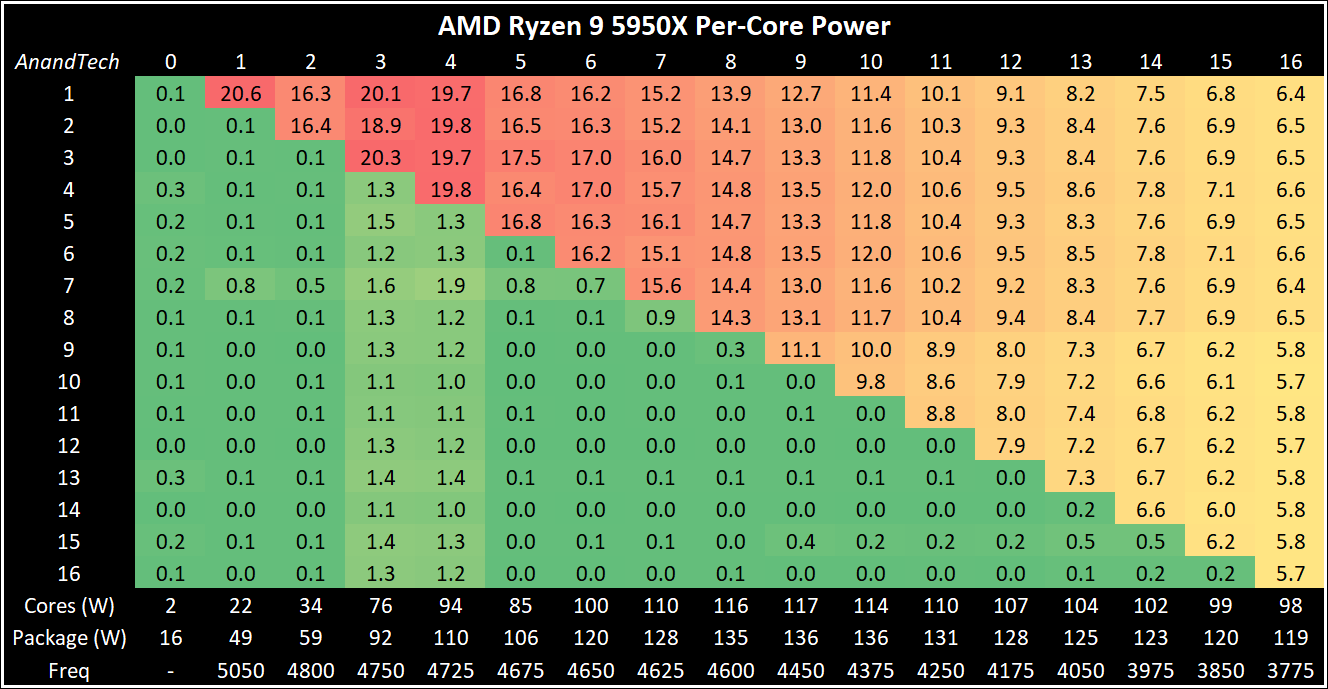
TDP lost meaning years and years ago, and power usage isn't linear. The extra 100-300mhz at the top end is a huge impact to power. Check out for example the per core power charts that Anandtech does: https://www.anandtech.com/show/16214/amd-zen-3-ryzen-deep-di... Compare for example the 1 core power numbers between the chips. The 5600X 1 core result is 11w @ 4.6ghz, whereas the other two chips boost higher and hit 4.…

>https://images.anandtech.com/doci/16214/PerCore-1-5950X.png

Yeah comparing TDP is meaningless even within the same processor. The 4 core workload in this table uses 94W and the 16 core workload uses 98W. There is also an anomaly at 5 cores where the CPU uses less power than if it only used 4 cores.

If you tried to derive conclusions about the power efficiency of the CPU you would end up making statements like "This CPU is 3-4 times more power efficient than itself"

Re: Apple Silicon M1 chip in MacBook Air outperforms high-end 16-inch MacBook Pro

#804

Earlier quoted context omitted.

M1 is not magic and can't break the laws of physics. SMT makes better use of silicon and will probably push speeds closer. OTOH, M1 has a fast memory that the i9 can't match. I still bet on the i9, but it'd be interesting to run a test.

>M1 is not magic and can't break the laws of physics. Anandtech's deep dive provides several examples of advances in Apple's core design that didn't involve magic or breaking the laws of physics. For example... Instruction Decode: >What really defines Apple’s Firestorm CPU core from other designs in the industry is just the sheer width of the microarchitecture. Featuring an 8-wide decode block, Apple’s Firestorm is b…

> Featuring an 8-wide decode block, Apple’s Firestorm is by far the current widest commercialized design in the industry. Other contemporary designs such as AMD’s Zen(1 through 3) and Intel’s µarch’s, x86 CPUs today still only feature a 4-wide decoder designs

This is one place where the 64-bit ARM ISA design shines: since all instructions are exactly 4 bytes wide and always aligned to 4 bytes, it's easy to make a very wide decoder, since there's no need to compute the instruction length and align the instruction stream before decoding.

Re: Apple Silicon M1 chip in MacBook Air outperforms high-end 16-inch MacBook Pro

#805

Earlier quoted context omitted.

Hence why Cinebench is often used these days when evaluating real-world performance with sustained workloads.

Different tests. Different purposes. GB deliberately avoids running up the heat because it is focused on testing the chip, not the machine's cooling ability. Cinebench, as you say, tests "real-world" conditions, meaning the entire machine, not just the chip.

The chip's ability to run at sustained load is a part of its design also. Precisely because modern chips has to throttle in order to meet power and thermal envelopes, we should be looking at sustained performance as a more accurate measure.

In a majority of cases, burst performance only affects things like responsiveness, and those things should be measured instead for a better reflection of the benefits.

Re: Apple Silicon M1 chip in MacBook Air outperforms high-end 16-inch MacBook Pro

#806
post #685

Earlier quoted context omitted.

> Why would anyone (who is not forced) buy an Intel PC laptop when these are available and priced as competitive as they are? - locked bootloader - no bootcamp - can't install or boot linux or windows - virtualization limited to arm64 machines - no windows x86 or linux x86 virtual machines - only 2 thunderbolt ports - limited to 16GB RAM - no external gpu support/drivers - can't use nvidia or amd cards - no AAA gamin…

- Starts at $999 for the base laptop version. You can get much cheaper still good Windows laptops.

In my experience, Microsoft and PC laptop manufacturers still haven't figured out how to make a trackpad that works as well as a 2008 era Macbook.

Re: Apple Silicon M1 chip in MacBook Air outperforms high-end 16-inch MacBook Pro

#807

Earlier quoted context omitted.

The results seem a little weird but if remotely true then these machines are going to sell like cup cakes. Why would anyone (who is not forced) buy an Intel PC laptop when these are available and priced as competitive as they are?

> Why would anyone (who is not forced) buy an Intel PC laptop when these are available and priced as competitive as they are? - locked bootloader - no bootcamp - can't install or boot linux or windows - virtualization limited to arm64 machines - no windows x86 or linux x86 virtual machines - only 2 thunderbolt ports - limited to 16GB RAM - no external gpu support/drivers - can't use nvidia or amd cards - no AAA gamin…

Most games played by most players are on iOS & iPadOS, and macOS Big Sur will run them on your MacBook.

Re: Apple Silicon M1 chip in MacBook Air outperforms high-end 16-inch MacBook Pro

#808

Earlier quoted context omitted.

The results seem a little weird but if remotely true then these machines are going to sell like cup cakes. Why would anyone (who is not forced) buy an Intel PC laptop when these are available and priced as competitive as they are?

> Why would anyone (who is not forced) buy an Intel PC laptop when these are available and priced as competitive as they are? - locked bootloader - no bootcamp - can't install or boot linux or windows - virtualization limited to arm64 machines - no windows x86 or linux x86 virtual machines - only 2 thunderbolt ports - limited to 16GB RAM - no external gpu support/drivers - can't use nvidia or amd cards - no AAA gamin…

> - no AAA gaming

I thought Google, Microsoft, Nvidia, etc. were all pushing streaming gaming services that will run on any hardware with a decent internet connection. I would imagine the hardware video decoder in the M1 chip would allow 4K streaming video pretty well.

Re: Apple Silicon M1 chip in MacBook Air outperforms high-end 16-inch MacBook Pro

#809
post #579

Earlier quoted context omitted.

The results seem a little weird but if remotely true then these machines are going to sell like cup cakes. Why would anyone (who is not forced) buy an Intel PC laptop when these are available and priced as competitive as they are?

> Why would anyone (who is not forced) buy an Intel PC laptop when these are available and priced as competitive as they are? as a power user I will not be touching anything apple ARM until all my hundreds of software apps are certified to work exactly the same as on x86_64. i will not rely on rosetta to take care of this. i need actual testing. besides this, 8GB of RAM is how much a single instance of chrome uses. i…

> this could be a good time to jump the apple ship. it's pretty clear their focus is not their power users' focus.

Let's back up a second: Tim Cook said this transition would take place over two years. This is just the first batch of computers running Apple Silicon.

I certainly hope and think that Apple can come out with a beefy 16 inch MacBook Pro with 32 gigs of ram within the next two years. Also, in that time I imagine everything in Homebrew would be ported over natively.

Re: Apple Silicon M1 chip in MacBook Air outperforms high-end 16-inch MacBook Pro

#810
post #785

This is very interesting and in line with Apple's claims. I am looking forward to some real world numbers for different tasks in the next few weeks and months as native apps become available. Jonathan Morrison posted a video [0] comparing a 10-core Intel i9 2020 5K iMac with 64GB RAM against an iPhone 12 Mini for 10-bit H.265 HDR video exporting and the iPhone destroyed the iMac exporting the same video, to allegedly…

> This is the most excited I have been for general purpose computer performance gains in about a decade. I think I would be excited if it were not built by Apple. That functionally means it’s only going to be in Apple products at a 300% markup.

No one's stopping any other company from doing it. But as usual, Apple has been the only company (for better or worse) that has been innovating on the desktop for the past decade. Every other manufacturer is content with producing the same milquetoast laptops.
Post reply on HN