Live data from Hacker News

Apple unveils M1, its first system-on-a-chip for portable Mac computers

9to5mac.com

721–730 of 1001 posts

Re: Apple unveils M1, its first system-on-a-chip for portable Mac computers

#721

Earlier quoted context omitted.

I can't see how something that tiny can compete in any meaningful way with a giant nVidia type card for training. I'd imagine it's more for running models that have been trained already, like all the stuff they mentioned with Final Cut.

Isn't it better to rent a cloud with as many GPUs as necessary for a time needed to train the model? I don't know state of things in ML.

Cloud GPU instances are very expensive. If you get consumer GPUs not only do you save money, you can sell them afterwards for 50% of the purchasing price.
Re: Apple unveils M1, its first system-on-a-chip for portable Mac computers

#722

Earlier quoted context omitted.

Also just two ports on a PRO model. C‘mon there is plenty of room on both sides. Maybe lets it look elegant but then the cable mess will be on the desk, thanks.

This MBP refresh replaces the lower-end MBP which also only had 2 ports. This is a small detail that is easy to miss. The "higher-end" MBPs with 4 ports are only availabe with the intel CPUs for now

Those 8 extra PCIe lanes eat a lot of power. It's worth noting that Intel's processor they used in the 2019 MBP 13 had 16 PCIe lanes (I think the chipset added more too), but this chip probably has 10-12 at the absolute most.

The "we integrated thunderbolt" bit is also implying an untruth that nobody else does that. Intel did that last year with Ice Lake. AMD will do that next year when they upgrade their IO die.

Re: Apple unveils M1, its first system-on-a-chip for portable Mac computers

#723
post #706

Earlier quoted context omitted.

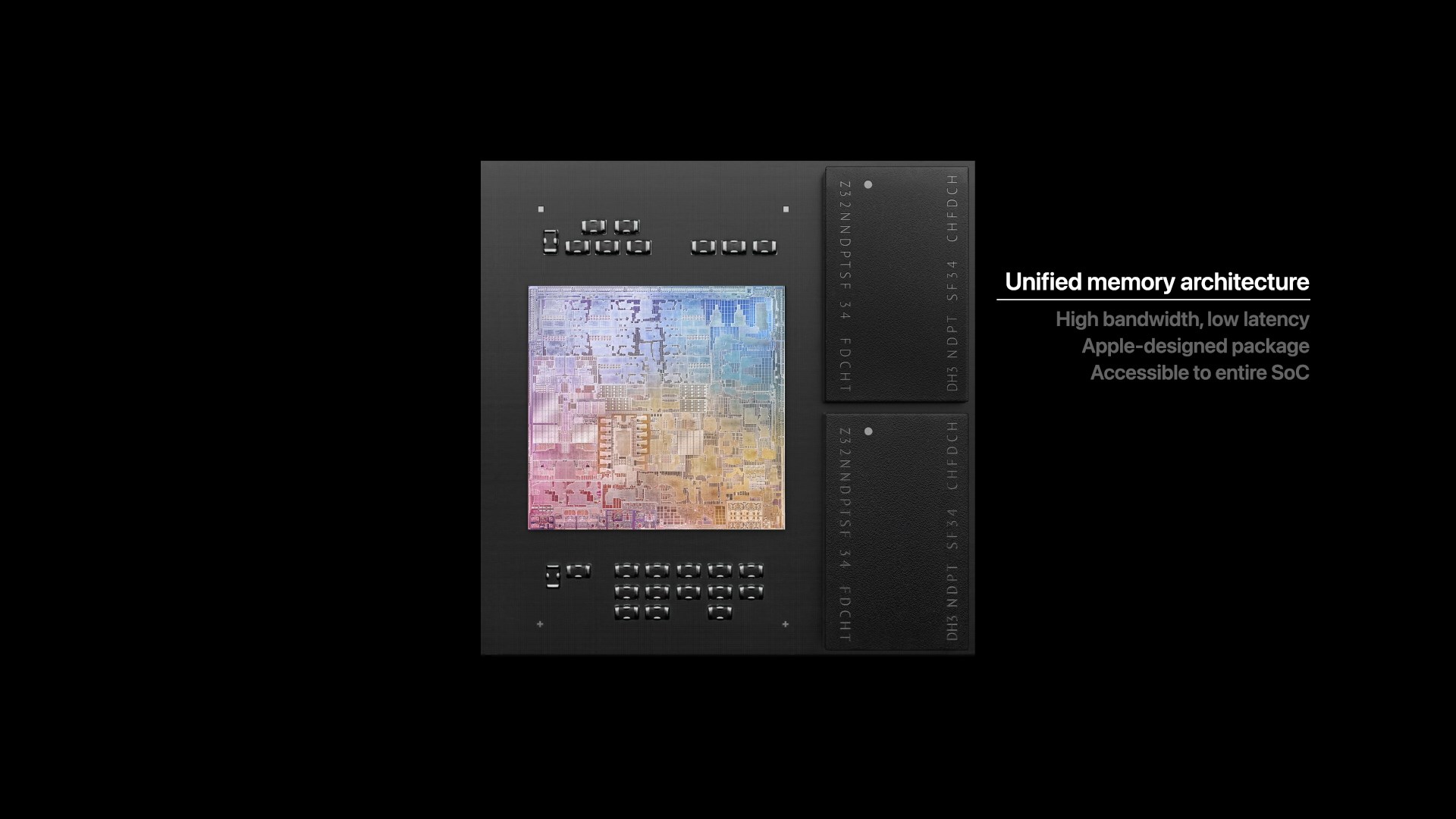
RAM limits are pretty easy to explain. 16GB chips cost disproportionately more and use more power. I wonder if they use 2 4GB chips or 1 8GB chip in the low-end SKU?

It's even easier to explain than that. The RAM is integrated into the CPU. While there are a few SKUs here, Apple only designed and built one CPU with 16GB RAM. The CPUs are binned. The CPUs where all RAM passed testing are sold as 16GB, the 8GB SKUs had a failure on one bank of RAM. There are no 32 or 64 GB models because Apple isn't making a CPU with 32 or 64GB of RAM yet.

It looked to me that they were placing 2 DDR4 modules beside the chip.

https://images.anandtech.com/doci/16226/2020-11-10%2019_08_4...

Re: Apple unveils M1, its first system-on-a-chip for portable Mac computers

#724

I honestly expected more. While compute performance and power efficiency seems to be really good, the M1 chip is apparently limited to 16GB RAM, 2TB storage and 2 Thunderbolt/USB4 controllers. Comparing the new 13" MacBook Pro with the previous one that's a regression in every aspect as the Intel-based ones allow up to 32GB RAM and 4TB storage and offer 4 Thunderbolt 3 ports.

They only upgraded the entry level Macs, as expected. The previous 2 port 13" MBP was also limited to 16GB RAM.

The 4 port 13" MBP will most likely get upgraded early next year and also support more RAM. Apple did announce the transition will take them two years, not sure why people are surprised that their high end hardware is not updated yet on day one.

Re: Apple unveils M1, its first system-on-a-chip for portable Mac computers

#725
post #569

"Testing conducted by Apple in October 2020 using preproduction MacBook Air systems with Apple M1 chip and 8-core GPU, as well as production 1.2GHz quad-core Intel Core i7-based MacBook Air systems, all configured with 16GB RAM and 2TB SSD. Tested with prerelease Final Cut Pro 10.5 using a 55-second clip with 4K Apple ProRes RAW media, at 4096x2160 resolution and 59.94 frames per second, transcoded to Apple ProRes 42…

Sorry to ask, what is the "Fabric" module in their architecture? Also, is the "Neural Engine" some neural network specific processor?

I wondered this too. In my experience, "fabric" typically refers to the programmable logic region in a FPGA-based SoC (such as the Xilinx Zynq). I'm assuming the M1 does not have this, so I'm not sure what it means in this context.

Re: Apple unveils M1, its first system-on-a-chip for portable Mac computers

#726
post #502

Earlier quoted context omitted.

Personal opinion, no insider info I think it's a good CPU, but I don't think it'll be a great CPU. Judging by how heavily they leaned on the efficiency, I am pretty sure that it will be just good enough to not be noticeable to most Mac users. Can't wait to see actual benchmarks, these are interesting times.

You skipped the keynote parts where they say faster 2x, 4x, 8x... and they say faster than every other laptop CPU and faster than 98% of laptops/PCs in their class sold last year? They said it several times. But I agree... let's wait for the benchmarks (btw. iPads already overturns nearly all laptop CPUs)

A number of times when they said that I though, "but, that is a GPU heavy workload". Its not clear if they were comparing to existing mac's or more recent ryzen/intel xe machines. Both of which have very significant GPU uplifts with their integrated GPUs.

AKA, I suspect a big part of those perf uplifts evaporate when compared with the laptops that are appearing in stores now.

And the ipad benchmarks also remain a wait and see, because the perf uplifts I've seen either are either safari based, or synthetic benchmarks like geekbench. Both of which seem to heavily favor apple/arm cores when compared with more standard benchmarks. Apples perf claims have been dubious for years, particularly back when the mac was ppc. They would optimize or cherry pick some special case which allowed them to make claims like "8x" faster than the fastest PC, which never reflected overall machine perf.

I want to see how fast it does with the gcc parts of spec..

Re: Apple unveils M1, its first system-on-a-chip for portable Mac computers

#728
post #481

Earlier quoted context omitted.

I think this is for inference not learning, even though they use the term machine learning. They seem to just mean running models based on machine learning approaches. Tensorflow includes stuff for inference.

My thinking was along the same line as yours, but the way apple framed it seems to suggest that the M1 accelerates model training and not just inference. Here's the actual quote "It also makes Mac Mini a great machine for developers, scientist and engineers. Utilizing deep learning technologies like tensorflow ... which are now accelerated by M1". It should be pretty straightforward to test this though: installing te…

[deleted]

Re: Apple unveils M1, its first system-on-a-chip for portable Mac computers

#730

Do I need to worry now that a walled-garden company - with all its advantages - pulls ahead of open ecosystems? I only use Linux at home. Will I be doomed to inferior H/W going forward? This is not a rhetorical question or a flame... It's an honest question... Is Apple pulling ahead of everybody else and soon going to be our only option?

I actually worried about this because of Windows on ARM only supporting ARM apps installed via the Microsoft Store which banned competing browsers like Firefox. You can run x86 apps with emulation without the Microsoft Store but why even bother with an ARM device then?

Turns out Windows on ARM is a farce and never had a chance in the first place. The available SoCs were crap, no hardware manufacturer actually launched ARM laptops in significant quantity, apps had to be ported to UWP, etc... It's basically Windows RT again and it was a total failure at that.

Post reply on HN