Live data from Hacker News

WD SN850 delivers the best performing SSD we've tested

tweaktown.com

51–60 of 62 posts

Re: WD SN850 delivers the best performing SSD we've tested

#51
post #42
post #5

What's the endurance of these devices? Could I rely on the swap file for large cfd meshes in a pinch for a week?

~600TB write endurance = ~500 cycle NAND Flash

Unfortunately, SLC caching means the math isn't quite that simple anymore. I would guess that this flash is probably rated for something in the 1500-3000 cycle range, and the difference between that and the apparent 500 cycle drive endurance rating comes down to a combination of a conservative warranty period, and estimated write amplification during typical usage.

Re: WD SN850 delivers the best performing SSD we've tested

#52
post #9

I've heard that SATA and NVME SSDs have similar performance for use cases such as lightweight app usage and loading games. Does anyone know what the typical use cases are for these high performance drives?

I find the worst case scenarios come up pretty frequently. Even novice users can have a ton of photos, browser tabs, thumbnails, music, email, icons, full text search, etc. Once you get used to a system that has great I/O it's hard to go back. Sure large games often have difficult I/O patterns, but it's far from the only used case.

Re: WD SN850 delivers the best performing SSD we've tested

#53

Earlier quoted context omitted.

What brand/model? I’m not finding these, just the old/expensive APC models and the like.

https://www.amazon.com/gp/product/B07GZR981Y/ I didn't do a lot of research, my main goal was to not have interruptions when the power blinks off. There's APC and Amazon basics models that are about the same capacity and price.

That model uses a sealed lead acid battery. There’s a picture of it in one of the reviews (the product description doesn’t mention battery technology).

Re: WD SN850 delivers the best performing SSD we've tested

#54
post #11

Maybe I haven't been paying attention, but I've never had a site attach extra text to copied text like this site does. I wanted to see what the test machine's case looks like, so I copied the make and model and pasted it into a search bar, and got "Read more:" and a link to the page along with the text I wanted to copy. No thanks. I'll be skipping that site in the future, unless that javascript comes from a place I c…

It's when marketing folks create tasks without any user research.

Re: WD SN850 delivers the best performing SSD we've tested

#56

Can..... this be used as a media hosting drive? Like for plex and maybe heavy server loads?

What kind of video files do you have on Plex that needs an NVME drive? 8k videos?

The only time I max out my sata scratch drive is when I’m unpacking a video. Playing a 4K and a 1080p video at the same time barely spikes my ZFS pool on my NAS.

Re: WD SN850 delivers the best performing SSD we've tested

#58
post #47
post #39

Earlier quoted context omitted.

>One important point that the StackOverflow answers miss is that the Windows checkbox for buffer flushing has a different meaning for SATA SSDs than for NVMe SSDs. can you elaborate on this? What's the exact difference? Do sata drives get more aggressive buffer flushing than nvme drives?

The exact difference, as far as I'm aware, has never been publicly documented by Microsoft, and I have not attempted to properly and thoroughly reverse engineer that particular mess. But the end result is that in the default state (buffer flushing enabled), most or all disk benchmarking tools show drastically lower write performance on consumer NVMe drives than should be expected compared to their theoretical advanta…

>But the end result is that in the default state (buffer flushing enabled), most or all disk benchmarking tools show drastically lower write performance on consumer NVMe drives than should be expected compared to their theoretical advantage over SATA SSDs.

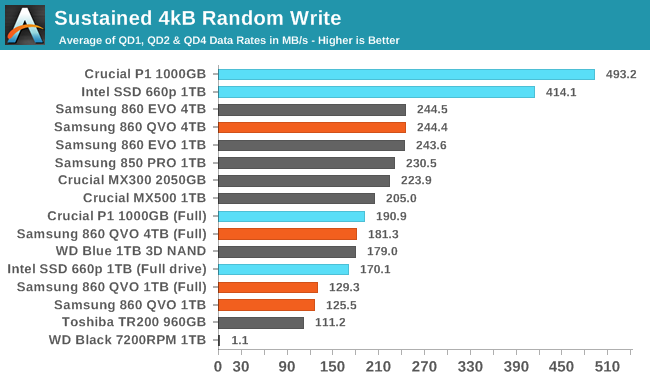
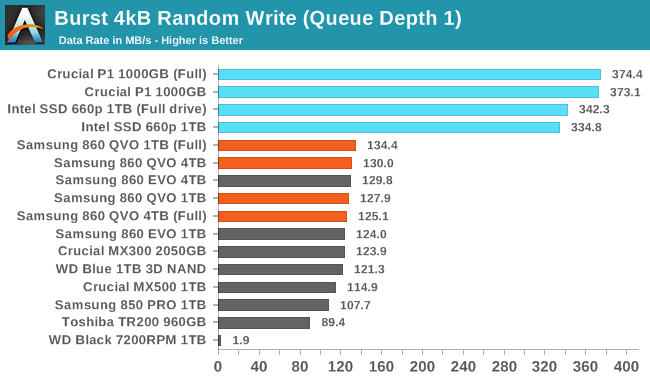
This... doesn't seem to be the case? If you look at this chart[1] from anandtech, you can see that the nvme drives (crucial P1, intel 660p) are significantly ahead of the sata drives (860 evo, 860 qvo, crucial mx500). The sustained write results[2] worse for nvme drives, but they're still better than similar sata drives if we control for flash type (qlc vs tlc) and capacity.

Also, comparing nvme drives to sata drives is hard to begin with, since they're usually in different price segments. sata drives tend to be cheaper than nvme drives (maybe the controller is cheaper?), so if you were comparing a sata drive and a nvme drive of the same price, you might end up with a "worse" nvme drive because of the nvme premium.

[1] https://images.anandtech.com/graphs/graph13633/burst-rw.png

[2] https://images.anandtech.com/graphs/graph13633/sustained-rw....
Re: WD SN850 delivers the best performing SSD we've tested

#59
post #58
post #47

Earlier quoted context omitted.

The exact difference, as far as I'm aware, has never been publicly documented by Microsoft, and I have not attempted to properly and thoroughly reverse engineer that particular mess. But the end result is that in the default state (buffer flushing enabled), most or all disk benchmarking tools show drastically lower write performance on consumer NVMe drives than should be expected compared to their theoretical advanta…

>But the end result is that in the default state (buffer flushing enabled), most or all disk benchmarking tools show drastically lower write performance on consumer NVMe drives than should be expected compared to their theoretical advantage over SATA SSDs. This... doesn't seem to be the case? If you look at this chart[1] from anandtech, you can see that the nvme drives (crucial P1, intel 660p) are significantly ahead…

The charts you linked to are showing measurements taken under Linux.

Re: WD SN850 delivers the best performing SSD we've tested

#60
post #59
post #58

Earlier quoted context omitted.

>But the end result is that in the default state (buffer flushing enabled), most or all disk benchmarking tools show drastically lower write performance on consumer NVMe drives than should be expected compared to their theoretical advantage over SATA SSDs. This... doesn't seem to be the case? If you look at this chart[1] from anandtech, you can see that the nvme drives (crucial P1, intel 660p) are significantly ahead…

The charts you linked to are showing measurements taken under Linux.

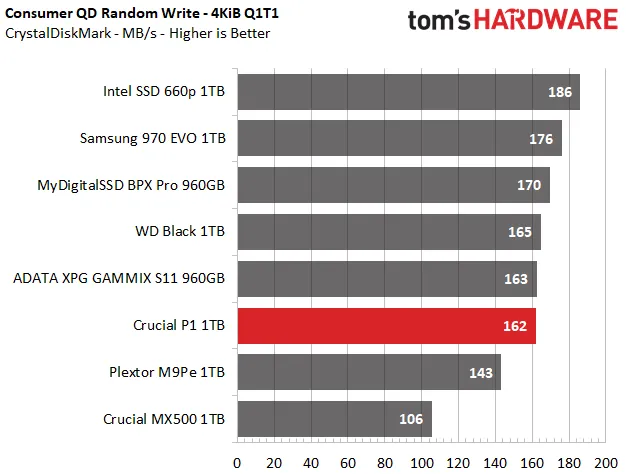
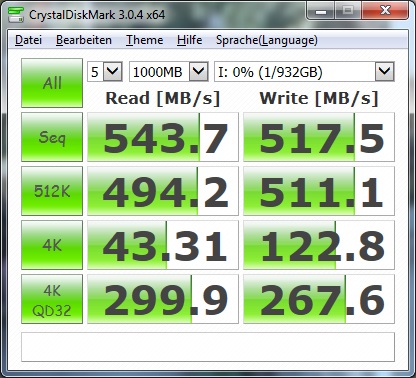
Here are some charts from crystaldiskmark, which is windows only. Note the 4k Q1T1 figures.

crucial p1:

https://images.hothardware.com/contentimages/article/2843/co... (169.8 MB/s)

https://cdn.mos.cms.futurecdn.net/nVhtVJZ64vDP7coALo7y3T-970... (162 MB/s)

samsung 860 evo:

https://i1.wp.com/www.tech-critter.com/wp-content/uploads/20... (118.25MB/s)

https://www.notebookcheck.net/fileadmin/Notebooks/Schenker/X... (122.8 MB/s)

Post reply on HN