Live data from Hacker News

Banks, QE, and Money-Printing

lynalden.com

231–240 of 249 posts

Re: Banks, QE, and Money-Printing

#231

Earlier quoted context omitted.

John Harvey is heterodox. Essentially the equivalent of climate change denial for economists.

So you are disagreeing with what he asserts in the article? Please elaborate. > Essentially the equivalent of climate change denial for economists I don't know him, but that sounds like a stretch...

99% of economists disagree with him, that's what makes him heterodox. I'm not going to waste my time, but it's easy to find a dunk if you just google him.
Re: Banks, QE, and Money-Printing

#232
post #43

Earlier quoted context omitted.

> Unfortunately, like a lot of beautiful macroeconomics, it isn’t a policy prescription. Nobody who decides the policy will have read the theory anyway, so that doesn't really matter. It requires a suspension of disbelief to accept that economic policy is decided based on theory. It is the same fig-leaf as copyright supporting artists, then the law clearly being written by groups like Disney based on their own conven…

> suspension of disbelief to accept that economic policy is decided based on theory Not decided on. But influenced by. Or at least, who gets to be influential is influenced by it. MMT’s political bullet point of “deficits don’t matter so spend like crazy” empowers a unique set of policies. So those actors push it so voters will accept the cost of their goodies. > the same fig-leaf as copyright supporting artists, the…

"MMT’s political bullet point of “deficits don’t matter so spend like crazy” empowers a unique set of policies."

Good job that isn't what MMT says then isn't it.

Quite why people insist on putting up that straw man I don't know. It just makes them look ridiculous.

MMT says when you run out of things to buy at a price worth paying the spending automatically stops, and that means you can only really buy the unemployed.

If you want anything else you have to tax first to make what you want to buy unemployed. Then you can buy it.

It's no longer a matter of running out of money, as that is impossible, it's a matter of running out of unemployed to deploy.

Re: Banks, QE, and Money-Printing

#233

Earlier quoted context omitted.

> Most people are barely getting 1% annual raises which means income increases by 138% over the same period. Where is that 1% coming from? It seems to me US salaries growth pretty much followed 3/5% average for the last 50 years, with some obvious drawdowns during crises. Source: https://tradingeconomics.com/united-states/wage-growth > In the last 4 decades wages have barely increased, but major assets like cars and…

Your points actually contradict each other. Do interest rates trump supply and demand and global capital movements, or not? Here's a graph of median personal income: https://fred.stlouisfed.org/series/MEPAINUSA672N And here's a graph of median house prices: https://fred.stlouisfed.org/graph/fredgraph.png?id=MSPUS&nsh... That is almost exactly an increase of 8X, compared to roughly 1.5X for personal income. Do you thi…

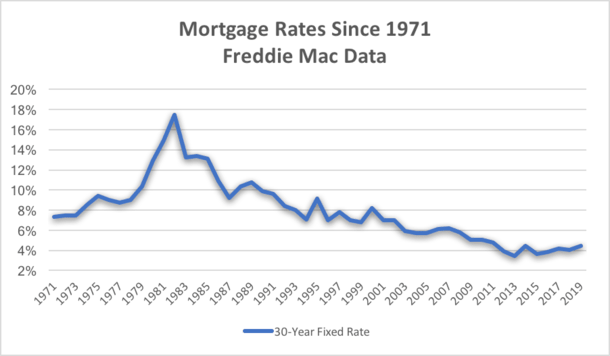
Mortgage interest rates are significantly lower than they were 40 years ago.

Considering a large portion of mortgage payments go towards interest, this is a huge deal.

https://www.thetruthaboutmortgage.com/wp-content/uploads/201...

Re: Banks, QE, and Money-Printing

#234
post #28

Earlier quoted context omitted.

The economy has two components - today and the future. Today, we decide who gets what stuff. Then the people who have most of the stuff decide what to create for the future. The bridge isn't free - the resources needed to build the bridge (time, steel, engineering attention, government attention, etc, etc) are being reallocated from someone else who would have used the resources to do something. If the bridge is more…

>>"The problem with money printing is it is all but impossible to figure out where the resources are being reallocated from - with taxes it is fairly obvious. With money printing it is not. It may well be impossible to say what we lost to get the bridge built because we can't figure out what would have happened if the money had not been printed. " It seems to me that, following your logic, if you don't "print the mon…

If income is taxed, less resources get allocated to work & workers. If alcohol is taxed, there is less alcohol. Tax petrol, less cars.

It is a high bar on the word 'impossible' not to be able to guess what the rough impact of a tax is.

Re: Banks, QE, and Money-Printing

#235
post #59

Earlier quoted context omitted.

You mean intellectual growth then? Because for everything else someone somewhere will need very tangible resources e.g. raw materials to build that phone you are using do X or Y.

Because for everything else someone somewhere will need very tangible resources e.g. raw materials to build that phone you are using do X or Y. The price of a CPU is unrelated to the price of sand. CPUs are 10000x faster over the last couple of decades. So there’s little or no correlation required between raw materials consumption and growth.

A CPU is one of the few dozens of components that you need to get a tangible result out of a CPU. You need hard disks, screens, antennas, batteries and so on and so forth. So you need, copper, lithium and God knows what else. All these materials get transformed and many of them in the process get transformed to toxic material for humans.

Do you really believe that computing comes cheap and is unrelated to climate change? I find that line of thinking extremely naive.

Let me share a few links:

https://www.nature.com/articles/s41558-018-0321-8

https://www.theguardian.com/environment/2010/apr/30/cloud-co...

etc.

Re: Banks, QE, and Money-Printing

#236
post #235

Earlier quoted context omitted.

Because for everything else someone somewhere will need very tangible resources e.g. raw materials to build that phone you are using do X or Y. The price of a CPU is unrelated to the price of sand. CPUs are 10000x faster over the last couple of decades. So there’s little or no correlation required between raw materials consumption and growth.

A CPU is one of the few dozens of components that you need to get a tangible result out of a CPU. You need hard disks, screens, antennas, batteries and so on and so forth. So you need, copper, lithium and God knows what else. All these materials get transformed and many of them in the process get transformed to toxic material for humans. Do you really believe that computing comes cheap and is unrelated to climate cha…

Do you really believe that computing comes cheap and is unrelated to climate change? I find that line of thinking extremely naive.

No I believe something more subtle than that: that the same raw materials that make a computer of speed X can be used to make a computer of speed 1000X with the input of better design. So we have economic growth there purely through intellect with no correlation to raw materials consumed.

Re: Banks, QE, and Money-Printing

#237
post #235

Earlier quoted context omitted.

A CPU is one of the few dozens of components that you need to get a tangible result out of a CPU. You need hard disks, screens, antennas, batteries and so on and so forth. So you need, copper, lithium and God knows what else. All these materials get transformed and many of them in the process get transformed to toxic material for humans. Do you really believe that computing comes cheap and is unrelated to climate cha…

Do you really believe that computing comes cheap and is unrelated to climate change? I find that line of thinking extremely naive. No I believe something more subtle than that: that the same raw materials that make a computer of speed X can be used to make a computer of speed 1000X with the input of better design. So we have economic growth there purely through intellect with no correlation to raw materials consumed.

Sorry, I misunderstood. Now makes sense to me.

Re: Banks, QE, and Money-Printing

#238
post #125

Earlier quoted context omitted.

haha, typical HN sentiment. Don't me wrong, studying in-demand tech skills is great, but it's hardly a scalable solution.

> it's hardly a scalable solution Isn't enabling and educating the population the original scalable solution to low growth?

True, well, probably in combination with other aspects..

But getting everyone into tech is a classic non-solution :) (It's kind of funny)

Re: Banks, QE, and Money-Printing

#239

Earlier quoted context omitted.

Fixed payents (bonds, etc) are fixed. Wage-earners see wages increase with inflation. Possible slight lag, but effectively little. Cash savings of course devalue. Asset holdings (real estate, equities) appreciate with inflation. Debts are reduced -- values fall as money is diluted (the gain side of banks' loss).

That's what I mean when I say poor - no debts, no assets just little savings in money and wages. Possible slight lag is not only possible and not slight, every increase in wages must be battled for while inflation comes automatically, money also represents 100% of the capital and therefore affects the poor completely.

The minimum wage argument is a fair one. All the more reason to index that.

Re: Banks, QE, and Money-Printing

#240
post #209

Earlier quoted context omitted.

That's what I mean when I say poor - no debts, no assets just little savings in money and wages. Possible slight lag is not only possible and not slight, every increase in wages must be battled for while inflation comes automatically, money also represents 100% of the capital and therefore affects the poor completely.

> money also represents 100% of the capital and therefore affects the poor completely. Per definition the poor don't have much savings. Their wealth is mostly in durable consumer goods: Car, television, furniture, etc. The market prices of these goods rise with inflation.

Consumer goods are not wealth, if they have any it's savings in cash. The cost of eating rises with inflation.
Post reply on HN