Live data from Hacker News

A tech antitrust problem no one is talking about: US broadband providers

arstechnica.com

111–120 of 354 posts

Re: A tech antitrust problem no one is talking about: US broadband providers

#111

Seriously, I feel like I say it every time it comes up: WHY aren't people taking action against ISP monopolies? It seems like such a cut-and-dried political issue: they're utilities and they overcharge you whether you're a Republican or Democrat. And taking action doesn't require new antitrust concepts, because it's just your garden-variety utility. It's the same established principles as electric or natural gas. Yet…

Maybe because the actual antipathy towards Facebook and Google is about their role in discourse and electioneering; antitrust is just a weapon that happens to be nearby.
Re: A tech antitrust problem no one is talking about: US broadband providers

#112

Seriously, I feel like I say it every time it comes up: WHY aren't people taking action against ISP monopolies? It seems like such a cut-and-dried political issue: they're utilities and they overcharge you whether you're a Republican or Democrat. And taking action doesn't require new antitrust concepts, because it's just your garden-variety utility. It's the same established principles as electric or natural gas. Yet…

Just a decade ago, SMS messages in the US cost 10 to 25 cents per SMS. You also got charged for spam SMS. Prices were completely disjointed from the reality of underlying costs (zero for the telcos). My college CS professor gave senate testimony on this: https://www.judiciary.senate.gov/imo/media/doc/keshav_testim...

(side rant: in the following ten years, the tech giants sweeped in, competed, provided a better service, with better cross-platform support, for zero dollar immediate cost to the end customer -- gained a massive following (think whatsapp), and are now vilified for their "monopoly" and the "harm" it has caused.)

My read of this situation is:

- Real monopolies (esp Telco) have entrenched lobbying bases

- Tech has done a poor job at lobbying, possibly due to idealism that logic wins even though thats now how things work in the US

- Tech has disrupted so much that they now have multiple industries as enemies

- Tech is concentrated enough geographically that there is some jealousy against this sector "over there" raking in too much money, even if they have provided an amazing service

Re: A tech antitrust problem no one is talking about: US broadband providers

#113

This is such a weird thing. After spending time in SE Asia, where bandwidth is cheap and plentiful (in the cities), it's painful coming back to Europe (and Australia). I'm in Berlin atm, and the wifi is shit, bandwidth is expensive and unreliable. And the phone plans suck. I was in Perth (Australia) before that, and access there is terrible. In Cambodia, 120Gb (per week) of download cost me US$1 (per week) over good-…

I understand there are some specifics going on in Germany. While I've never quite understood, I've seen many German posters call out a national broadband backbone based on Copper as the root cause. I don't know if this is true, but I am in Ireland and know that also the UK did a rollout of a Fibre backbone network, and in both there's widespread availability of 1GB+ consumer connections. I think what's happened is in…

> I think what's happened is in many or some European countries there was a rush to increase Broadband adoption and speeds, where being the first mover left them with now outdated backbone infrastructure.

If you are referring to the copper network built in the 80s under Kohl, that is not what happened. Some call it "conflict of interest", some blatant corruption.

Re: A tech antitrust problem no one is talking about: US broadband providers

#114

Earlier quoted context omitted.

> The Democratic party platform explicitly talks about removing barriers to municipal broadband as a goal Since the cities are generally under solid Democratic control (there's not a single Republican in elective office in Seattle, for example), there's something else going on.

State governments have a lot of power.

More specifically, several state have laws banning municipalities from involving themselves in Internet connectivity.

Re: A tech antitrust problem no one is talking about: US broadband providers

#116

Earlier quoted context omitted.

It's only baffling if you didn't bother to read the party platforms. The Democratic party platform explicitly talks about removing barriers to municipal broadband as a goal, which is the only way you are going to get competition where ISPs have a monopoly. At least in the current landscape where it's cost-prohibitive for a competitor to enter a region. Also (emphasis mine), > Democrats will restore the Federal Commun…

I don't think this is a Dem versus Rep thing. Local corruption issues like this usually end up boiling down to following the money. Many municipal broadband projects end up being scrapped after lobbyists $$ get involved regardless of who is running the show.

It's less that lobbyists are involved but that "why go through the effort of setting up municipal broadband when we (AT&T/Spectrum) are more than happy to work with you and come to an agreement about serving your area."

I'm not confident that municipal broadband will ever really take off in the US but I think local loop unbundling might have a chance since I'm sure companies are more than happy to unload all the expensive construction work to the local gov't.

Re: A tech antitrust problem no one is talking about: US broadband providers

#117

Seriously, I feel like I say it every time it comes up: WHY aren't people taking action against ISP monopolies? It seems like such a cut-and-dried political issue: they're utilities and they overcharge you whether you're a Republican or Democrat. And taking action doesn't require new antitrust concepts, because it's just your garden-variety utility. It's the same established principles as electric or natural gas. Yet…

It's only baffling if you didn't bother to read the party platforms. The Democratic party platform explicitly talks about removing barriers to municipal broadband as a goal, which is the only way you are going to get competition where ISPs have a monopoly. At least in the current landscape where it's cost-prohibitive for a competitor to enter a region. Also (emphasis mine), > Democrats will restore the Federal Commun…

> which is the only way you are going to get competition where ISPs have a monopoly

Would it not be possible to make it illegal to provide internet access and to own the infrastructure at the same time?

Where I'm from, there are two national phone networks, owned by the two biggest phone plan providers. They also rent out their network infrastructure to smaller companies, which effectively means they control the price of phone plans. As a result, phone plans are comparatively very expensive where I'm from. It seems like separating the infrastructure from the phone plan providing would make the market more competitive, leading to lower prices.

Re: A tech antitrust problem no one is talking about: US broadband providers

#118

Earlier quoted context omitted.

We see this so often now I'm starting to think it's an intentional strategy. Step 1: create conditions that prevent capitalism from solving a problem. Step 2: declare that capitalism has failed and call for government solutions.

There's a republican version, too: Step 1: kneecap a social progrm Step 2: argue that because the social program isn't working, it should be canceled outright.

The difference is that Democrats keep succeeding in enacting strangling regulation, and Republicans keep failing to "kneecap" social programs.

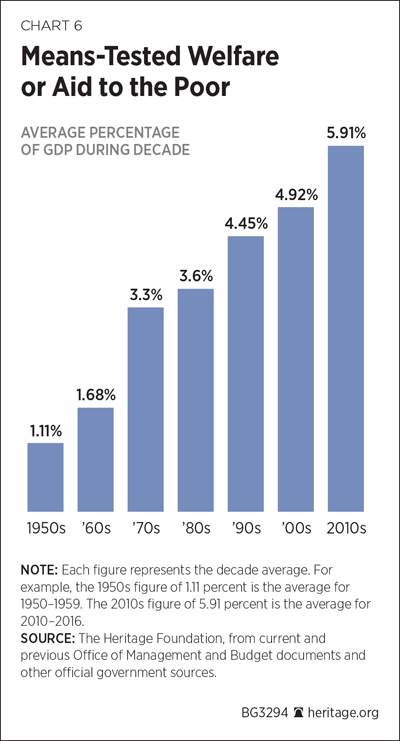
What major social program has seen funding cut since the 1970s? The percentage of the economy that goes to means-tested welfare has almost doubled from 1970 to today: https://www.heritage.org/sites/default/files/inline-images/B.... The only blip was right after the 2008 recession, but spending has mostly recovered since that time.

Now, I support welfare spending. (I'd like it better if we focused more on cash transfers to the poor, though.) But the notion that any major social program has ever been "kneecapped" is a myth.

Re: A tech antitrust problem no one is talking about: US broadband providers

#119

Earlier quoted context omitted.

It's only baffling if you didn't bother to read the party platforms. The Democratic party platform explicitly talks about removing barriers to municipal broadband as a goal, which is the only way you are going to get competition where ISPs have a monopoly. At least in the current landscape where it's cost-prohibitive for a competitor to enter a region. Also (emphasis mine), > Democrats will restore the Federal Commun…

> Democrats will restore the Federal Communications Commission's (FCC) clear authority to take strong enforcement action against broadband providers who violate net neutrality principles This seems antithetical to their newfound views on how corporations like Twitter should be able to block political news on their platforms. I don't see how it's dramatically different for Twitter (or Facebook or Google) deciding to b…

"Net Neutrality" has never been about moderation of content on websites. Conflating the two is disingenuous.

Re: A tech antitrust problem no one is talking about: US broadband providers

#120
post #74

I'm not convinced Comcast is ripping off everyone as much as everyone says. USA is a big country and its expensive to wire everyone up. Lots of companies around have tried including Google who basically decided its easier to do make money from ads and self driving cars rather than wiring up neighborhoods and dealing with local regulations. The ISPs and cell networks actually do the hard and expensive work of installi…

It is expensive to wire rural areas up. That is why the [government is paying for it](https://arstechnica.com/information-technology/2015/08/att-g...). Why isn't this a utility again?

Comcast and Charter essentially have a [duopoly](https://arstechnica.com/information-technology/2018/07/comca...) over much of the United States. Where is the competition? The actual competition is in lobbying local governments to make ISP-as-utility illegal. See the [case of Wilson, North Carolina](https://www.npr.org/2020/05/29/865908114/small-america-vs-bi...).

People seem to easily forget that every major corporation is evil by default. If it is profitable, it gets done. Laws and public image are the only thing holding them back.

Post reply on HN