Live data from Hacker News

When X-Rays were used at the Shoe Store

spectrum.ieee.org

81–90 of 126 posts

Re: When X-Rays were used at the Shoe Store

#81
post #6

I'm 49 and I'm sure I remember there still being machines in stores when I was 7 or 8. Is that possible? I don't recall them actually in use - but they were visibly present. (I'm in the UK) EDIT: https://en.wikipedia.org/wiki/Shoe-fitting_fluoroscope#Regul... Looks possible.

My father is approximately 60 and has told me about messing with these things as a kid in Edinburgh.

Re: When X-Rays were used at the Shoe Store

#82
post #42

Earlier quoted context omitted.

I've had foot problems for a while, and I went to a podiatrist who suggested I wear crocs. Said that shoes were a modern creation and that our feet weren't designed to need them. It was an unmitigated disaster. So I went to a different podiatrist. She said "let me guess, you went to Dr. So-and-so?" and I replied yes, she said "Yeah, I don't agree with him. Shoes are modern, but so are floors." My feet are much happie…

I’ve never understood the argument that floors and pavement are the cause of modern foot problems due to their hardness. It just doesn’t add up. Sure, running barefoot through a well-maintained soccer field is going to be lower impact than running on pavement. But ancient humans didn’t evolve on soccer fields. If you ever try running through unmaintained land barefoot, it’s terrible on your feet! Uneven terrain, bran…

[deleted]

Re: When X-Rays were used at the Shoe Store

#83

Next time you need an X-ray ask the doctor why that costs more than a pair of shoes. I mean they used to include one free with a pair.

A fluoroscopic image is very low resolution compared to an actual film (then), or DICOM (now).

The views taken are done to show particular things and the person doing it needs training. Then the reporting needs paying for, and radiologists aren’t cheap. The images and paperwork (referral, report, images, billing and demographics) need storing and need to have a system for finding them again.

The department needs things for cleaning your blood off the floor, handling you trying to die while on site and generally working safely.

And lastly, everyone clips the ticket, insurance primarily.

But I mostly like your take, it’s great.

Re: When X-Rays were used at the Shoe Store

#84
post #4

Tangent. People are still getting conned when it comes to shoes. Custom designed soles, with padding in the "right" places based on the shape of your foot, in order to "absorb impact" or "correct overpronation". Which is nonsense and unnecessary unless you have foot deformities. Your foot is perfectly capable of absorbing impact and whatnot. This is all marketing aimed at gullible new runners who want to go from couc…

I agree with this. Due to youthful stupidity I've probably had at least a dozen severe sprains and so I am now very prone to them (rolling an ankle at least once a year until I made a change). I switched to five fingers, which I acknowledge are full of hype and woo on the marketing side, and have never rolled an ankle since. It's been 13 years or so..

Re: When X-Rays were used at the Shoe Store

#85

Earlier quoted context omitted.

Exactly. People ran barefoot, then with a thin piece of leather strapped to their feet for hundreds of thousands of years. All this arch and ankle support of the last few decades has done nothing except cause injuries.

What about all the concrete and asphalt we run on now? Doesn't that make a difference?

Human bipedalism evolved in places like the East African Rift Valley which is rocky, hard packed ground and not at all the soft grasses people imagine. If you've ever hiked in Pennsylvania, it's a bit like that.

Re: When X-Rays were used at the Shoe Store

#86
post #70

"When mm waves were used at the airport (2044)"

mm waves are lower energy than visible light, which is far lower energy than x-rays. Or perhaps you weren't implying that mm waves are ionizing and cause cancer?

Cancer via ionization is not the only damage that can be imparted on to human cells.

It is quite plausible that we will discover new things that are dangerous in the future (to varying degrees), as we once did with x-rays.

Re: When X-Rays were used at the Shoe Store

#87
I remember these machines well. My father was a radiologist and wouldn't let us use them. He knew they were dangerous and the shoe sales people were unqualified.

As a side note, many of his fellow radiologists lost fingers because they didn't follow procedures using shields and lead gloves.

Re: When X-Rays were used at the Shoe Store

#88

Next time you need an X-ray ask the doctor why that costs more than a pair of shoes. I mean they used to include one free with a pair.

Many things would be much cheaper if all safety protocols were removed. Cars are a great example: Safety features may add around $2k annually [0], though they've helped prevent a few hundred thousand deaths since 1980 roughly cutting in half the per-capita automobile fatalities. As it is, they cost about $44 billion annually [2] which means in addition to lives saved, the reduction in deaths save us up to $44 billion/year. (probably not all attributed to safety features given the reduction in drunk driving.)

Considering the $2k cost and roughly 5 million cars sold each year, the safety measures cost $10 billion, for an ROI of up to $30 billion/year.

There was an unfortunate uptick as smart phones gained popularity, though it seems like public awareness campaigns and distracted driving laws may have helped that.

Car safety is a pretty good example of how both government regulation and the free market can work together to achieve positive results. (marketing based on safety features allowed companies to compete on something other than price).

That's not an endorsement to embrace all government regulation, just an example of how it isn't all meaningless bureaucracy.

[0] https://crashstats.nhtsa.dot.gov/Api/Public/ViewPublication/...

[1] https://en.wikipedia.org/wiki/Motor_vehicle_fatality_rate_in...

[2] https://www.cdc.gov/winnablebattles/report/motor.html
Re: When X-Rays were used at the Shoe Store

#89
post #75

A related phenomenon was x-ray salons, "the most scientific way to remove hair." Hundreds of these cropped up in the early 20th century, originally growing out of their use in the medical profession. Most targeted working class, immigrant women to the US. They were eventually banned but persisted underground for quite some time. There's a good history of them in Plucked: A History of Hair Removal. https://books.googl…

Those machines were terrible but you have to be a little wistful for the days when the American public actually liked science and liked products associated with it.

Re: When X-Rays were used at the Shoe Store

#90

Earlier quoted context omitted.

No one expected him to be one at the time, we didn't know the dangers. It's like asking why removing Asbestos costs so much when my grandfather put this building together earning a nickel a day.

I'm not talking about expectations. I am talking about the price of medical imaging, not the price of the analysis of medical imaging. It is my impression that a clear distinction between these matters can and frequently is made.

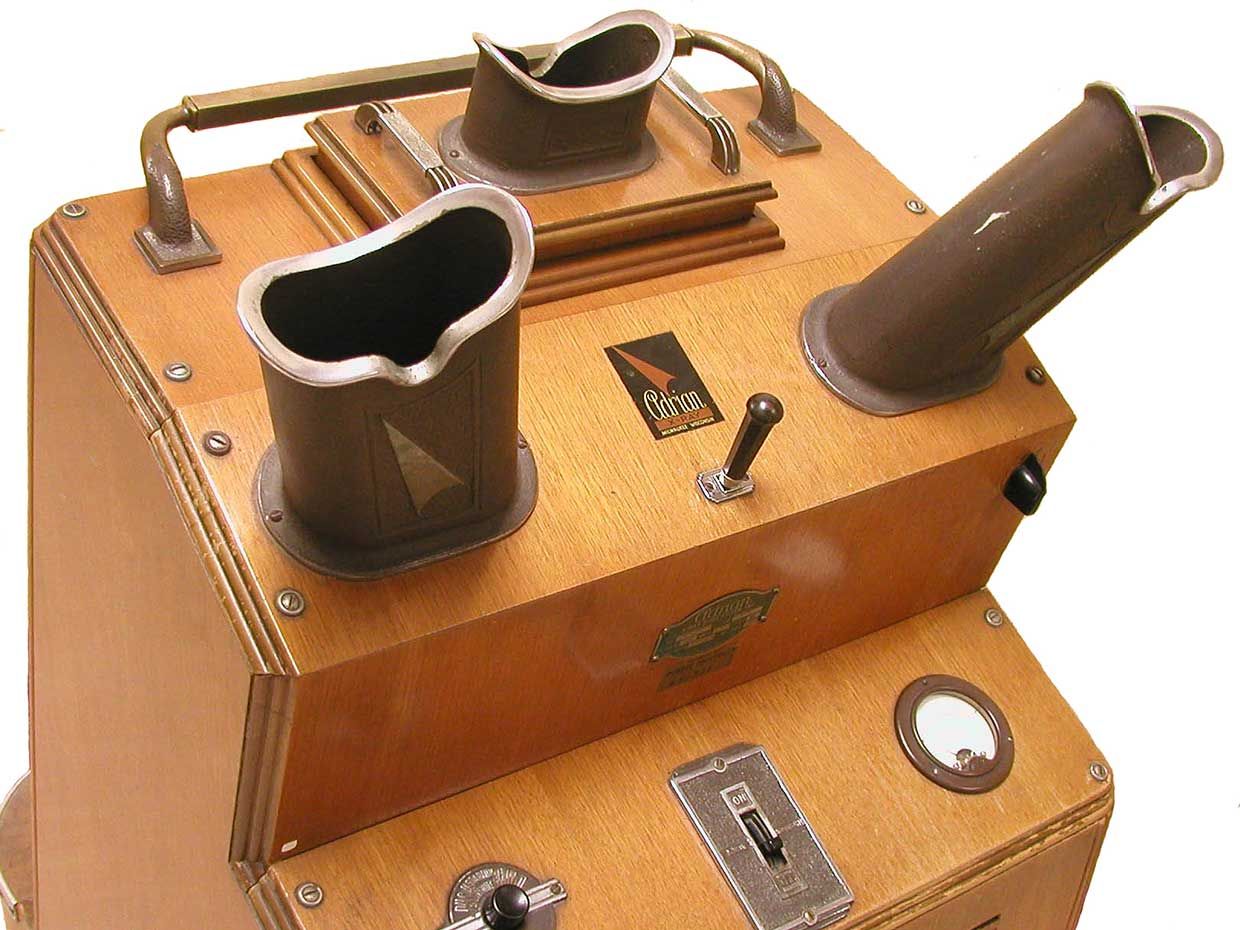
The price of being imaged with one of these:

https://spectrum.ieee.org/image/MzcwNzM3OQ.jpeg

Was cheaper than being imaged today with one of these:

https://upload.wikimedia.org/wikipedia/commons/thumb/0/0a/Xr...

Because the first one was a hack put together before we knew how bad it was. The second one is a high quality unit, with high safety standards, and regulatory compliance. The first one has none of those features.

You may as well ask yourself why a 737 costs more than the Wright Flyer.

Post reply on HN