Live data from Hacker News

Vaccine hopes rise as Oxford jab prompts immune response among old and young

reuters.com

491–500 of 712 posts

Re: Vaccine hopes rise as Oxford jab prompts immune response among old and young

#491
post #475

TIL about the "jab" word in this context (English is not my first language). I thought the author had misspelled "lab".

I'm a native English speaker (American) and have thought it was odd for a few weeks that Reuters in particular likes to use the word "jab" for "vaccination". It's not commonly used that way in the US.

Re: Vaccine hopes rise as Oxford jab prompts immune response among old and young

#492
post #475

TIL about the "jab" word in this context (English is not my first language). I thought the author had misspelled "lab".

It's mine, and the one I study. I'm guessing it's slang for injection? Looking it up now...

I sympathize with your pain of learning a new language (or system or whatever): It's hard to tell if it's a mistake on their part, a mistake on your part, some kind of regionalism, some kind poetry...

Re: Vaccine hopes rise as Oxford jab prompts immune response among old and young

#493
post #299

Earlier quoted context omitted.

citation? That seems very unlikely. US farmers constantly look for greater efficiencies. They are also among the most conservative about land policy i.e. erosion, chemical application etc because it costs them money.

Citation for what? On average your looking at ~90B in net profits from farming, the subsidies however are much harder to track down. Ethanol subsides for example are often excluded as are insurance, tariffs etc.

So, just talking thru the hat were we? As you say, you can't point to support for that statement about '100% of profits'.

Re: Vaccine hopes rise as Oxford jab prompts immune response among old and young

#494

Earlier quoted context omitted.

Drug companies also fund their own research, to the tune of massive expenditures. What you’re suggesting would incentive these companies to disengage from partnerships involving public funding. Whoever pays for the research, each company’s goal is to profitably sell a non-generic treatment. If the only way they can do that is to eschew public funds, they will do this and the result will be less cooperation and a far…

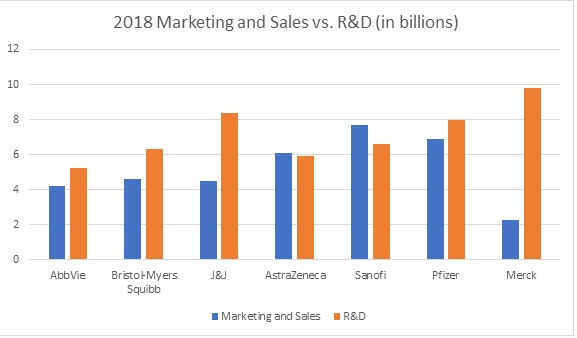
Honestly, this is overblown. Most of the budget for these corporations goes to marketing, and the R&D mostly goes to repatenting efforts or incremental repurposings. They rarely come out with anything new, and if you look at recent years you may as well say that they never do.

Most of the budget for these corporations goes to marketing

Often repeated, but the data doesn't bear it out, especially in aggregate.

https://www.raps.org/getattachment/5578195e-ed51-4f03-8adc-c...

Re: Vaccine hopes rise as Oxford jab prompts immune response among old and young

#495

I'm in the trial. Here's the participant information sheet, in case anyone's curious: https://drive.google.com/file/d/1WB5QPmECchlThnem9wcX0PDaKQW...

I'm surprised they don't seem to do frequent and regular COVID testing of participants to catch asymptomatic infections. Naively, it would seem worthwhile in order to predict how well the vaccine would slow down the spread.

I guess the reason is that the study is narrowly tailored to vaccine approval requirements?

Re: Vaccine hopes rise as Oxford jab prompts immune response among old and young

#496

I'm concerned that, given both effectiveness & willingness to get a vaccine, we may only experience incremental improvements in transmission rates. The flu vaccine is generally about 50% effective, and only about 50% of (Americans) say they will definitely or probably get a vaccine. If that holds, then combined, that would only cover 25% of the population. Well below herd immunity. Yes, it would be an improvement, bu…

The challenge is that we don't really know where the number of immune or semi-immune individuals comes in order to achieve "herd immunity" from Covid.

Nature has a good article that goes into depth a bit here: https://www.nature.com/articles/d41586-020-02948-4

Basically, there are reasonable estimates that the range could be anywhere from 20% - 70%.

The effect also greatly depends on which portion of the population gets vaccinated. If (in an imaginary world) the most at-risk 50% of the population got vaccinated, we could reasonably expect Covid to actually become something like the flu.

Finally, I expect this is something that'll gain acceptance over time. There are some not unreasonable factors that could cause people to be nervous about a Covid vaccine initially, that will be softened over time. Things like it being developed under the supervision of politicians who could be motivated to rush it out, or just being developed faster than any vaccine ever.

Or, on the flipside, continued travel restrictions for individuals who haven't been vaccinated. Americans traveling to certain tropical countries have been required to get specific vaccines for years, I wouldn't be surprised if over the next few, travel to Europe or even Canada requires a Covid vaccine.

Re: Vaccine hopes rise as Oxford jab prompts immune response among old and young

#498
post #435
post #190

Earlier quoted context omitted.

Ignoring the law doesn’t lead to normal: just more preventable deaths and bankruptcies when businesses burn capital trying to stay open without enough customers to be profitable, even assuming they avoid legal repercussions.

A few things here: * What law? In the US, the lockdowns were under emergency powers of the executive branch, which are supposed to only last a limited time (30 days where I am, for example). Several of these were challenged and found to be unlawful. * The US lockdowns were originally only mean to prevent hospitals from being overloaded. We are way way past that point where that was an issue - all the emergency capaci…

In the U.S., the lockdowns were issued in compliance with local laws. As you could easily learn for yourself, those vary from state to state and city to city so you can't make a blanket statement without being incorrect. In the context of this thread, you specifically referred to “ignoring close orders” which implicitly acknowledges the existence of an order issued by someone with the authority to do so under current law.

In some cases there have been legal challenges to those laws so there aren't givens but even if those are successful, my point was that even if you do re-open you can't force customers to come back when they feel unsafe. Even in the states where restrictions have been relaxed, a large number of people are not comfortable hanging out at a bar or restaurant — the problem being the risk of a serious disease, not the countermeasures deployed against it.

> The US lockdowns were originally only mean to prevent hospitals from being overloaded. We are way way past that point where that was an issue - all the emergency capacity has been dismantled for months.

The lockdowns were, as clearly communicated at the time, intended to slow community spread. Avoiding hospital overload was part of that but so was avoiding large numbers of people getting a serious disease with potentially life-changing impact when they don't need to.

> As sibling comment implies, something like half the states in the US aren't under any lockdown now, businesses there aren't having issues staying open, and their stats are no worse than the locked-down states.

And that commenter was wrong just like you are wrong. Anyone who follows this issue knows that the cases have been rising recently (~35%) and there's a noticeable correlation with the states which re-opened high risk activities and those who did not.

For example, they mentioned South Dakota which is at an all-time peak:

https://www.nytimes.com/interactive/2020/us/south-dakota-cor...

Compare with, say, New York which is roughly 20 times larger even before you account for density differences:

https://www.nytimes.com/interactive/2020/us/new-york-coronav...

A common cause of error here are people looking at the all-time cumulative stats rather than the last week or two and missing that while, say, NYC was hit early with quick community spread in a dense environment and thus had a brutal spring but the increased lockdown have kept levels low since then.
Re: Vaccine hopes rise as Oxford jab prompts immune response among old and young

#499
This is only one of 11 vaccines now in phase III efficacy tests.[1] Six vaccines already have "partial approval", but those are the ones in Russia and China, which may or may not be working, and the governments decided to try anyway. All of those provoke an immune response. Whether it's enough of the right immune response is found out in phase III testing.

Something is probably going to work. The big question is how well. A 50% effective vaccine might be an overall lose - only half are protected but more than that abandon masks and social distancing.

The Johnson and Johnson vaccine, if it works, is the easiest to use of the early leaders. One dose, and it doesn't need to be refrigerated to dry-ice temperatures like some of the others. The Merck/IAVI vaccine is only in phase I, but it's a pill. If that works and is highly effective, it will be possible to wipe the virus out worldwide in a second round of immunizations.

[1] https://www.nytimes.com/interactive/2020/science/coronavirus... (or https://archive.is/D6C68)

Re: Vaccine hopes rise as Oxford jab prompts immune response among old and young

#500
post #381

Earlier quoted context omitted.

> Why risk it? It's worth pointing out that during a pandemic, while participating in a trial does carry a risk, so does not participating. A participant has some substantially greater probability* than the general population of avoiding an infection which apparently carries a risk of death or long term debilitating effects. * You'll have to incorporate the probability of being in the control group, of course, but th…

Oh yeah, that's for sure. The idea that there's a pretty decent chance that I've been vaccinated already which means I don't have to wait for a vaccine is great. My life can begin to go back to normal potentially months before it otherwise would.

>My life can begin to go back to normal potentially months before it otherwise would.

Howso? Socialization is a multi-party dynamic. Folks might not care/believe you if you state 'I'm vaccinated' until it's widely accepted.

Post reply on HN